Regression Testing for AI-Generated Hardware Designs
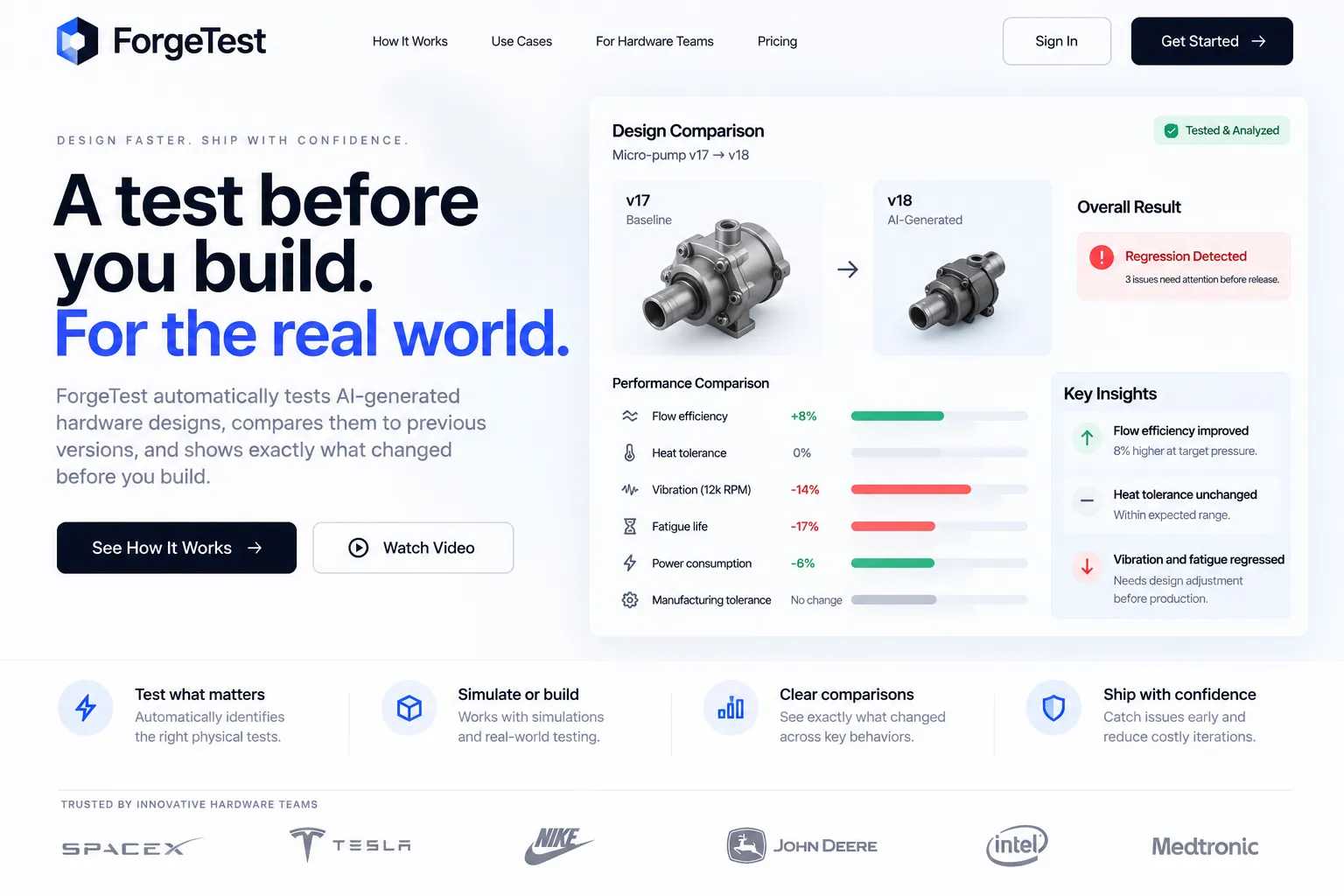
AI is beginning to generate physical device designs as quickly as engineers can describe them, but every new version can introduce subtle changes in heat, vibration, fatigue, power use, tolerances, or failure modes that are much harder to review than a software diff. Build a regression-testing layer for AI-generated hardware that determines which physical behaviors should remain unchanged, automatically simulates or fabricates the new design, and compares the results against the previous version before it moves forward. This matters now because AI is compressing hardware iteration cycles while physical testing remains slow and manual. Imagine an AI redesigning a micro-pump to make it 20% smaller and the system instantly showing that flow efficiency improved, heat tolerance stayed constant, but vibration and fatigue life regressed enough to block the release. That's a product that needs to exist.
Description
No additional description provided.
The Pitch
Hardware design is becoming less like drafting and more like editing. Once machines can generate thousands of plausible geometries, the scarce skill shifts from making a candidate to knowing which candidate quietly broke the wrong assumption. In software, regression testing became essential because codebases outgrew human comprehension; hardware is approaching the same point, except the bugs can appear as resonance at a certain RPM, a tolerance stack that only fails after assembly, or a thermal hotspot hidden inside an otherwise elegant shape.
The business works because it would sit at the point where speed becomes dangerous. Companies will gladly accept faster design cycles until one bad revision turns into a recall, a failed certification, a delayed launch, or a field failure that no one can explain. The more AI accelerates concept generation, the more valuable an independent memory of “what must not change” becomes. That memory is not just a checklist; it is an accumulating behavioral model of the product, its constraints, and its known fragilities.
There is also a subtle workflow advantage: engineers do not want a second design tool as much as they want a trusted brake. A system that can say “this redesign is smaller, but it moved the fatigue risk from the bracket to the fastener interface” becomes part of the organization’s judgment. Over time, the company that owns these comparisons owns a uniquely valuable dataset: not merely CAD files, but cause-and-effect records connecting design changes to physical outcomes.
The strongest version of this business is not about replacing simulation, prototyping, or human review. It is about connecting them into a repeatable standard for change. Today, physical validation is often treated as an event near the end of development; AI-generated hardware makes it need to become continuous. The company that defines that layer could become to mechanical, electrical, and electromechanical design what automated test suites became to software: invisible when everything works, indispensable the moment complexity starts moving faster than people can reason.