Referral Payment Platform for AI Agents
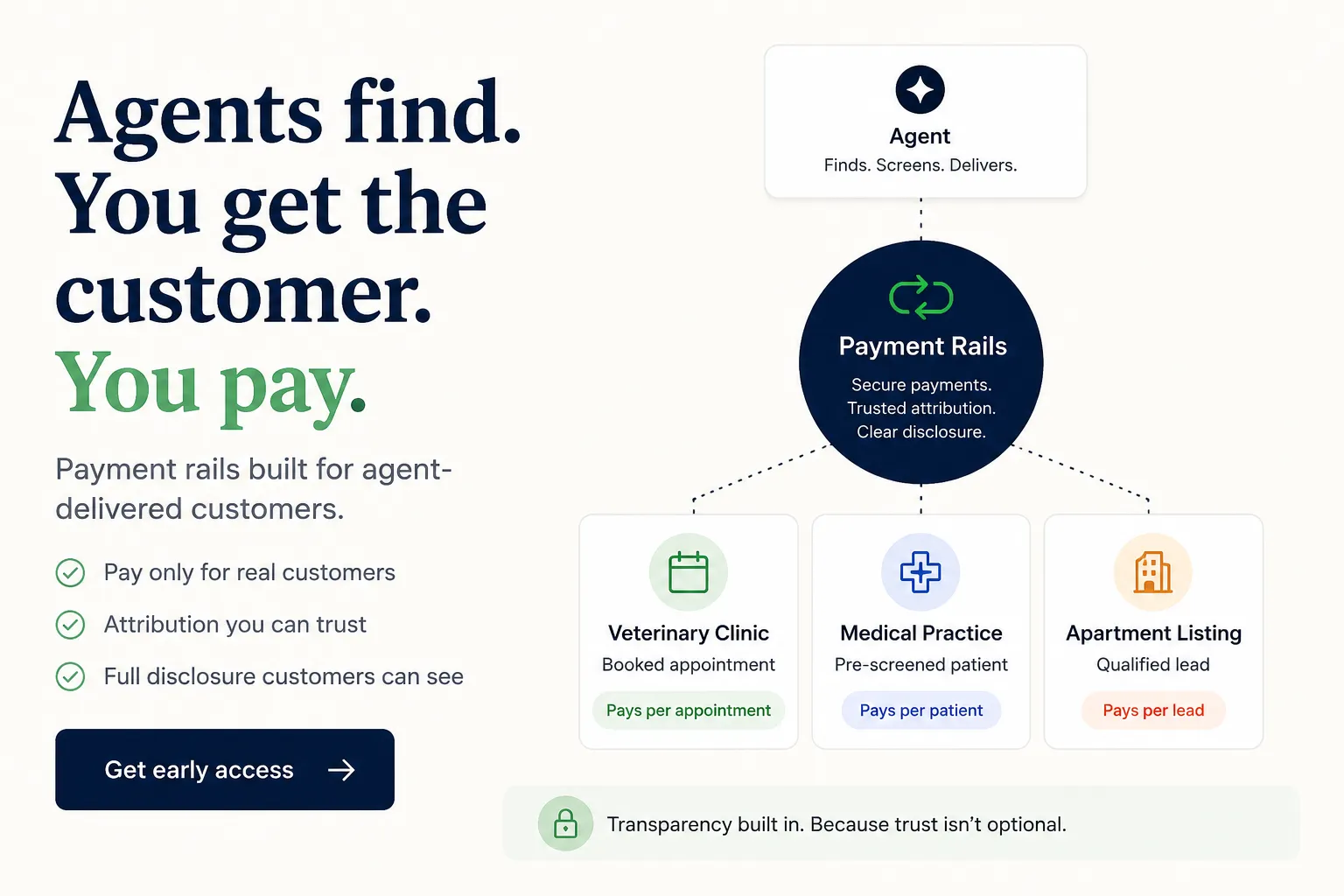
Every time an agent finds a vet, books a doctor, or surfaces an apartment, somebody gets a customer. The vet gets an appointment. The doctor gets a patient who has already been screened for network and availability. The landlord gets a qualified lead. Today, they get all of that for free while the consumer pays for the agent. That is backwards from how referral businesses usually work. A Place for Mom does not charge the family looking for senior care. The community pays because a filled room is worth real money. Wedding marketplaces work the same way. Vendors pay for access to demand. Agents are going to create the same economic opportunity, but the payment layer does not really exist yet. A vet should be able to pay for an appointment an agent delivers, with attribution the vet trusts and a clear disclosure the customer can see. The disclosure part matters. Agents are going to face much more scrutiny around recommendations and incentives than traditional referral sites did. Whoever builds the payment rail should assume transparency has to be part of the product from day one.
Description
No additional description provided.
The Pitch
Agents will collapse a long, messy discovery process into a single recommendation, and that recommendation will often be the moment a purchase decision is effectively made. In old referral markets, sellers paid for visibility somewhere along the search journey. In an agent-mediated market, the seller is not buying attention; they are buying a completed handoff at the edge of intent. That is much closer to a closed-door introduction than an ad impression.
The interesting shift is that agents may become the new front door to local commerce without owning the underlying supply. They do not employ doctors, manage apartments, or run veterinary clinics, but they can influence where demand flows. That creates a strange imbalance: the entity creating economic value for suppliers may not be the one collecting from them. A neutral payment and attribution layer turns that imbalance into a market, especially in categories where one booked appointment or signed lease is worth far more than the cost of acquiring it.
Trust is the hard part, and also the moat. Consumers will tolerate paid placement only if it is obvious, constrained, and does not corrupt the recommendation. Suppliers will pay only if they believe the agent actually caused the customer to arrive. The business that wins is not merely moving money; it is producing a trustworthy receipt for influence. In a world where AI recommendations can be invisible, bundled, or probabilistic, the ability to say “this referral happened, under these terms, with this disclosure” becomes commercially important.
This is especially powerful because many high-value service businesses are operationally unsophisticated but economically eager. A local clinic or property manager may never build an AI partnership strategy, yet they understand paying for a booked appointment or qualified lead. The right intermediary lets fragmented suppliers participate in agent-driven demand without each one negotiating bespoke deals with every AI interface.
The larger insight is that agents will not just change how consumers search; they will change who gets to monetize intent. Search advertising monetized queries. Marketplaces monetized comparison. Agent referral rails would monetize delegated decision-making. If people increasingly ask software to choose on their behalf, then the infrastructure around those choices—proof, payment, permission, and disclosure—becomes one of the most valuable layers in the new commercial stack.