Real-Time Partner Opportunity Routing API
Companies depend on partners whose appetite can change overnight, but most only discover the change after revenue falls. Partner Appetite API gives every counterparty a simple way to publish what they want, how much capacity they have, what they will pay and when that appetite expires, then automatically routes opportunities to whoever wants them now. Why now: APIs and AI make partner preferences easy to structure and update in real time instead of managing them through calls, spreadsheets and quarterly check-ins. Example: one lender stops taking near-prime borrowers on Tuesday, and by Wednesday those applications are automatically flowing to three lenders with available capacity.
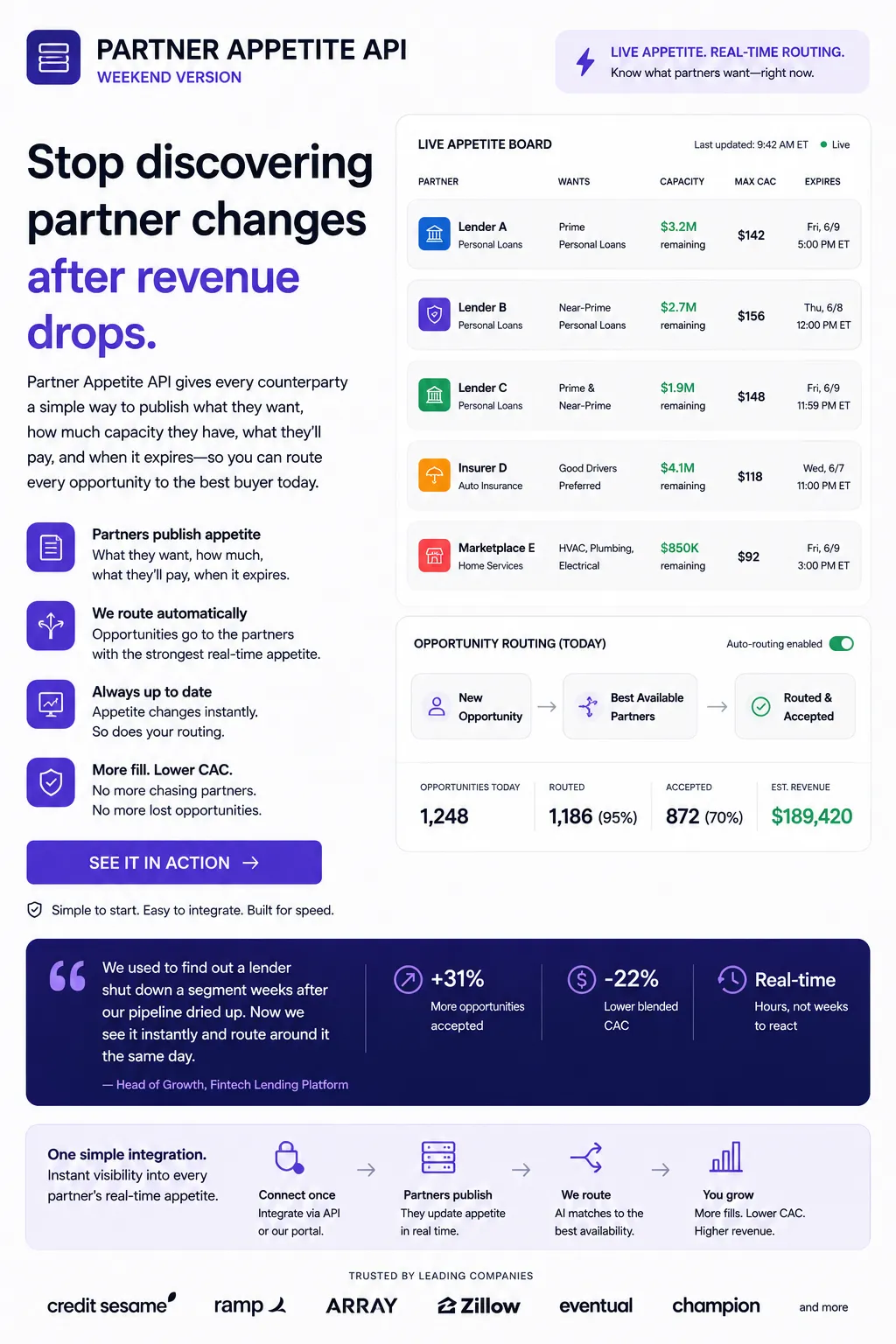
Description
No additional description provided.
The Pitch
Treat partner preference as inventory. Today, a company may know its own demand in real time, but the supply of willingness on the other side is usually trapped in relationship managers’ heads, email threads, portals, and stale PDF guidelines. That creates a strange market failure: opportunities are rejected not because no one wants them, but because the system does not know who wants them this week.
The deepest value is not better routing; it is making appetite explicit. Many industries operate with counterparties who are constantly adjusting risk, margin, capacity, geography, category focus, or regulatory exposure. Those changes are economically meaningful, but they are rarely communicated with the same precision as prices or stock levels. A shared appetite layer would turn vague partner conversations into machine-readable commercial intent, which is the missing connective tissue between demand generation and fulfillment.
This would also change the power dynamics of partner networks. The companies sending volume would no longer be overly dependent on yesterday’s best partner, and the receiving partners would no longer need to rely on constant sales coverage to remind the market what they want. A smaller or more specialized counterparty could compete by broadcasting sharp, current appetite rather than by having the biggest relationship team. That makes the network more liquid, and liquidity tends to create its own gravity.
The business becomes more interesting as it accumulates history. Once appetite changes are timestamped against outcomes, the system can learn which partners are reliable, which signals are performative, which demand types are chronically underserved, and where capacity consistently clears at better economics. Over time, the company would not merely transmit preferences; it would understand the shape of demand and supply across a market better than any individual participant.
The non-obvious wedge is that “no” is often temporary, contextual, and valuable. Most companies treat rejection as an endpoint, but in partner-driven markets it is often just a routing error caused by stale information. A business that captures appetite at the moment it changes can turn missed transactions into completed ones, while reducing the quiet waste of human coordination that everyone accepts as normal.