Real-Time Marketplace for AI Inference Priority
Inference eventually becomes a scarce resource during periods of peak demand. This marketplace lets applications buy, sell, or trade inference priority in real time. Every AI request receives a market price based on urgency instead of a fixed queue. During a global sporting event, an emergency translation app could outbid thousands of low-priority content generation requests to guarantee sub-second responses.
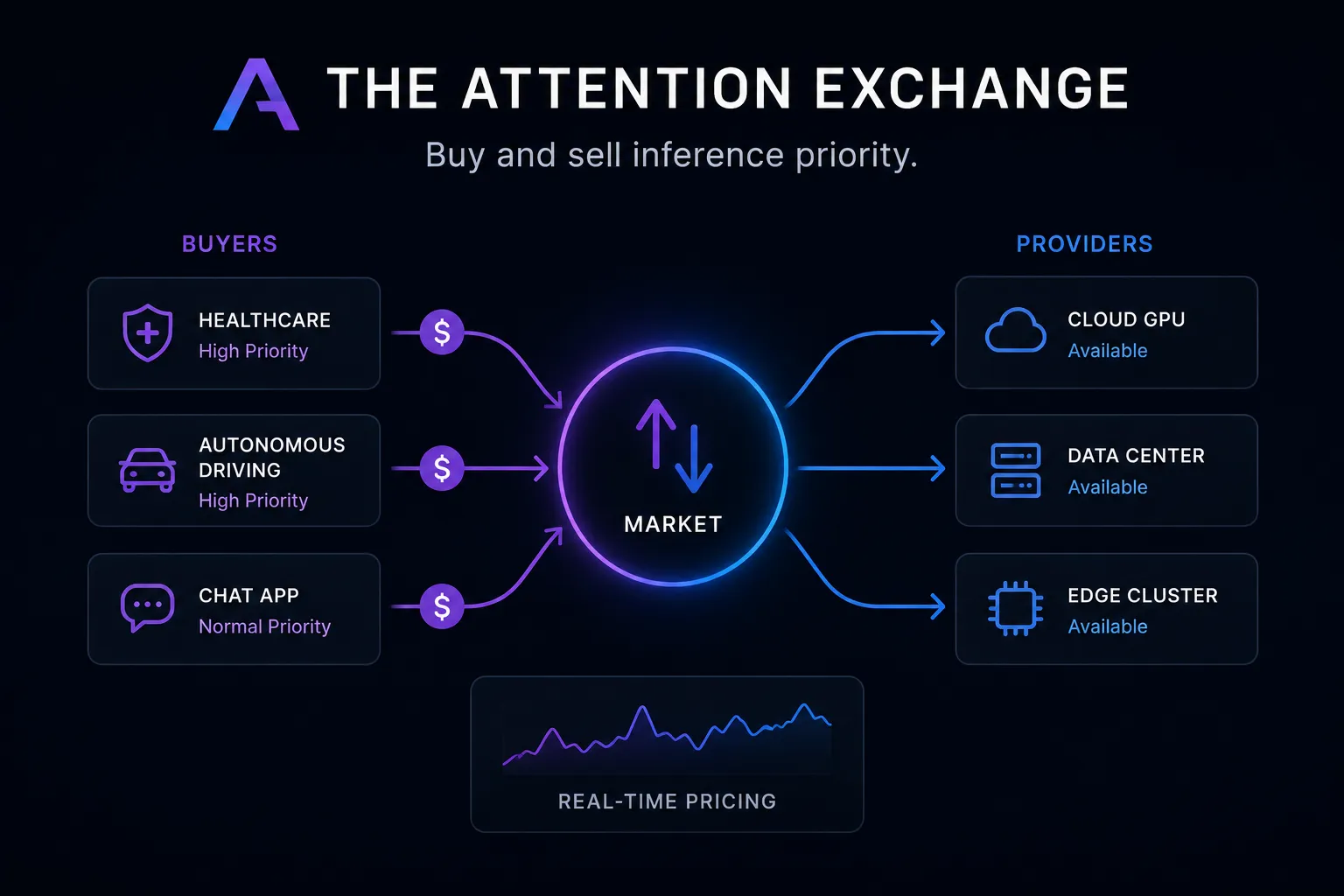
Description
No additional description provided.
The Pitch
Inference is not just compute; it is time. The same model response can be nearly worthless after five seconds and invaluable within half a second. Today, most AI infrastructure treats latency as a technical service level, but the economic truth is sharper: every request has a different decay curve. A fraud alert, a live translation, a customer support draft, and a background summarization job should not be competing in the same line as if they value time equally.
The strange thing about AI demand is that much of it is flexible, but the infrastructure often pretends it is not. Many requests can wait, degrade, route to a smaller model, or be completed overnight with no meaningful loss. Others cannot. A market for priority would expose this hidden elasticity. Instead of every application overprovisioning for its worst hour, the system could let low-urgency workloads sell their place in line when the world suddenly needs capacity elsewhere. That turns delay from a failure into an asset.
This would also create a new kind of reliability: not the promise that everything is always fast, but the ability to make the most important things fast when it matters. Fixed queues are egalitarian in a way that becomes irrational under stress. If compute is constrained during a product launch, disaster, election night, cyberattack, or championship game, “first come, first served” is a poor allocation rule. A price signal is often the simplest way to distinguish impatience from importance.
The business becomes more interesting as AI becomes embedded in workflows rather than visited as a destination. When AI is a toy, latency is annoyance. When it is inside trading systems, hospitals, logistics networks, call centers, classrooms, and accessibility tools, latency becomes a business variable. The buyer is not merely purchasing tokens; they are purchasing continuity, trust, and the right to stay responsive when everyone else slows down.
The deepest opportunity is that this marketplace could make inference capacity more useful without inventing new chips or models. It would increase the effective supply of compute by matching urgency to availability. Scarcity does not disappear, but it becomes organized. In a world where intelligence is cheap on average and expensive at the exact moment you need it most, the company that prices urgency may become as important as the company that provides the intelligence itself.