Real-Time Marketplace for AI Compute Capacity
AI is creating enormous demand for compute, but buying it still looks like buying cloud infrastructure: companies choose providers, reserve capacity, and hope they picked the right combination of price, performance, geography, and availability. The Compute Exchange would turn AI compute into a real-time global market where every workload automatically bids for exactly what it needs and capacity providers compete to run it. A company might submit a job requiring a certain latency, privacy level, model quality, and maximum cost; the exchange could route it instantly to AWS, a specialist GPU cloud, unused enterprise capacity, or an edge data center. Providers could sell spare compute, buyers could reserve or hedge future capacity, and prices would move continuously with supply and demand. If compute becomes one of the world’s most important commodities, there may eventually need to be a Nasdaq for machine intelligence.
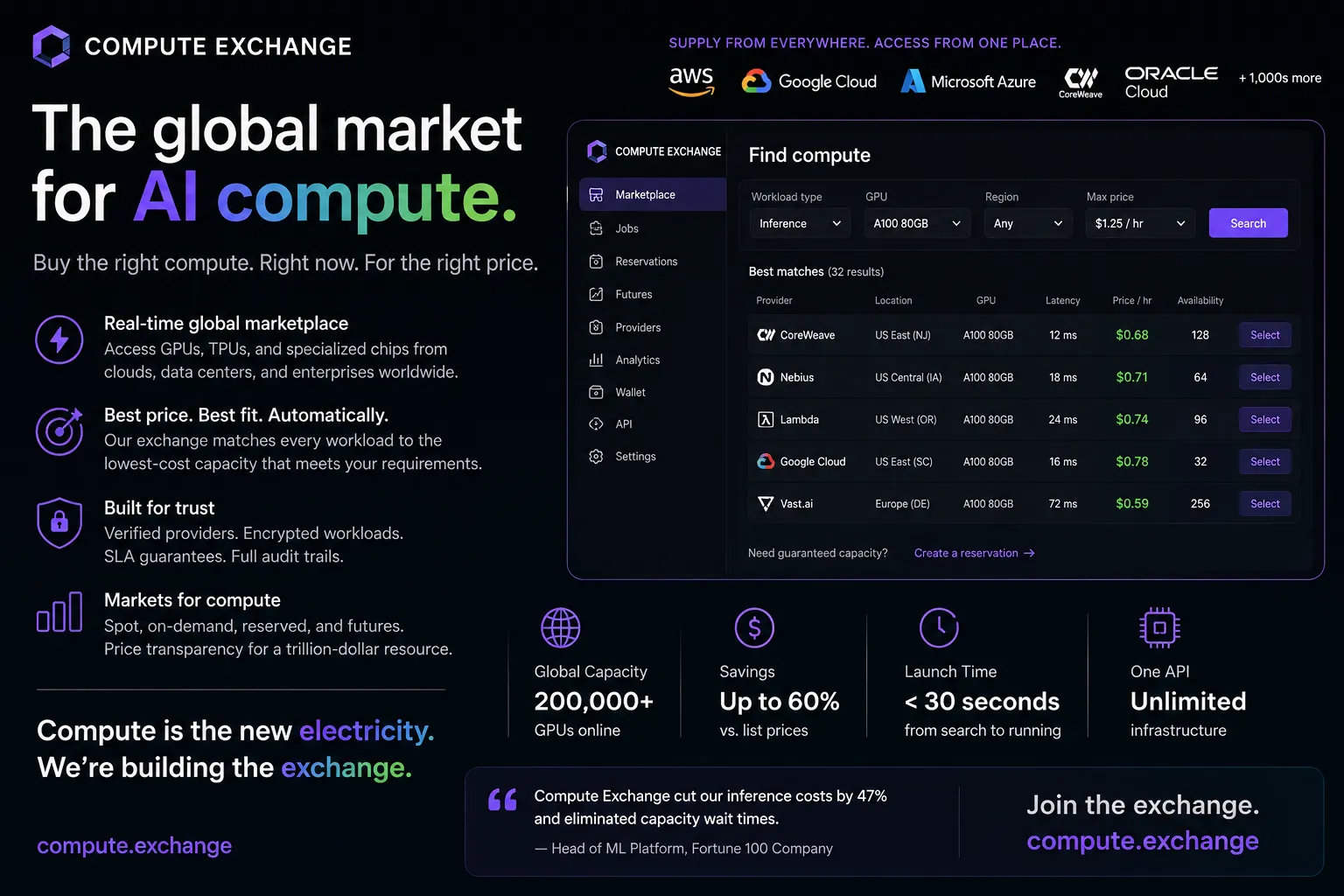
Description
No additional description provided.
The Pitch
Compute exchange would exist because AI compute is drifting away from being a static infrastructure purchase and toward being a perishable, tradable input. A GPU-hour that goes unused tonight cannot be stored for tomorrow. At the same time, demand is spiky, heterogeneous, and increasingly indifferent to where the work runs as long as the right constraints are met. That combination is what makes markets appear: wasted supply on one side, urgent variable demand on the other, and enough standardization in the middle to make matching possible.
The non-obvious opportunity is that the buyer often does not actually want “AWS” or “H100s” or a named data center. They want a result under conditions: finish this inference cheaply, train this model by Friday, keep this data in-region, hit this latency, avoid this failure mode. Once workloads can be described this way, the provider brand becomes less central than execution quality. The exchange would not merely sell cheaper compute; it would translate business intent into machine-readable demand and let the market discover the best way to satisfy it.
This also changes the economics for suppliers. Today, large clouds benefit from distribution and trust, while smaller GPU clouds, edge operators, enterprises, universities, and data centers often struggle to turn fragmented capacity into dependable revenue. A liquid market would make orphaned compute useful. The more unusual the supply becomes—different chips, geographies, energy profiles, security postures—the more valuable the exchange is, because no single buyer wants to manage that complexity directly.
The deepest version of the business is not brokerage but trust. Compute markets will only work if buyers believe jobs will run correctly, privately, and predictably, and sellers believe they will be paid fairly for verifiable work. That creates room for a neutral layer that measures performance, enforces guarantees, normalizes reputations, and makes capacity comparable without pretending all compute is identical. In commodity markets, the exchange’s power comes from defining what is being traded.
If AI keeps spreading into every product, compute will become less like software procurement and more like electricity, bandwidth, or financial liquidity: something companies consume constantly, optimize automatically, and cannot afford to misbuy. The company that makes compute tradable would sit at the point where model ambition meets physical scarcity. That is a rare position, because it captures value not by owning all the infrastructure, but by making everyone else’s infrastructure more economically legible.