Real-Time Entity Resolution for Insurance Workflows
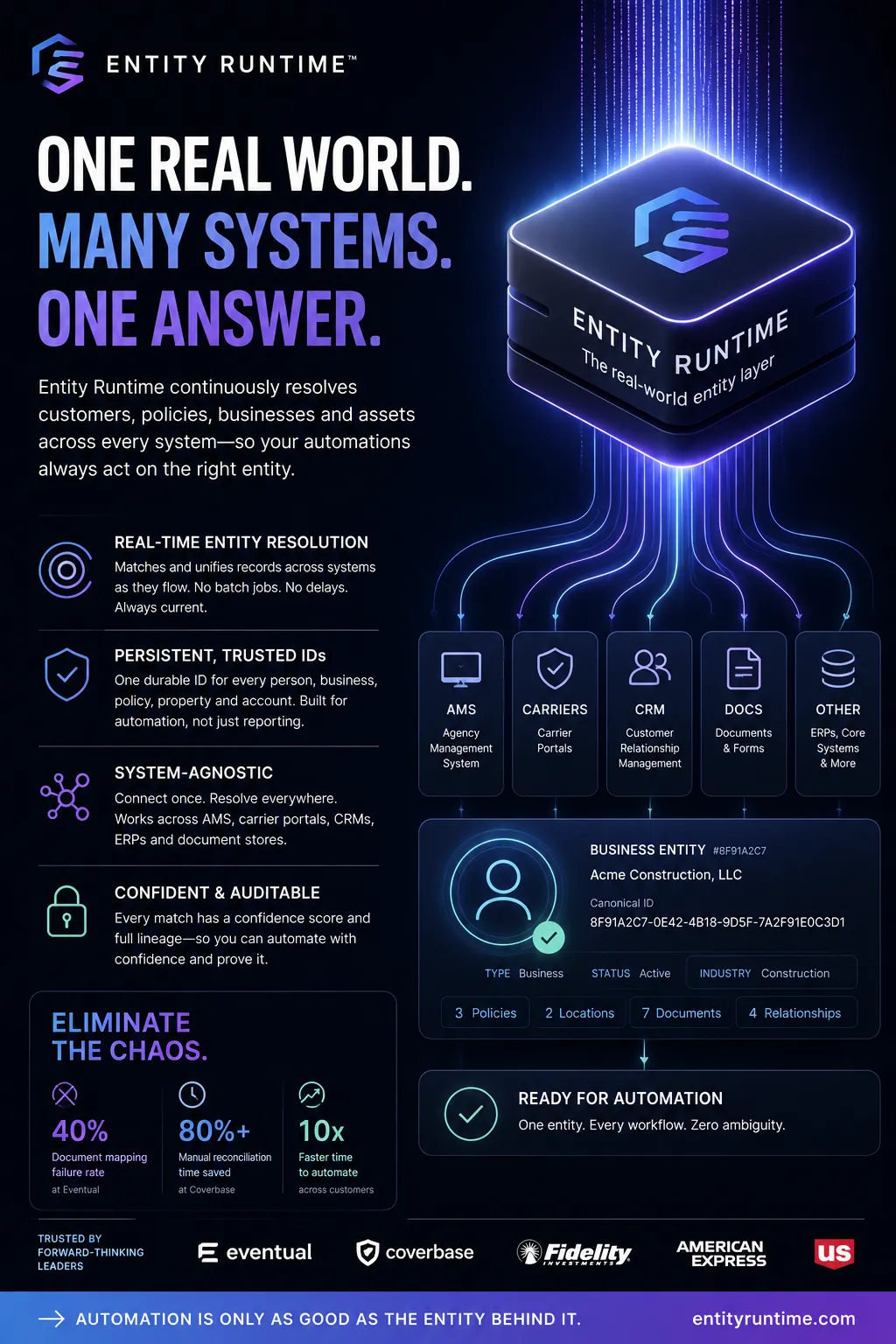
Companies can move data between systems, but automation still breaks because “John Smith,” “J. Smith,” policy 4821 and account 9937 are not reliably understood as the same real-world entity. Entity Runtime would sit between applications and continuously resolve customers, policies, businesses, assets and counterparties into persistent IDs that every downstream workflow can call in real time. Why now: AI is pushing systems from record-keeping into action, but insurance and financial workflows still suffer from inconsistent standards, custom fields and re-keying between systems. Example: an agency sends a policy to three carriers whose systems name and structure the insured differently; Entity Runtime resolves the records once and gives every automation the same canonical entity.
Description
No additional description provided.
The Pitch
The hardest part of automating messy industries is not moving data; it is deciding what the data is actually about. Most software treats identity resolution as a cleanup task inside a database, but in insurance and finance it is closer to infrastructure. If a person, company, policy, vehicle, property, beneficiary, and counterparty cannot be recognized consistently across systems, every automation inherits a small uncertainty that eventually becomes manual review.
The valuable shift is from static matching to a runtime layer. A persistent entity ID is not just a better record; it is a shared point of coordination between tools that were never designed to agree with one another. Once downstream systems can call the same resolved entity in real time, workflows stop depending on brittle field mappings and start depending on a continuously updated understanding of the world. That makes the company more like a naming system for business relationships than another integration product.
The wedge is especially strong in industries where ambiguity is expensive but unavoidable. Insurance and financial services are full of near-duplicates, household relationships, subsidiaries, policy renewals, DBA names, legacy account numbers, and documents that describe the same thing in different dialects. These are not edge cases; they are the ordinary texture of the work. A business that becomes trusted at resolving this ambiguity can sit underneath many categories of software without competing with them directly.
The timing matters because AI increases the cost of unresolved identity. When humans operated workflows, they quietly supplied context: “this is the same insured,” “that account belongs to the parent company,” “this endorsement refers to the renewal.” As AI agents and automated workflows take on more of that work, the missing context has to become machine-readable. Entity resolution becomes the safety layer that determines whether automation is useful or dangerous.
The most interesting business quality is compounding memory. Every resolution teaches the system how a market refers to its entities, and every customer benefits from a richer map of names, structures, and relationships. Over time, the company would own a durable layer of institutional context that individual applications struggle to build because each sees only its own slice of reality. In a world of increasingly automated operations, knowing that two records refer to the same real-world thing may become one of the most valuable primitives in enterprise software.