Real-Time Counterparty Matching Network
Companies build static partnerships around something that is inherently dynamic: another company's willingness to buy, fund, insure or distribute an opportunity. Counterparty Liquidity Network turns that appetite into a live market where companies submit commercial opportunities, counterparties continuously publish what they want, and the network clears each opportunity to the best available buyer. Why now: more commercial relationships are becoming API-connected and machine-decisioned, making real-time markets possible where bilateral partnerships used to be required. Example: a fintech submits a qualified borrower and dozens of lenders compete for it based on current appetite, price and capacity, making any single lender replaceable.
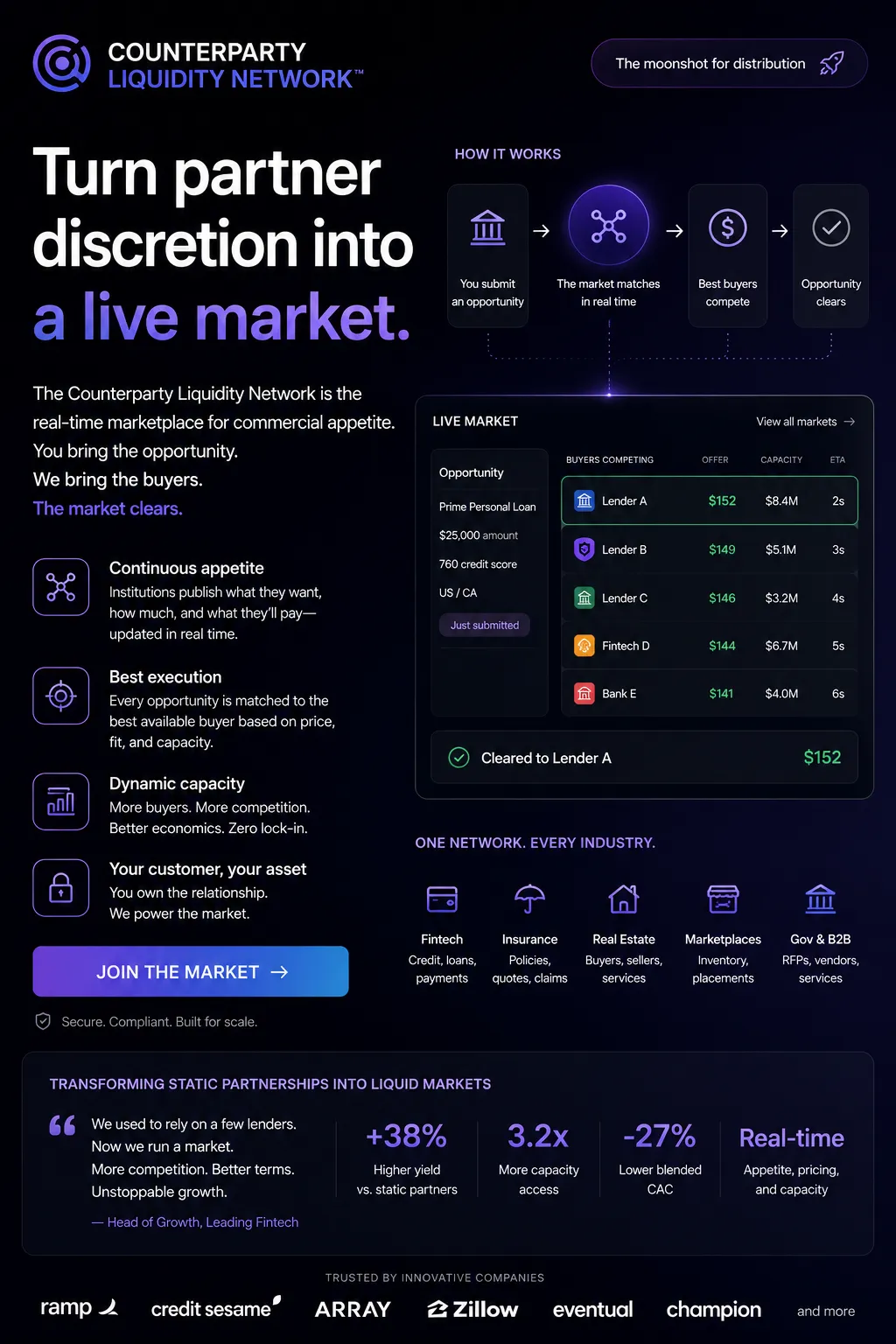
Description
No additional description provided.
The Pitch
Many “partnerships” are really just disguised liquidity problems. A company does not actually need one lender, one insurer, one distributor, or one channel partner; it needs the best available counterparty at the exact moment an opportunity appears. Today that need is often trapped inside a static contract, so the company experiences counterparty preference as if it were a fixed business relationship rather than a fluctuating market condition.
The hidden inefficiency is that appetite changes faster than partnership infrastructure. A lender may want prime borrowers in California in the morning and pull back by afternoon. An insurer may be aggressive in one category until its exposure limit is hit. A distributor may want inventory until demand shifts. Static integrations freeze these moving preferences into yesterday’s assumptions. A live counterparty market would make willingness itself the traded commodity.
This kind of network becomes more valuable because it weakens the old advantage of bilateral exclusivity. In many industries, the incumbent partner’s power comes from being embedded, not from being the best buyer at that moment. Once opportunities can be routed dynamically, embeddedness stops being a moat and becomes just one bid among many. That changes the economics: originators capture more of the value they create, while counterparties are forced to compete on current usefulness rather than historical access.
The business would also sit at a very interesting data layer. It would not merely know who bought what; it would know who wanted what, when they wanted it, how badly, under what constraints, and when their appetite disappeared. That is a much richer map of commercial demand than ordinary transaction data. Over time, the network could understand not just clearing prices, but the shape of institutional intent across markets.
What makes the idea especially powerful is that it turns fragmentation from a problem into supply. Every additional counterparty adds another pocket of appetite; every additional originator adds more chances to satisfy it. The result is not a marketplace in the consumer sense, but a clearing layer for commercial intent. If built well, companies would stop asking “Who are our partners?” and start asking “Who is the right counterparty for this exact opportunity right now?”