Real Human Personalization Benchmark for AI Agents
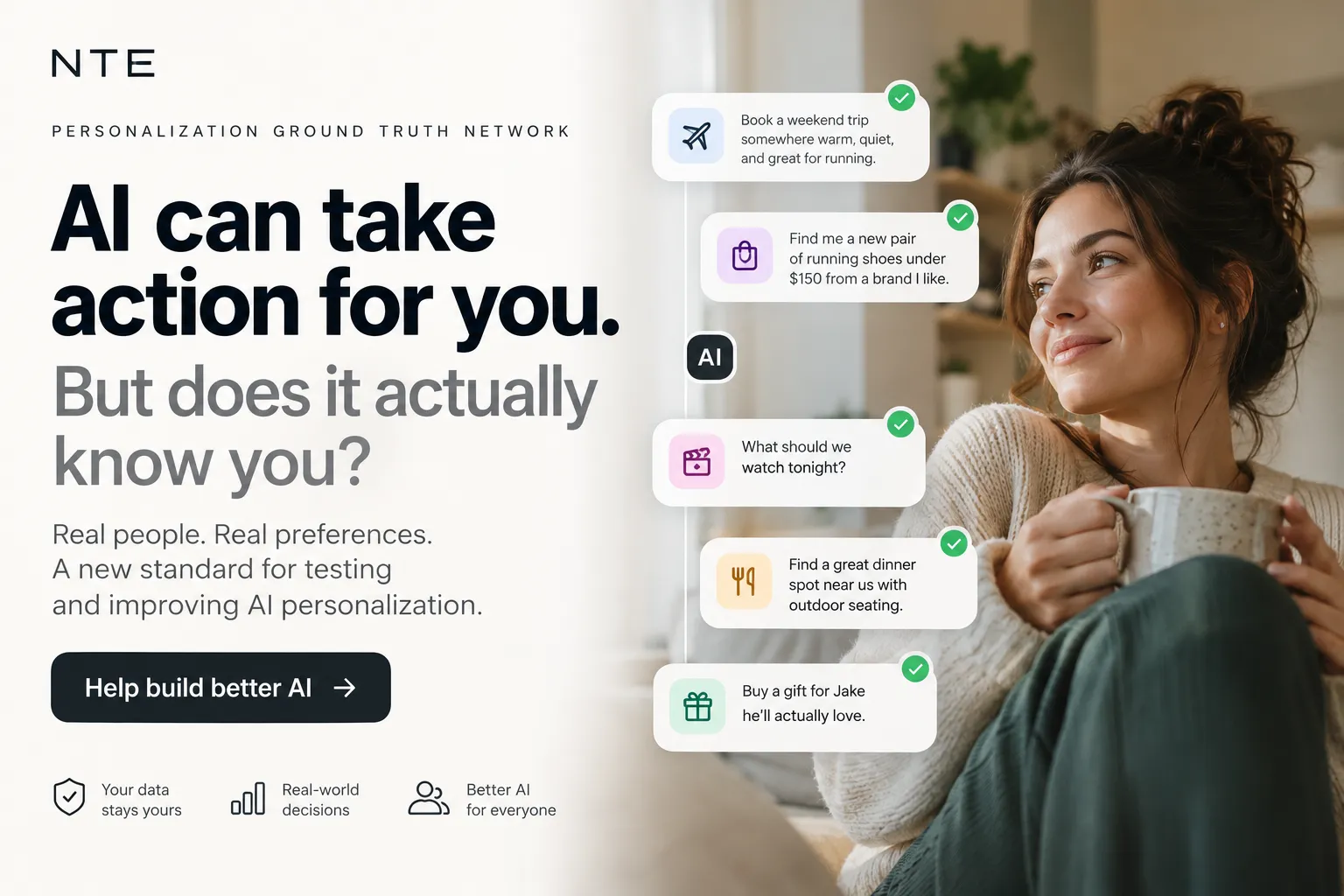
AI agents are getting better at remembering who you are, but there is still no reliable way to know whether they actually understand you. An agent can successfully book a hotel, recommend a product, or choose a movie while making the completely wrong choice for the person it represents, and synthetic personas or ordinary software benchmarks cannot fully measure that. Someone should build a network of real people with explicit, evolving preference profiles that AI companies can use to test personalization over time: did the agent make the right decision, use the right context, ignore stale information, and adapt when the person’s preferences changed? As agents move from answering questions to actually making decisions, personalization needs its own ground truth. For example, a shopping agent might correctly find a pair of running shoes under $150 but still fail because it ignored that the user hates that brand—a real-human preference benchmark would catch the failure.
Description
No additional description provided.
The Pitch
Personalization is one of the few areas in AI where “better” cannot be judged by the model alone. A model can sound empathetic, recall facts, and satisfy stated constraints while still being wrong in the way a close friend would instantly recognize. The gap is not intelligence; it is fidelity to a particular person. As agents take on more delegated decisions, that gap becomes measurable economic risk rather than a charming imperfection.
The most valuable asset here would not be the software but the continuity of human preference data. Most testing captures a snapshot: a task, an answer, a rating. But real preferences decay, contradict themselves, and depend on context. Someone may love boutique hotels for vacations but prefer predictable chains for work trips; they may say they want adventurous restaurants until traveling with children. A system that tracks how real people’s preferences evolve over months or years would create a kind of living measurement layer that synthetic datasets cannot imitate.
This would matter because AI companies will increasingly compete on trust, not just capability. Once many agents can complete the same transaction, the winning one is the one people feel safe letting act without supervision. That trust has to be earned through evidence that the agent knows when to remember, when to forget, when to ask, and when not to overfit to an old signal. A benchmark built around real human nuance turns personalization from a vague product claim into something that can be tested, compared, and improved.
There is also an unusual defensibility in the fact that people are hard to simulate precisely because they are inconsistent. Synthetic personas are useful until everyone optimizes against the same imaginary users. A network of consenting real people with rich, changing preference histories would be difficult to copy because its value compounds through time: the longer it runs, the more it reveals about drift, exceptions, and hidden tradeoffs.
If this existed, it could become part of the quality infrastructure for agentic software. Not because every decision needs a human judge, but because the industry will need a trusted way to answer a deceptively simple question: did the agent act like it understood the person, or did it merely complete the task?