Rapid Response Biobank for Exceptional Longevity Samples
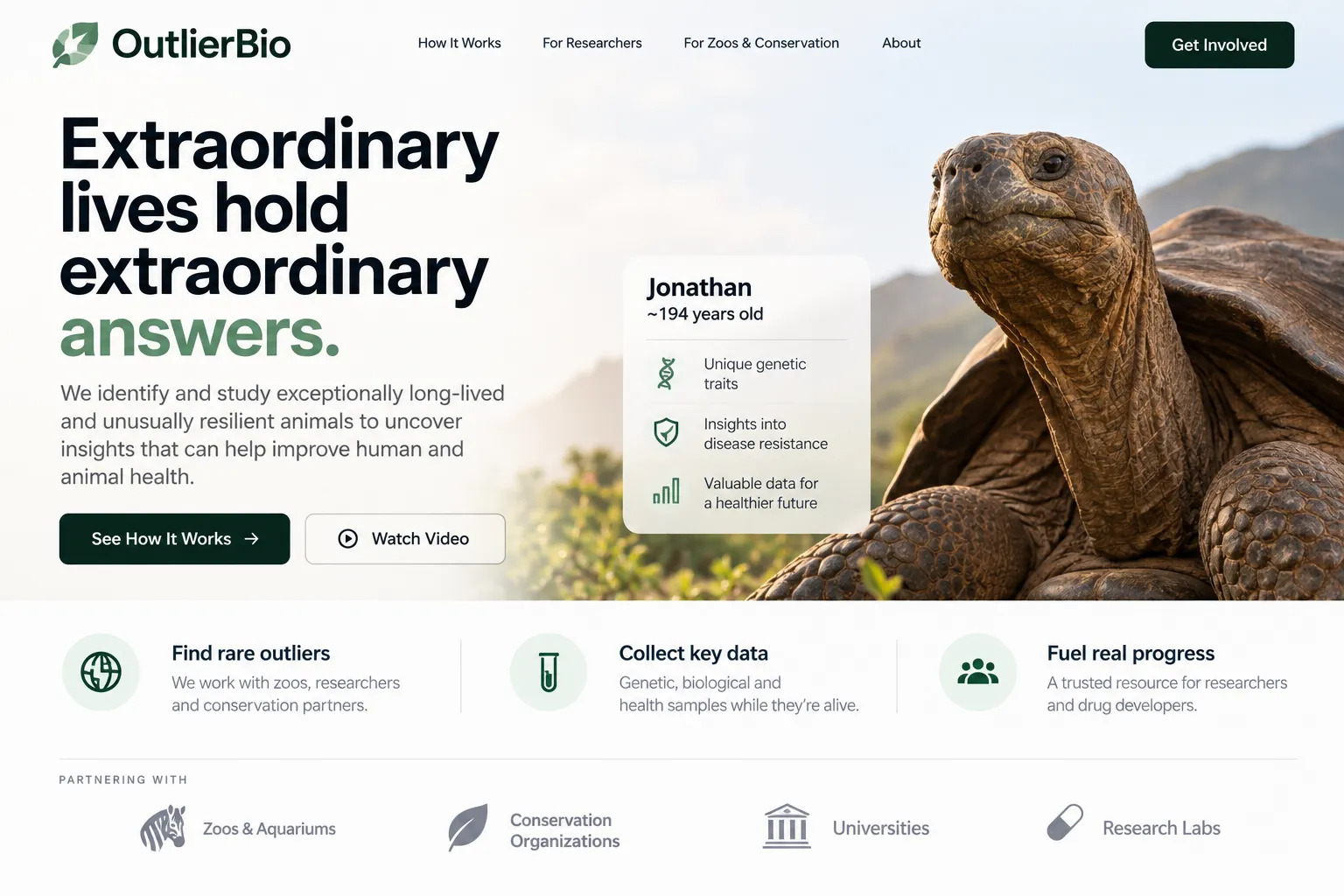
Nature occasionally produces biological outliers that live dramatically longer, resist diseases they should develop, or survive conditions that kill almost everything else, but many of those one-of-a-kind experiments disappear before scientists can study them properly. Build a global rapid-response biobanking network that identifies exceptional animals and humans while they are still alive, collects standardized genetic, epigenetic, proteomic, microbiome, and health data, and preserves those samples as a searchable resource for researchers and drug developers. This matters now because sequencing and multi-omics have become cheap enough to deeply characterize rare individuals, while AI is making it increasingly possible to find useful patterns across species and datasets. Imagine a zoo flagging an animal living twice its species’ normal lifespan and researchers receiving a complete biological record before that irreplaceable opportunity is lost forever.
Description
No additional description provided.
The Pitch
The scarcest input in biology is not computing power or sequencing capacity, but truly unusual living evidence. Most biomedical datasets are built from the common middle: average patients, average lab animals, average outcomes. Yet the most valuable clues often sit at the edges, in organisms that violate the expected rules. A company that systematically captures those edge cases would own a kind of biological option value that cannot be recreated once the subject dies.
The key insight is that rare biology is perishable. An unusually old whale, cancer-resistant elephant, long-lived dog, or human super-responder is not just a curiosity; it is a time-sensitive research asset. Today, these cases are usually noticed informally, studied inconsistently, or lost in fragmented institutional records. Turning accidental anecdotes into standardized, preserved, searchable evidence would convert biological luck into durable infrastructure.
This could also become more valuable with time in a way most datasets do not. A sample collected today may be only partially interpretable, but future models, assays, and comparative methods can keep extracting new meaning from it. The business is not merely selling access to data as it exists now; it is accumulating a library of extreme phenotypes whose significance increases as biology becomes more computational and cross-species analysis improves.
There is a strong coordination problem hiding in plain sight. Zoos, wildlife centers, hospitals, breeders, veterinarians, and researchers may each encounter exceptional cases, but none has enough coverage or incentive to build the whole capture system alone. A neutral, trusted network could become the default destination for these discoveries, much as rare manuscripts belong in archives rather than desk drawers. The defensibility would come less from secrecy than from reach, standardization, provenance, and the habit of being called first.
The most interesting commercial fact is that drug discovery is always searching for naturally validated mechanisms. Biology that already works in a living organism carries a different kind of credibility than a synthetic hypothesis. If even a small fraction of these outliers reveal mechanisms relevant to aging, cancer, immune regulation, metabolic resilience, or neurodegeneration, the archive becomes a map of experiments nature has already run, but science has never had the discipline to collect.