Public Database for Painful Customer Problems
Startup idea sites are full of solutions someone desperately wants to find a problem for. Reverse it. Build a giant public database where people post annoying, expensive, repetitive, ridiculous problems from their jobs and lives. Other users vote on how painful they are, add examples, and say what they'd pay to make them disappear. Entrepreneurs browse problems instead of ideas. If someone builds a company around yours, maybe you get a tiny royalty or piece of the business. Worst case, you complained on the internet. Best case, someone finally fixes the thing you've been complaining about for five years.
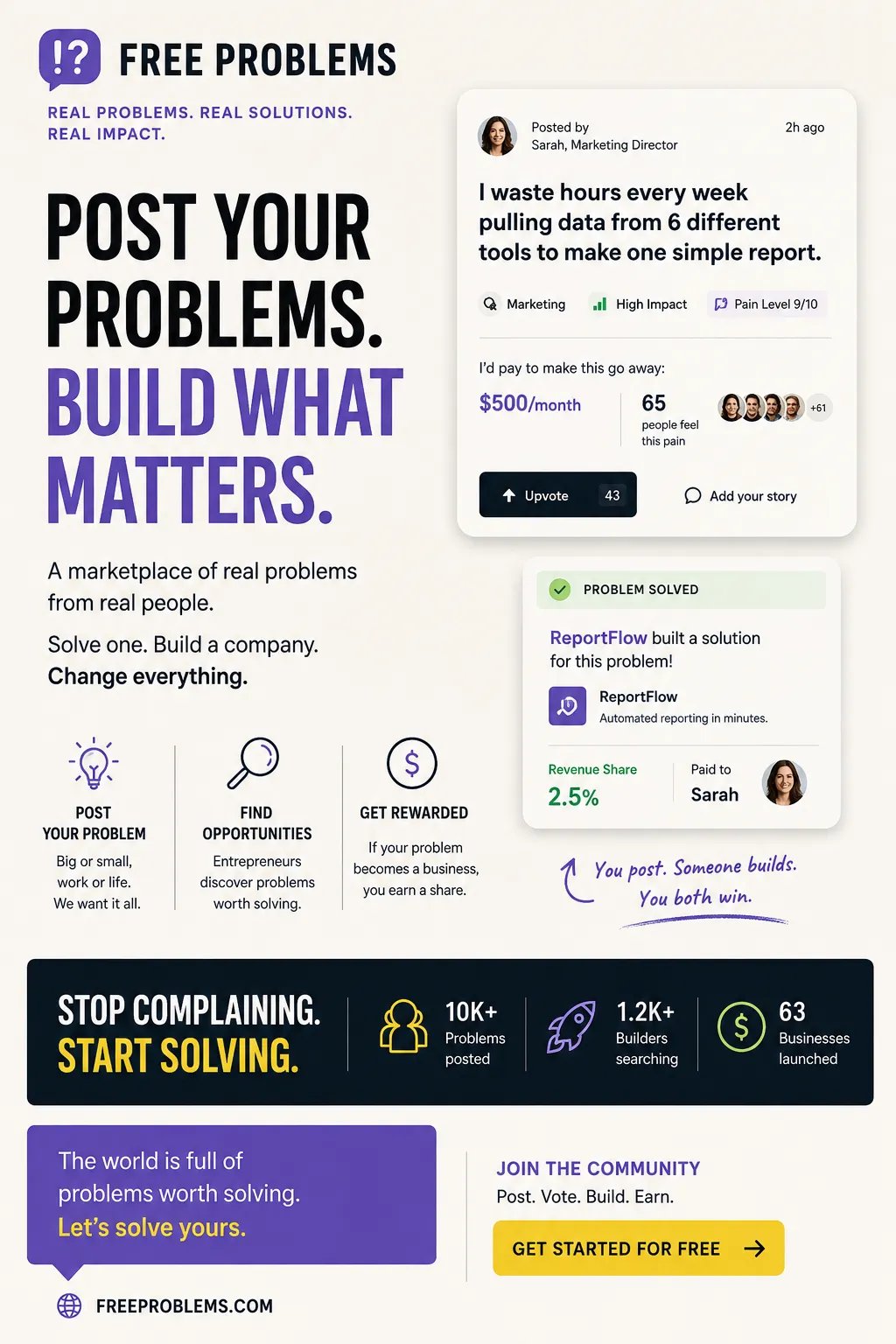
Description
No additional description provided.
The Pitch
A business like this would be compelling because pain is usually scattered in places builders do not look. The most valuable startup ideas are often trapped inside procurement departments, weird compliance workflows, hospital back offices, construction sites, school administration, insurance claims, and the private frustrations of people who have stopped expecting software to help them. A public market for problems would make that hidden demand legible. It would turn “someone should fix this” from a hallway complaint into searchable evidence.
The interesting shift is that it would treat problems as assets before they become companies. Today, the person closest to a painful workflow often lacks the time, technical ability, or appetite to build a company around it, while the person capable of building usually lacks authentic access to the problem. This creates a strange inefficiency: the people with the best raw material for startups and the people with the ability to exploit it rarely meet. A database with attribution, examples, and incentives could make problem discovery feel less like luck and more like a supply chain.
The voting layer matters less as popularity and more as pattern recognition. A single complaint is noise; fifty variations of the same complaint across different industries may reveal a category. The best opportunities often hide behind boring repetition, not dramatic novelty. If nurses, freight brokers, accountants, and property managers are all describing the same underlying coordination failure in different words, that is a more useful signal than another trend report about artificial intelligence.
There is also a powerful social mechanic in making complaint productive. People already spend enormous energy describing broken systems online, but most of that energy evaporates into jokes, rage, or resignation. Giving those complaints structure, comparability, and potential upside changes the emotional contract. It says: your irritation may be economically meaningful. That is a surprisingly strong reason for people to contribute high-quality detail, especially when the alternative is telling the same story to coworkers for the hundredth time.
The company would not just be a place for entrepreneurs to shop for ideas; it could become a living map of unmet demand. Over time, the most valuable data would not be the individual posts but the clusters: which problems recur, who feels them most acutely, what workarounds people tolerate, and where willingness to pay appears before a product exists. That is the rare kind of marketplace where even failed searches create value, because every unsolved complaint makes the map more accurate.