Public Data Business Opportunity Alerts
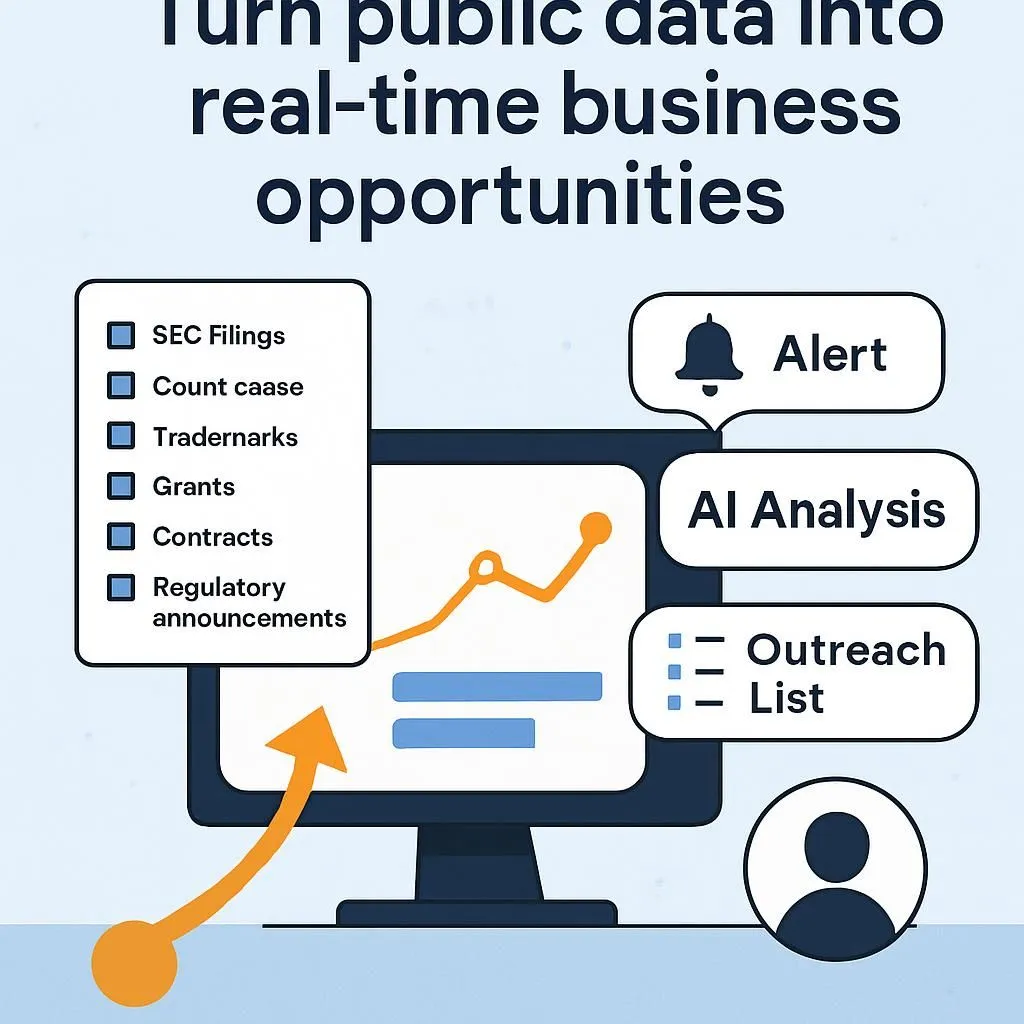
A platform that turns public data into real-time business opportunities. By monitoring sources like SEC filings, court cases, trademarks, grants, contracts, and regulatory announcements, the platform identifies events that signal demand before the market notices. Users receive actionable alerts, AI-generated analysis, and recommended outreach lists. Instead of searching for leads, businesses discover opportunities the moment they emerge, creating a continuous pipeline of high-intent prospects.
Description
No additional description provided.
The Pitch
Most business development still treats demand as something that becomes visible only after a buyer raises their hand. But many buying decisions are preceded by public events: a company files to go public, loses a lawsuit, wins a government contract, registers a new trademark, receives a grant, changes leadership, or enters a regulated process. These moments are not merely “news.” They are forced changes in priorities, budgets, risk, and urgency. A company that can translate those signals into commercial context would sit upstream of the entire sales market.
The interesting truth is that public data is abundant but commercially illegible. A court filing may imply a need for crisis communications, e-discovery, insurance, recruiting, or compliance support, but only to someone who knows how to read it. An SEC filing may reveal expansion plans, vendor gaps, financial stress, or new operational complexity. The value is not in aggregating documents; it is in interpreting why a specific event creates a likely near-term need for a specific kind of provider. That interpretation layer is where the business becomes more than a database.
This would also change the psychology of selling. Most lead generation is based on stale attributes: industry, size, geography, job title. Those factors describe who a company is, not what just happened to it. Event-driven demand is different because it gives sellers a reason to be timely, relevant, and useful. Outreach tied to a concrete change feels less like interruption and more like recognition. The best lead is not the company that matches a profile; it is the company whose circumstances have just shifted in your direction.
The defensibility would come from accumulating judgment about which signals actually matter. Many public events are noise, and many apparent opportunities are false positives. Over time, the platform could learn that certain combinations of filings, language, jurisdictions, company types, and timing reliably precede spending. That feedback loop turns public information, which anyone can access, into private understanding, which is much harder to copy.
The larger idea is that markets produce early warnings before they produce transactions. Today those warnings are scattered across bureaucratic systems designed for disclosure, not commerce. A company that makes them legible would not just help businesses find prospects; it would reveal a hidden layer of economic activity where demand first becomes visible.