Public Claim Verification Ledger for Companies
Companies have systems of record for customers, code and finances, but nothing that serves as the system of record for what the company is allowed to say is true. Claim Ledger would turn every meaningful public assertion into a structured object: the claim, where it appears, who owns it, what evidence supports it, when that evidence was last verified and what product or policy change would invalidate it. Why now: existing marketing-compliance products largely focus on reviewing content against policies before publication, while documentation-drift tools recognize that product and documentation frequently fall out of sync after changes occur. Example: “available in all 50 states” is linked to the underlying coverage table. The moment coverage changes to 48 states, every surface carrying the old claim is automatically identified.
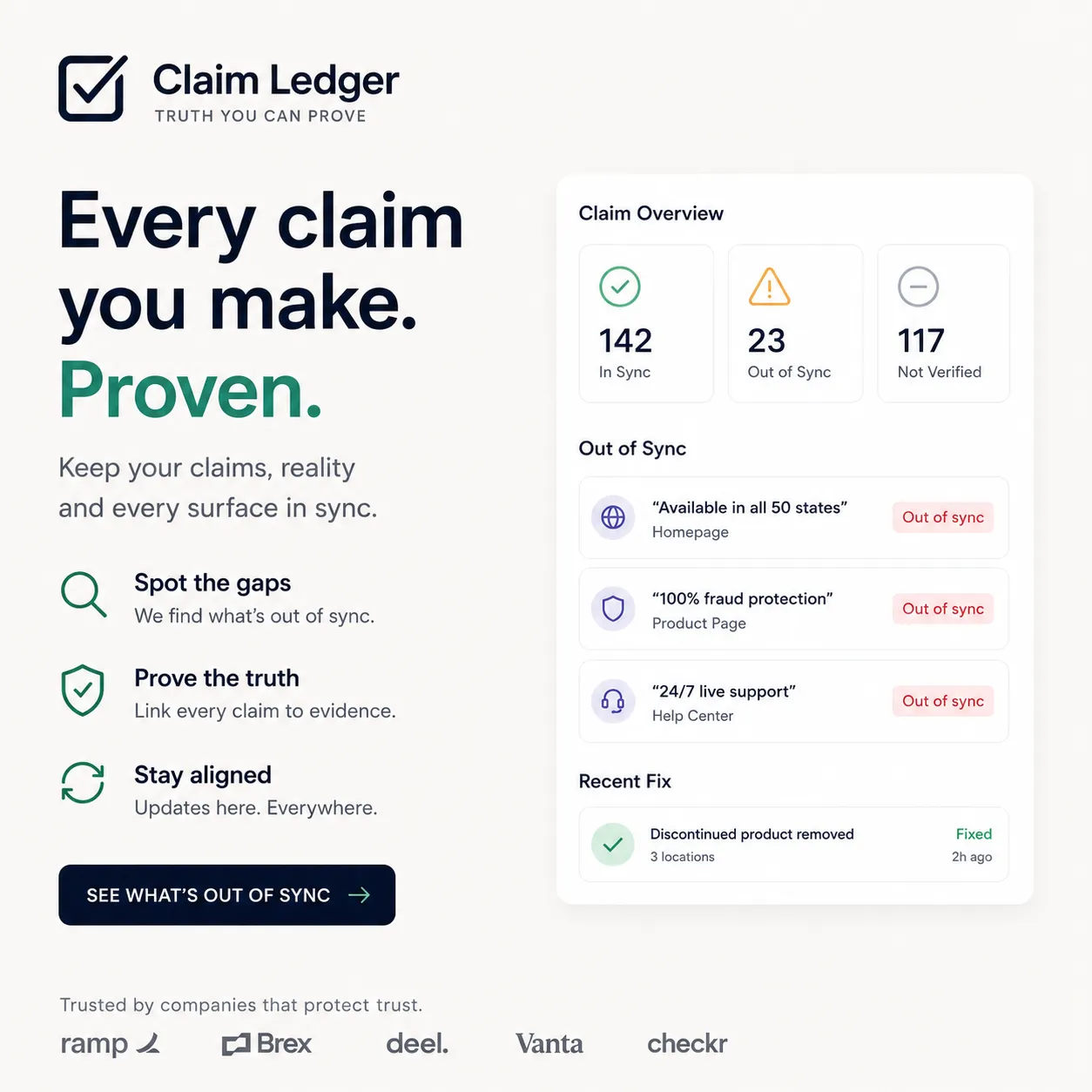
Description
No additional description provided.
The Pitch
Corporate truth has become operationally fragile. A company no longer makes claims only in brochures and press releases; it makes them across landing pages, help centers, sales decks, ads, onboarding flows, AI chat answers, app store descriptions, security questionnaires, marketplace listings, and customer emails. The same assertion is often rewritten dozens of ways by different teams, then quietly detached from the facts that made it true. The business exists because “what we say” has become a distributed production system, but most companies still manage it like a copywriting problem.
The sharp insight is that many reputational and regulatory failures are not caused by lying, but by truth expiring. A statement can be accurate on Monday and dangerous on Friday because a product changed, a vendor coverage area narrowed, a certification lapsed, a policy was revised, or a lawyer approved language under assumptions that no longer hold. That creates a category of risk that traditional approval workflows are poorly suited to catch: they certify a moment in time, while the underlying business keeps moving. A ledger that connects claims to living evidence would make drift visible before it becomes embarrassment, refund liability, or enforcement.
This would become more valuable as companies adopt AI-generated content, because AI increases the surface area of assertions while weakening the memory of where those assertions came from. If every team can instantly produce polished copy, the scarce asset is no longer language; it is provenance. The company that can say, “this sentence is supported by this data source, approved by this owner, and invalidated by these conditions,” will operate with a kind of institutional self-awareness that most organizations lack.
The business is also compelling because it sits at the intersection of several departments that each feel the pain differently but share the same object. Legal cares about substantiation, marketing cares about speed, product cares about accuracy, compliance cares about auditability, and support cares about consistency. A claim is one of the rare units of work that can connect all of them without forcing them into the same workflow. If the ledger becomes the place where important assertions live, it becomes harder to launch, change, or publish without consulting it.
The deeper bet is that companies will eventually treat claims like they treat code dependencies or financial controls: not as text to be reviewed occasionally, but as assets with owners, sources, and failure modes. In a world where trust is increasingly won by being precise, the companies that know exactly what they are claiming—and why—will move faster precisely because they are less afraid of being wrong.