Provenance Tracking for AI Research Results
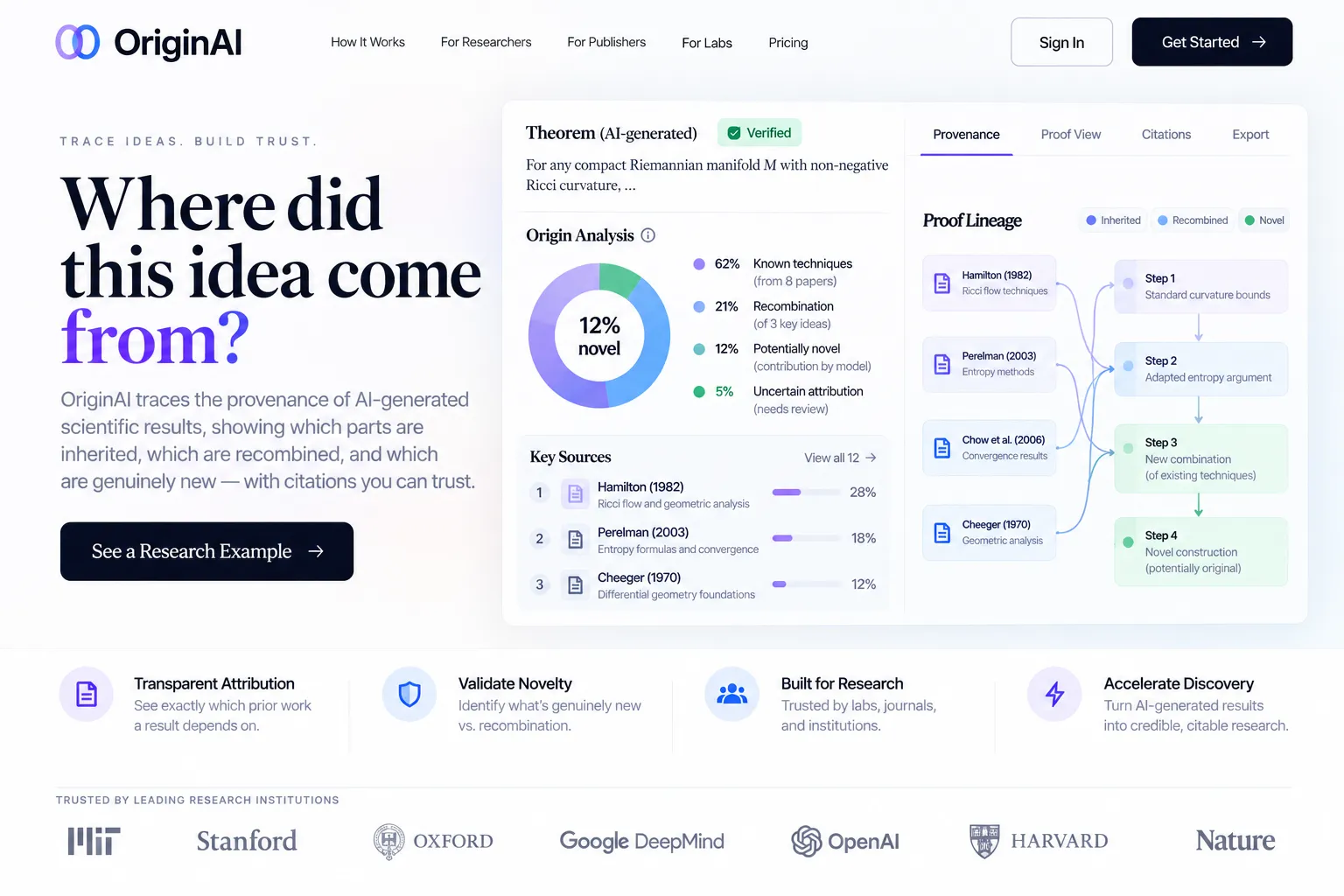
AI systems are beginning to produce mathematical proofs and scientific results, but proving that an answer is correct does not prove that the underlying idea is actually new. Build a provenance layer that traces every AI-generated theorem, proof, hypothesis, or research result back through the papers, techniques, lemmas, and prior work it depends on, showing which parts are inherited, recombined, uncertain, or genuinely novel. This becomes essential as AI starts contributing directly to research and questions of attribution, originality, and scientific credit become harder to resolve. Imagine an AI-generated proof passing formal verification while the system also shows that most of its reasoning came from two existing papers, one step was a new combination of known ideas, and one construction appears genuinely original.
Description
No additional description provided.
The Pitch
The valuable unit in AI science will not be the answer, but the lineage of the answer. As machine-generated research becomes abundant, correctness will become cheaper than trust. A proof may be valid, a molecule may work, a hypothesis may predict something real, but institutions still need to know whether they are looking at discovery, duplication, translation, or plagiarism at machine speed. The business is compelling because it sits at the point where scientific output stops being scarce and scientific credit becomes the bottleneck.
Research has always depended on provenance, but today it is encoded socially: in citations, reputations, lab memory, peer review, and the tacit knowledge of specialists who know which ideas “sound like” which prior work. AI breaks that system because it can absorb and recombine more literature than any human can audit, while producing outputs that look polished enough to obscure their ancestry. A provenance layer would turn an informal scholarly instinct into infrastructure: not merely “what did this cite?” but “what intellectual debt is hidden inside this result?”
The non-obvious prize is that novelty is not binary. Most important work is partly inherited, partly recombined, and partly new. Current systems are bad at expressing that gradient. A tool that can say “this step is a known technique in a new domain,” “this lemma is equivalent to an overlooked result from 1998,” or “this construction has no close ancestor in the corpus” would become useful not just for policing misconduct, but for understanding the shape of discovery itself. It would help researchers see where the actual invention lies.
This also creates a new layer of scientific defensibility. As AI-generated papers, patents, grants, and drug candidates multiply, disputes over priority will become more expensive and more frequent. The institution that can produce a credible map of derivation will have an advantage in publishing, patent examination, journal review, lab management, and academic credit. The system does not need to settle every philosophical question about originality; it only needs to make the hidden dependencies legible enough that humans can argue from evidence instead of vibes.
The deeper business insight is that scientific memory is becoming too large and too fast-moving for citation graphs alone. If AI is going to participate in discovery, science needs a record not just of outputs, but of intellectual motion: how an idea traveled, mutated, merged, and became something else. That record could become as fundamental to future research as version control became to software.