Provenance Insurance for AI Content Verification
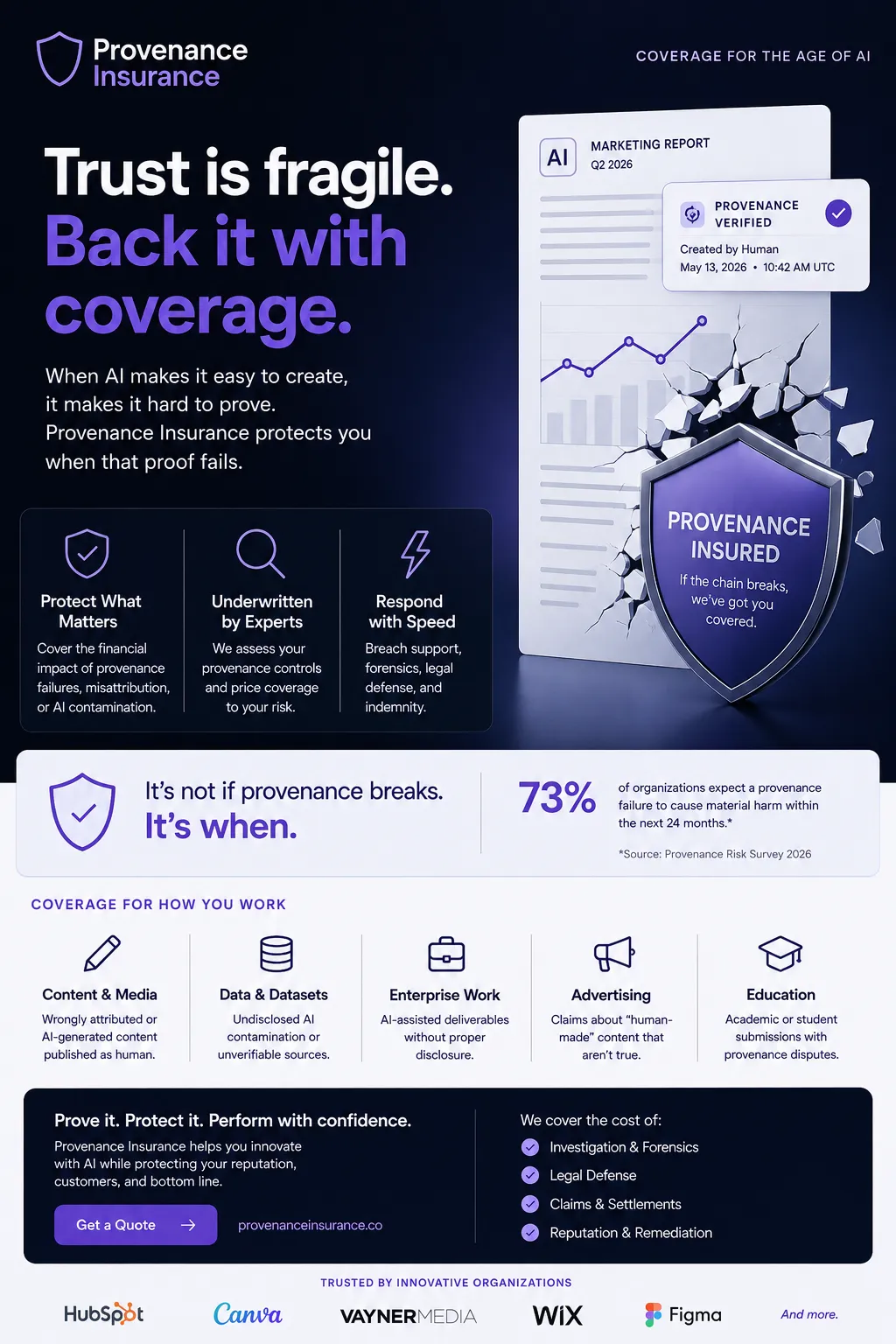
Invisible watermarks and provenance systems create a new problem: companies will start making decisions based on provenance they assume is accurate. Provenance Insurance would cover the consequences when it isn't. A publisher could insure against accepting synthetic work represented as human. A company could insure a dataset against undisclosed AI contamination. An advertiser could insure a campaign marketed as human-created. The insurer would audit the systems used to establish provenance and price coverage based on how easily that chain can break. AI detection tries to determine where something came from. Provenance Insurance would put money behind the answer.
Description
No additional description provided.
The Pitch
The most interesting thing about provenance is that it will become a dependency before it becomes reliable. Once media platforms, publishers, employers, courts, advertisers, and compliance teams begin treating provenance labels as evidence, the label itself becomes a business input. That creates a gap between technical confidence and institutional reliance. Insurance lives in exactly that gap: not where certainty exists, but where people must act despite uncertainty.
The business works because provenance failure is not merely a technical error; it can become a reputational, contractual, or regulatory event. A mislabeled image, dataset, article, or campaign may not be expensive because of the file itself, but because someone made a public claim based on it. The insured object is less the content than the trust decision attached to it. That is why this could be more valuable than another detection tool: detection sells an opinion, while insurance recognizes that the opinion will sometimes be wrong and makes that risk legible.
A good provenance insurer would also become one of the few parties with a financial reason to understand how provenance actually breaks. Most companies will evaluate these systems through procurement checklists, vendor claims, and compliance theater. An insurer would care about the unglamorous weak points: handoffs between tools, metadata stripping, contractor workflows, model fine-tuning history, archive migrations, and incentives to misrepresent origin. Over time, its underwriting data could reveal which provenance chains are robust in practice, not just elegant in standards documents.
There is also a useful asymmetry in the market: companies want to claim authenticity, but they do not want to be solely responsible for proving it forever. As “human-made,” “AI-free,” “licensed training data,” and “verified source” become commercial claims, buyers will ask what stands behind them. Insurance turns provenance from a self-attestation into something closer to a backed guarantee. That shift matters because trust marks only become economically meaningful when false trust has a cost.
The deeper thesis is that AI will make origin a managed risk category, much like cybersecurity made access control one. Companies will not be able to eliminate provenance ambiguity, but they will need budgets, policies, audits, and counterparties for it. The insurer that prices this risk well would not just pay claims; it would define the practical standard for what “known origin” is worth.