Proof Contracts for Verified Real-World Events
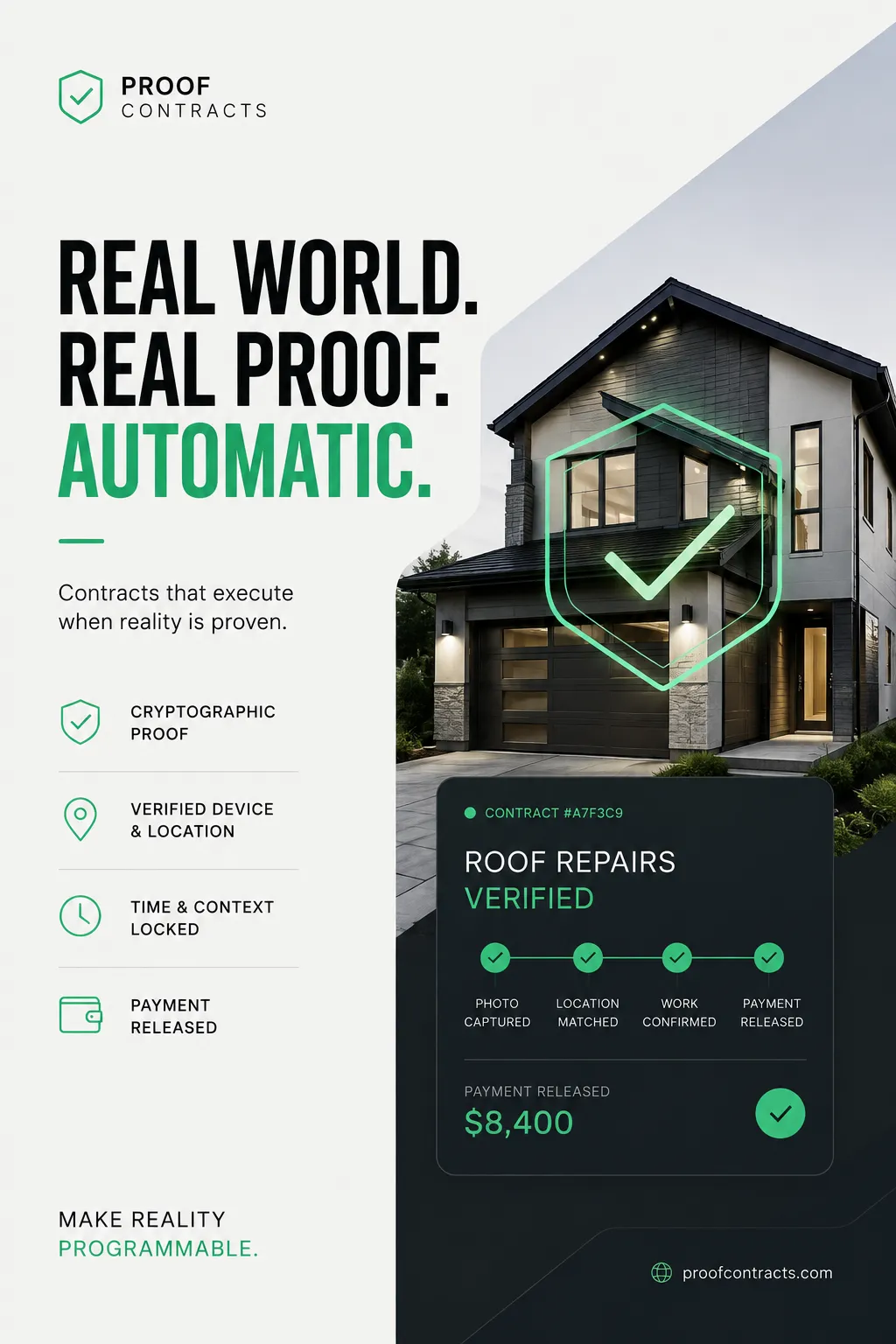
AI is making it easier to authenticate where digital evidence originated, but authentication alone doesn't do anything. Proof Contracts would make real-world events programmable: contracts whose execution depends upon cryptographically verified evidence that something actually happened. A contract could specify the devices, people, location, time window and evidence required, then automatically trigger payment, insurance coverage, warranties or compliance once those conditions are proven. Instead of an insurer receiving photos and deciding whether a roof was repaired, the policy itself could say: $8,400 releases when authenticated evidence proves these five repairs occurred at this property. Smart contracts made money programmable; Proof Contracts would make reality programmable.
Description
No additional description provided.
The Pitch
Evidence can be verified; it is that verification can move from being an after-the-fact argument to being part of the transaction itself. Most commerce still relies on a gap between “the thing happened” and “the institution accepts that it happened.” That gap is where inspections, claims processing, disputes, chargebacks, audits, and administrative delay live. A business that shrinks that gap would not merely save paperwork; it would change when economic trust becomes available.
This is especially powerful in markets where the work is physical but the decision-making institution is remote. Insurance companies, lenders, governments, marketplaces, franchisors, and compliance departments constantly need to know whether something occurred in a place they did not visit. Today they solve this with human review, vendor networks, forms, and liability. Proof Contracts would let them describe acceptance conditions in advance, so the expensive part of the workflow shifts from subjective judgment to objective proof design. That is a more scalable primitive than another dashboard for reviewing evidence.
The deeper insight is that many “contracts” are really conditional promises waiting on reality to be confirmed. Payment after delivery, warranty after installation, reimbursement after service, coverage after mitigation, release of escrow after completion: these are all the same shape. If a standard way emerges to bind authenticated real-world evidence to contractual consequences, the business becomes a coordination layer across industries that currently look unrelated. Roofing claims and cold-chain logistics may seem far apart, but both are disputes about whether the world matched the agreed condition.
It would also create a new kind of trust market. Instead of every institution deciding which photos, devices, timestamps, contractors, or inspectors it trusts, those trust rules could become reusable and legible. The valuable asset would be the network of accepted evidence sources and the reputation of proof templates that parties are willing to rely on. Once enough counterparties agree that certain proofs are sufficient, the contract stops being a document people interpret and becomes a machine-readable boundary between doubt and obligation.
The business would be compelling because it turns verification from a cost center into infrastructure. The winners in administrative markets are often the companies that collapse a recurring argument into a standard rail: credit scores for repayment risk, barcodes for inventory, ACH for bank movement. Proof Contracts could do something similar for real-world completion, making “prove it happened” a programmable input rather than a bespoke process every time.