Programmable Equity Rewards for Loyal Shareholders
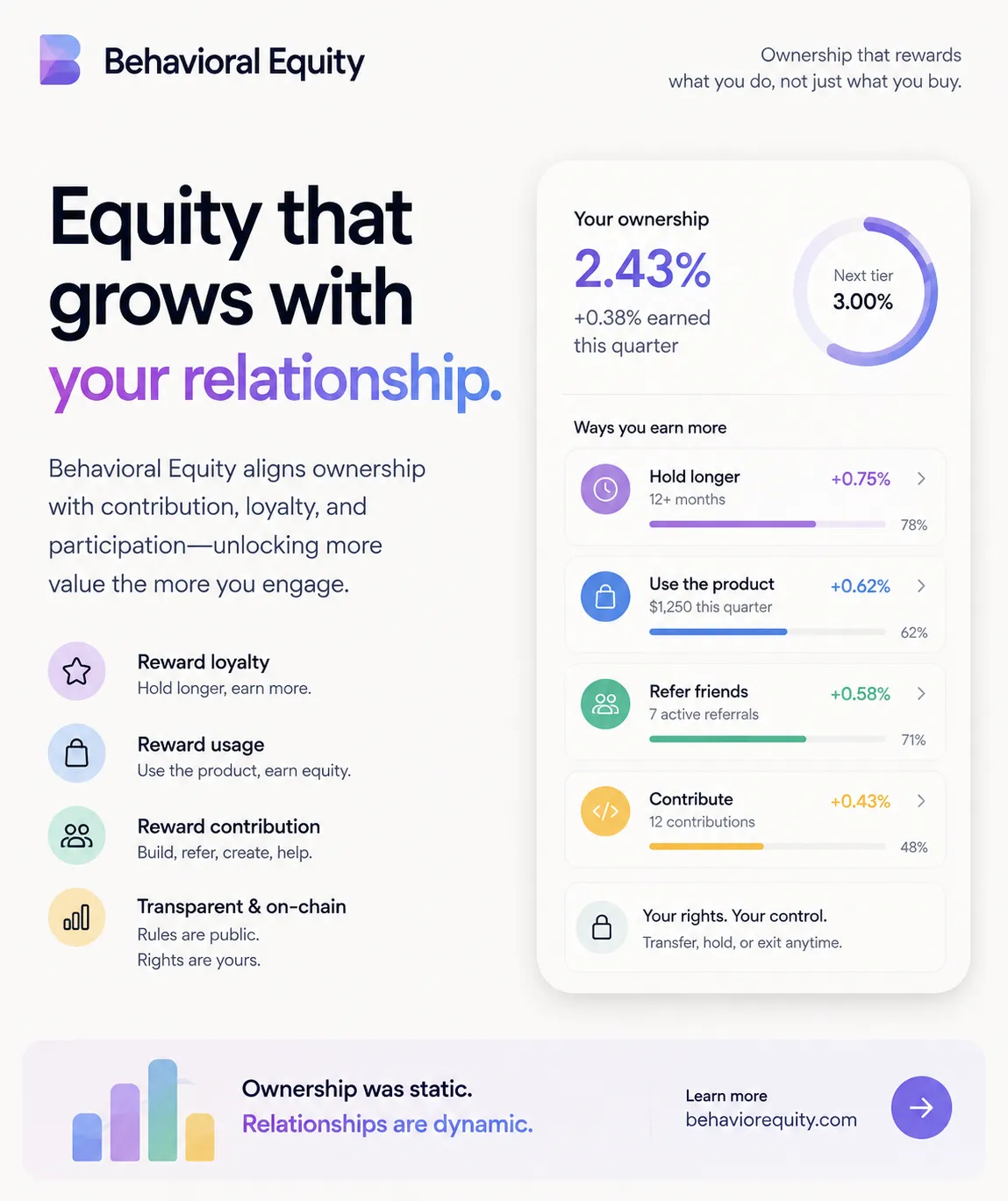
A share currently gives roughly the same rights whether its owner has held it for ten years, buys the company’s products every week or purchased it ten seconds ago. Programmable securities make that design choice optional. Behavioral Equity would let ownership rights evolve with the relationship: long-term holders could earn additional distributions, customers accumulate economic rights through spending and contributors receive governance weight for useful work. Starbucks Rewards gives you stars for loyalty today. A programmable Starbucks share could give you more Starbucks.
Description
No additional description provided.
The Pitch
Behavioral Equity it treats ownership less like a static legal unit and more like a living relationship. Today, companies spend enormous amounts of money trying to manufacture loyalty from customers, patience from shareholders, and commitment from contributors, while the equity layer remains indifferent to all three. A person who buys once, speculates briefly, and disappears is legible to the cap table in a way that a devoted customer often is not. That is a strange mismatch: the people creating the most durable enterprise value are often outside the ownership system entirely.
The deeper business opportunity is not merely “loyalty points, but shares.” Loyalty programs are company liabilities designed to encourage repeat behavior; behavioral equity would be an asset that can compound with the company itself. That changes the psychology. A reward point asks a customer to come back for a discount. A growing ownership claim asks the customer to see their consumption, advocacy, and patience as participation in an institution they partly belong to. For brands with genuine repeat behavior and emotional identity, this could turn customer retention into something closer to civic membership.
It also solves a quiet corporate governance problem: public markets often give the loudest voice to the most liquid capital, not the most aligned capital. If rights can vary based on holding period, usage, or contribution, companies can privilege the stakeholders whose incentives actually match the company’s long-term health. That does not require abandoning markets; it means making markets more expressive. The share stops being a blunt instrument and becomes a rules-based map of different kinds of commitment.
The most interesting companies for this would be those where customers already behave like quasi-owners: consumer brands, marketplaces, creator networks, sports clubs, games, open-source ecosystems, and communities with real economic gravity. In these businesses, the line between user, promoter, contributor, and investor is already blurred; the legal and financial architecture simply has not caught up. Behavioral Equity would give those relationships a native financial form.
If it worked, the company behind it would not just sell software for issuing exotic securities. It would define a new category of corporate design. The prize is a world where ownership can be earned through the behaviors that make an enterprise valuable, rather than only purchased at a moment in time. That is a more precise, and potentially much more powerful, version of capitalism.