Programmable Corporate Budget Allocation Platform
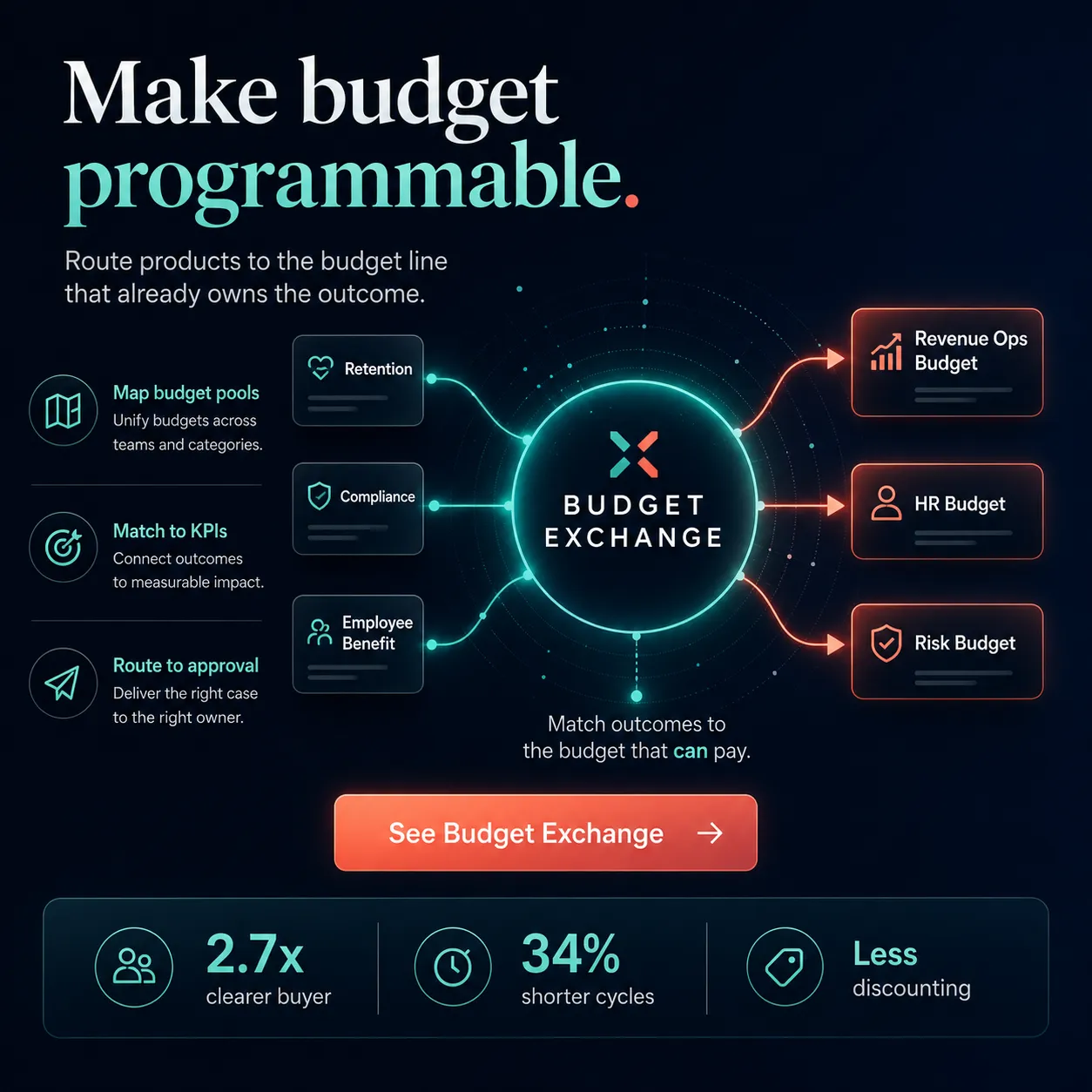
Make corporate budget itself programmable. Vendors describe the outcome they create; companies expose approved budget pools, constraints and KPIs; the network matches products to the budget lines most likely to fund them and can even reallocate discretionary spend when measured outcomes justify it. Why now: software procurement is becoming more data-driven while companies have thousands of fragmented budget lines that rarely move toward the highest-return use. Example: an employee benefit, compliance tool and retention product all compete for separate buyers today; Budget Exchange sees that all three improve the same workforce-risk KPI and routes spend from the budget pool with the strongest economic ownership.
Description
No additional description provided.
The Pitch
Corporate budgets are one of the last large enterprise systems still governed more by org charts than by evidence. Money gets assigned once, defended politically, and then trapped inside departmental containers even after the facts change. The strange result is that a company may know which metric matters, know which vendor improves it, and still be unable to move the relevant dollars without a slow internal negotiation. Turning budget into something that can respond to outcomes would make capital allocation inside a company behave less like annual theater and more like an operating system.
The deeper insight is that many vendors are not actually competing inside the categories they claim to occupy. A compliance product, a benefits product, and a retention product may all be selling to different departments, but economically they may be substitutable claims on the same underlying business risk. Today, procurement treats those purchases as separate because the company’s accounting structure says they are separate. A budget network that maps products to measurable outcomes would reveal the hidden market beneath the org chart: different ways to buy the same improvement.
This also changes the nature of enterprise sales. The hardest part of selling many products is not proving value in the abstract; it is finding the person whose budget can legally and politically recognize that value. Great vendors often die in the gap between the stakeholder who feels the pain and the executive whose line item can pay for the fix. If the system could identify the budget pool with the strongest economic reason to act, it would reduce a huge amount of wasted selling and internal debate. The buyer would no longer need to contort a purchase into the wrong category just because that is where money happens to be available.
The most interesting business here would not merely be a marketplace for software. It would become a memory layer for corporate spending: what was funded, from where, against which constraint, and what happened afterward. Over time, that record becomes difficult to replicate because it captures the causal relationship between spend and internal outcomes across many companies. Procurement systems know what was bought; finance systems know what was budgeted; performance systems know what changed. The valuable company is the one that connects those three facts.
If this existed, the prize would be larger than better vendor discovery. It would let companies notice when their own budget structure is lying to them. That is a rare kind of software: not just a tool for executing decisions, but a mechanism for revealing that the decision rights themselves are misallocated.