Private Betting Pools for Life Milestones
Your friends are already betting on who gets married next. Put money behind it. Wager lets a friend group create a private pool around life's inevitable milestones: next engagement, first kid, first person to move to the suburbs, first divorce if your group is particularly dark. Everyone makes their predictions anonymously, money goes into the pool, and payouts happen as life happens. Fantasy football works because it turns following your friends' favorite sport into a game. This turns following your friends into the sport.
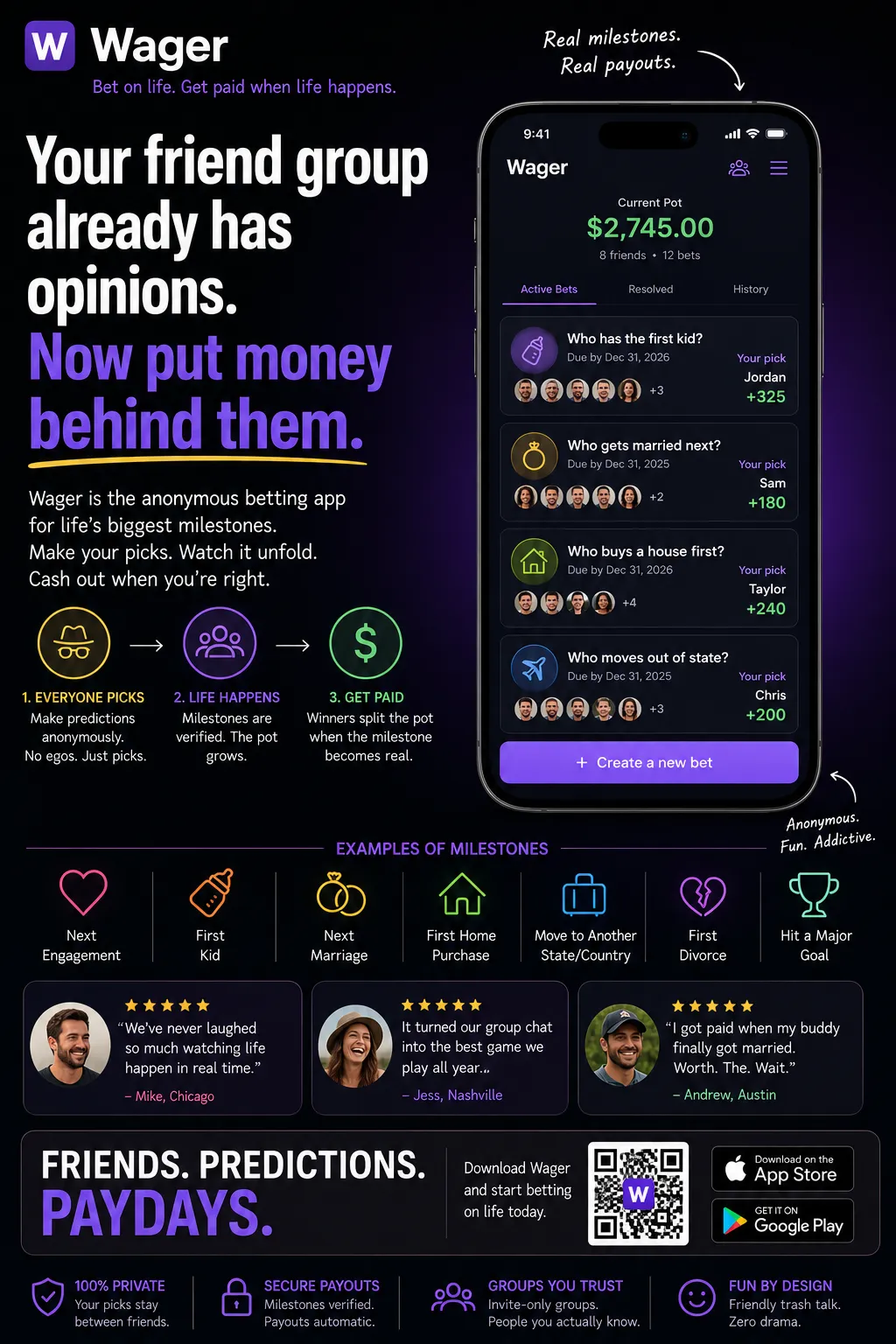
Description
No additional description provided.
The Pitch
Friend groups already maintain an invisible ledger of predictions, gossip, and status changes. People notice who is getting serious with a partner, who is quietly house-hunting, who is burning out at work, who is about to disappear into parenthood. Wager would not create the behavior so much as formalize it, giving shape to a kind of social speculation that already exists but currently lives in group chats, side conversations, and half-joking remarks at dinner.
The interesting part is that the “events” are scarce, emotionally loaded, and naturally recurring over years. Most consumer games need to manufacture stakes; adult life supplies them for free. Engagements, babies, relocations, breakups, career leaps, and midlife reinventions arrive slowly enough to sustain anticipation, but often enough to keep a group returning. The product would be less like a casino and more like a time capsule with odds attached: a record of what everyone thought they knew before life proved them right or wrong.
Anonymity is the key social invention. Public predictions about friends are awkward because they can seem judgmental, cruel, or presumptuous. Anonymous wagering lets the group express what it is already thinking without forcing anyone to own the opinion at the wrong moment. That changes the emotional texture: the fun comes not just from being right, but from discovering that everyone else also had private theories about the same people. The reveal is a social event in itself.
The money matters, but mostly because it makes the prediction feel real. A pool of even modest size turns idle gossip into commitment, and commitment creates memory. Without money, the game is just chatter; with money, a friend saying “I knew it” can be challenged by the record. That record becomes a strangely intimate archive of a group growing older together, tracking not scores or posts, but the milestones that actually define the passage of time.
The durable business is not built on one bet. It is built on the fact that close relationships generate endless soft uncertainty. As people age, their entertainment shifts from meeting strangers to interpreting the lives of people they already know. Wager would be compelling because it treats friendship itself as the feed, and the future as the game board.