Private AI Knowledge Base for Local Communities
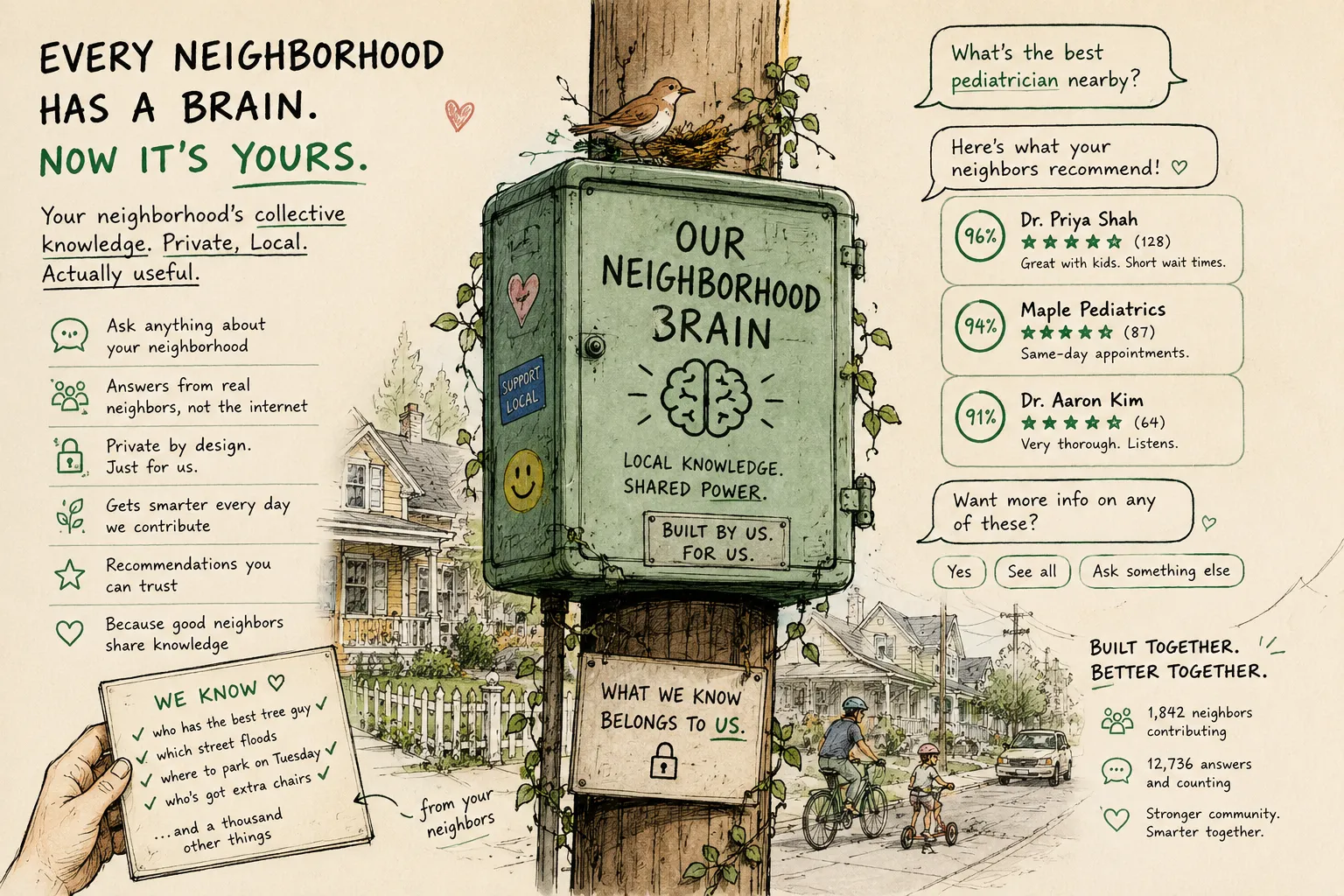
Communities generate incredibly valuable local knowledge—trusted contractors, schools, crime trends, events, neighborhood rules, recommendations, and local history—but that information is scattered across Facebook groups, text messages, and conversations. New residents repeatedly ask the same questions because no shared intelligence exists. This platform gives every neighborhood, apartment building, or town its own private AI trained exclusively on local information contributed by residents. Over time it becomes the definitive source of knowledge for that community while remaining entirely owned by its members. Shared compute and open-source AI models now make it affordable for even small communities to operate sophisticated private intelligence. Imagine moving into a neighborhood and asking one AI who the best plumber is, which streets flood during storms, where kids play after school, or which contractor every resident trusts.
Description
No additional description provided.
The Pitch
Local knowledge is one of the few forms of information where “more accurate” often means “more socially trusted,” not merely more complete. A generic search engine can tell you which plumber has the most reviews; a neighborhood intelligence layer can tell you which plumber quietly fixed three basements after the last flood, which contractor not to hire if your house is prewar, and which recommendation comes from the neighbor who actually knows what they are talking about. That kind of judgment rarely makes it into public databases because it is too contextual, too social, and sometimes too delicate.
The business becomes stronger the longer it exists because the most valuable asset is not the software but the accumulated memory of place. Most consumer apps decay into feeds, arguments, and recency bias; this would improve by turning repeated conversations into durable community knowledge. Every answered question, corrected rumor, vendor experience, policy clarification, and seasonal warning compounds into something hard to recreate from outside. A neighborhood that has used it for three years would have a living institutional memory that a new Facebook group or municipal website could not copy.
There is also an unusual ownership dynamic here: people are more likely to contribute sensitive local knowledge if they believe it is staying within the boundary of the community. The internet trained people to withhold useful detail because platforms collapse audiences together; what you would say to your block, you would not necessarily post to the world. A private AI for a defined place restores the small-room feeling of local conversation while making the knowledge searchable and persistent. That boundary is not a limitation; it is the reason the data can be good.
The wedge is especially interesting because neighborhoods suffer from constant knowledge churn. People move in, longtime residents move out, property managers change, schools redraw lines, local businesses turn over, and informal know-how disappears. The pain is not that answers do not exist; it is that they live in the heads of people who may not be present when needed. A community AI would function like civic memory for places too small or informal to have professional archives.
If it worked, it could become part of the invisible infrastructure of living somewhere. Not another social network demanding attention, but a local layer people consult at moments of uncertainty: before hiring, moving, voting, renovating, enrolling, commuting, or preparing for a storm. That is a rare position for a product—useful precisely because it is grounded in a place, and defensible precisely because every place knows things outsiders cannot.