Private AI Agent Intent Matching Exchange
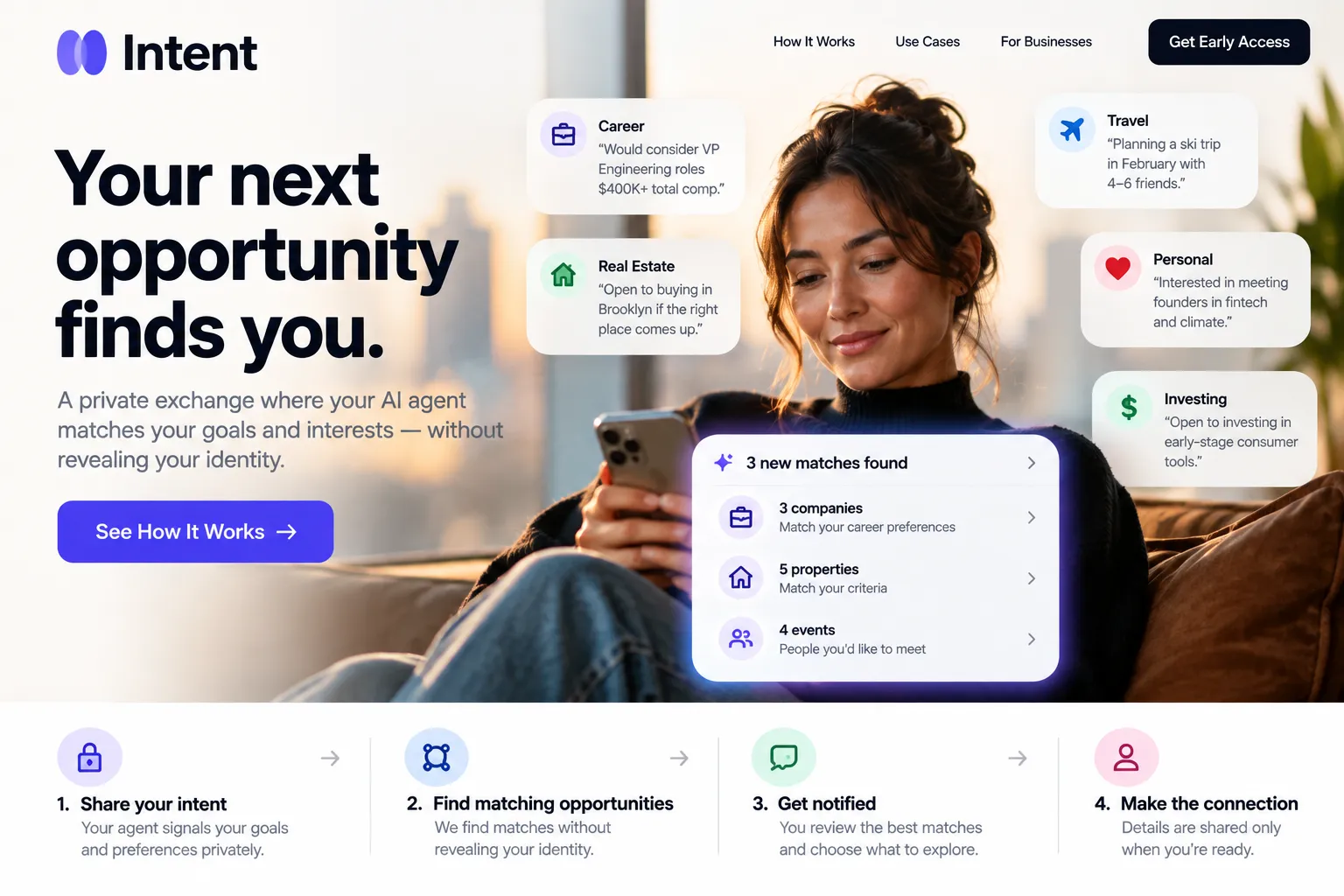
People constantly have things they would do under the right conditions—change jobs, sell a house, buy a car, take a meeting, invest, travel—but most of that intent stays invisible because announcing it publicly creates noise, leverage problems, or awkwardness. Build a private exchange where personal AI agents can match those conditional intentions without revealing who the people are until both sides have enough overlap to make the introduction worthwhile. One agent could quietly signal that its user would consider a VP Engineering role above a certain compensation level while a company’s agent searches for exactly that profile, and the network would surface a match before either side exposes sensitive details. This becomes possible now because personal agents increasingly understand private preferences and can negotiate on a user’s behalf without forcing those preferences into public marketplaces. Imagine discovering that three companies would meet the exact conditions required to make you leave your job even though you never told anyone you were looking. That’s a product that needs to exist.
Description
No additional description provided.
The Pitch
Turn latent intent into usable market liquidity. Many of the highest-value transactions in life never enter a marketplace because the act of listing changes the outcome. A person who says they are open to leaving loses standing at work. A founder who says they would sell weakens their negotiating position. A homeowner who says they might move invites interruption before they are serious. The result is not lack of demand, but demand trapped behind social and strategic risk.
The unusual insight is that privacy is not just a feature here; it is the mechanism that creates supply. Existing marketplaces reward explicitness: post the job, list the house, announce availability, broadcast interest. But in many categories, the best participants are precisely the ones who will not publicly participate. If a system can make it safe to express “under these conditions, maybe,” it does not merely compete with current marketplaces. It expands the market by pulling in people who were previously unreachable.
This would be especially powerful because conditional intent is often more valuable than active intent. Someone actively job hunting may be visible to everyone, but someone happily employed who would move only for a rare combination of role, compensation, location, and team is a scarcer asset. The same pattern applies to acquisition interest, real estate, expert meetings, investment opportunities, and partnerships. The best matches are often between parties who are not searching broadly, but would act quickly if an unusually precise condition were met.
The business also benefits from a structural shift in how trust and disclosure can work online. Traditional platforms ask users to reveal identity first and filter second, which creates spam, embarrassment, and strategic exposure. Agent-mediated matching can reverse that order: compare constraints first, reveal identity later. That makes the exchange feel less like a marketplace and more like a layer of confidential optionality sitting underneath ordinary life.
If it worked, the company would occupy a strange and valuable position: not the place people go when they are ready to transact, but the place that knows what would make them ready. That is a deeper asset than a database of listings. Listings describe the present. Conditional intentions describe the hidden edges where the future could change.