Privacy Scanner for AI Agent Payments
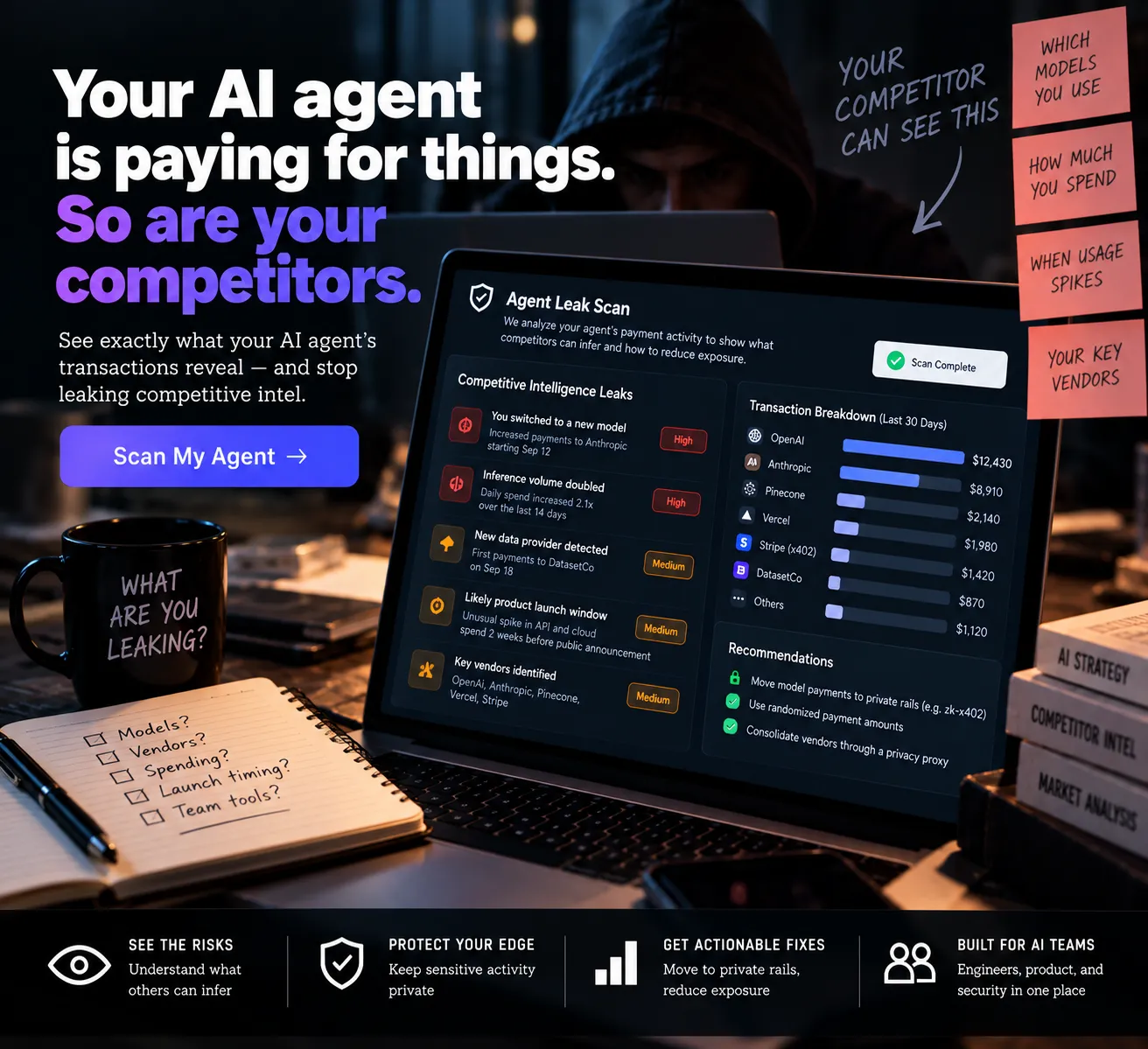
AI agents are starting to pay for APIs, data, software, and services on public payment rails, which means every transaction can quietly reveal how a company operates. Competitors may be able to infer which models you use, which vendors matter most, how much you spend, and when usage spikes before a launch. Build a privacy scanner for agent commerce that reads an agent’s payment activity exactly the way an outsider would, identifies the competitive intelligence being exposed, and recommends which transactions should move onto private rails. This matters now because agent payments are becoming machine-readable by default while companies are only beginning to realize that operational behavior can leak through the payment layer itself. Imagine connecting your AI agent’s wallet and seeing a report that says a competitor could already tell you switched models, doubled inference volume, and started using a new data provider two weeks before launch. That's a product that needs to exist.
Description
No additional description provided.
The Pitch
This treats payments not as finance data, but as operational metadata. Companies already understand that source code, customer lists, and product roadmaps are sensitive. They are much less prepared for the idea that a payment trail can become a behavioral transcript: what was tried, what was abandoned, what suddenly became important, and what is about to ship. As agents start transacting continuously, the payment layer stops being a monthly accounting artifact and becomes a real-time map of intent.
The asymmetry is especially interesting because the leak is hiding in a place companies are culturally trained to ignore. Engineering teams think in terms of API keys, logs, permissions, and network security; finance teams think in terms of reconciliation, controls, and compliance. Almost nobody owns the question of what an outside observer can infer from the pattern of machine-initiated purchases. That gap creates room for a product whose value is not merely detection, but translation: turning a stream of ordinary payments into the competitive story they accidentally tell.
This also becomes more valuable as agent commerce fragments across many small, specialized vendors. A human procurement process tends to compress activity into contracts, approvals, and invoices. Agents, by contrast, may create a dense trail of micro-decisions: querying one data source more often, routing tasks to a different model, testing a niche service, pausing usage after a failed experiment. The more autonomous the buyer, the more revealing the exhaust. What looks like harmless spend granularity to a machine can look like a product roadmap to a rival.
The best version of this company would not sell “privacy” in the abstract. It would sell the ability to see your company from the outside before someone else does. That is a sharper, more uncomfortable promise. Executives may not care about every exposed transaction, but they will care if payment behavior reveals a strategic vendor switch, a new market entry, a model migration, or a sudden surge in demand. The product becomes compelling when it prioritizes the few leaks that actually matter, rather than treating secrecy as a blanket preference.
The deeper thesis is that machine-to-machine commerce will need an observability layer for adversarial inference. Once agents can buy things, the question is no longer just whether the payment succeeded or whether the vendor is approved. It is whether the act of buying changed what the world can know about you. A company that can answer that question becomes part of the security perimeter for an economy where software no longer only communicates through APIs, but through purchases.