Privacy Rule Broadcasting for AI Wearables
Smart glasses, AI wearables, and always-on cameras are making it harder for schools, hospitals, offices, gyms, and other physical spaces to control when people can record, identify faces, or use AI around others. Build a machine-readable privacy layer for the physical world that lets any venue broadcast its rules and automatically tells compliant devices what they are allowed to do. A school could disable recording and face recognition, a hospital could restrict video but allow audio assistance, and a workplace could permit AI tools while blocking external data capture. This matters now because wearable AI is becoming powerful enough that physical spaces will need something more flexible than blanket bans and handwritten policies. Imagine walking into a courtroom and having your glasses automatically switch into a verified privacy mode that proves the camera and face recognition are disabled until you leave. That’s a product that needs to exist.
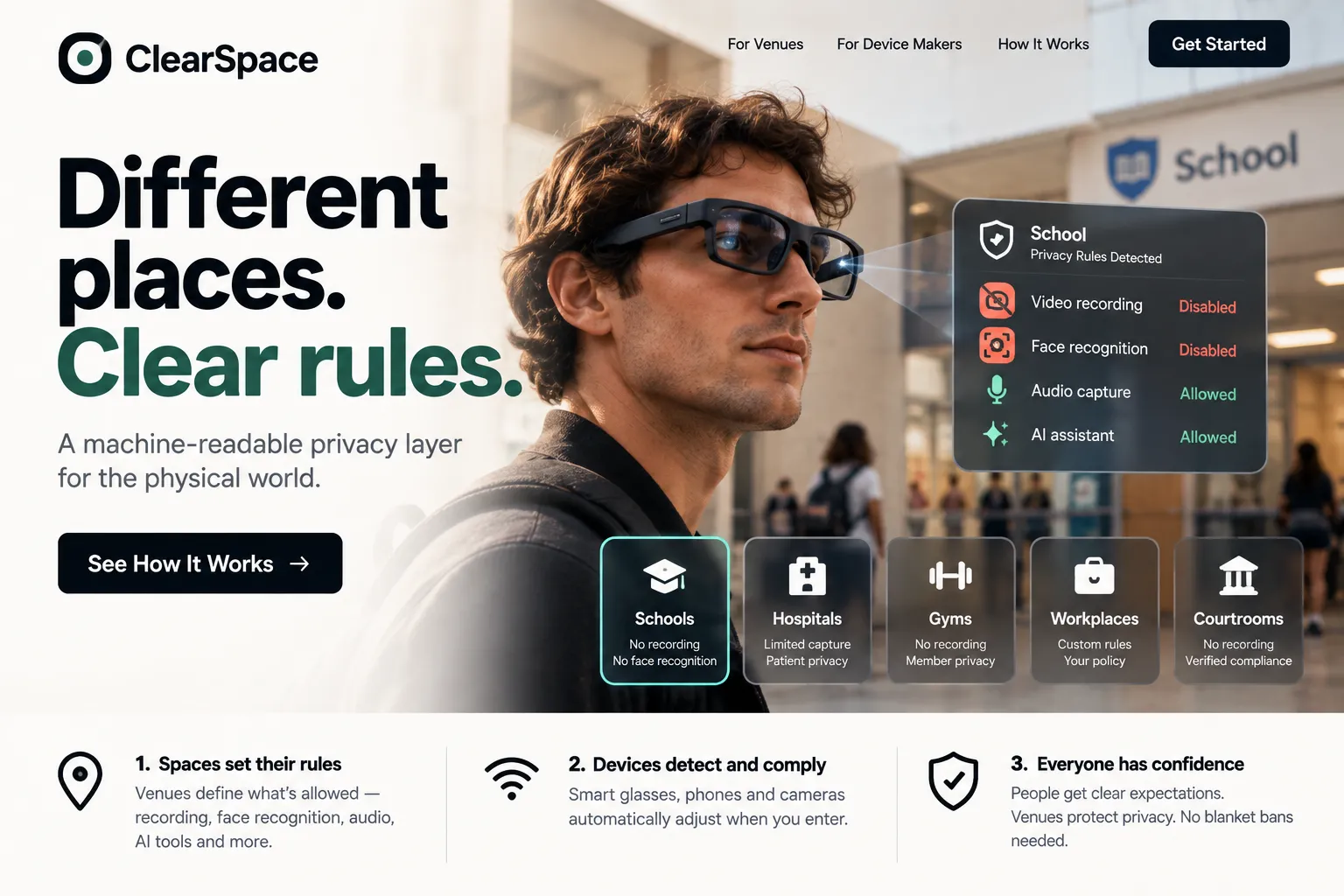
Description
No additional description provided.
The Pitch
Recording rules are becoming too complex to remain social norms. “Don’t take photos here” worked when cameras were visible, intentional, and episodic. It breaks when cameras are worn on faces, microphones are always listening, and software can infer identity, emotion, health, or confidential information from ambient data. The business works because the boundary is no longer between public and private space; it is between permitted and unpermitted computation inside the same room.
Physical venues have always controlled behavior through architecture, signage, staff, and law. But AI wearables create a new category of behavior that is invisible until after the harm occurs. A person can look compliant while their device is transcribing, recognizing faces, or sending data to a cloud model. That makes trust expensive. Schools, hospitals, courts, factories, and offices will not want to inspect every device manually, and device makers will not want every venue inventing its own rules. A common machine-readable layer becomes valuable because it turns an ambiguous social negotiation into an automatic handshake.
The most interesting part is that this is not merely a privacy product; it is a permission system for human environments. The winners in AI hardware will need legitimacy, not just capability. If glasses cannot prove they behave differently in a pediatric ward than in a park, institutions will respond with bans. A standard that lets devices demonstrate restraint could actually expand where AI wearables are allowed. In that sense, the business would sell trust to both sides: venues get enforceable boundaries, and device makers get access to places that would otherwise reject them.
There is also a strong network effect hidden in the physical world. Each additional venue that broadcasts rules gives device makers more reason to comply; each compliant device gives venues more reason to broadcast. Over time, the privacy layer could become part of the ambient infrastructure of buildings, like Wi-Fi or fire codes: unnoticed when working, conspicuous when absent. The company that defines this layer would sit at a powerful intersection of hardware, policy, and liability, because it would translate human expectations into operational constraints machines can understand.
What makes the opportunity durable is that the underlying tension will not go away as devices improve. Better AI makes the problem sharper, not softer. The more useful wearables become, the more society will need fine-grained ways to allow them without surrendering every room to surveillance.