Privacy-Preserving Online Age Verification Passport
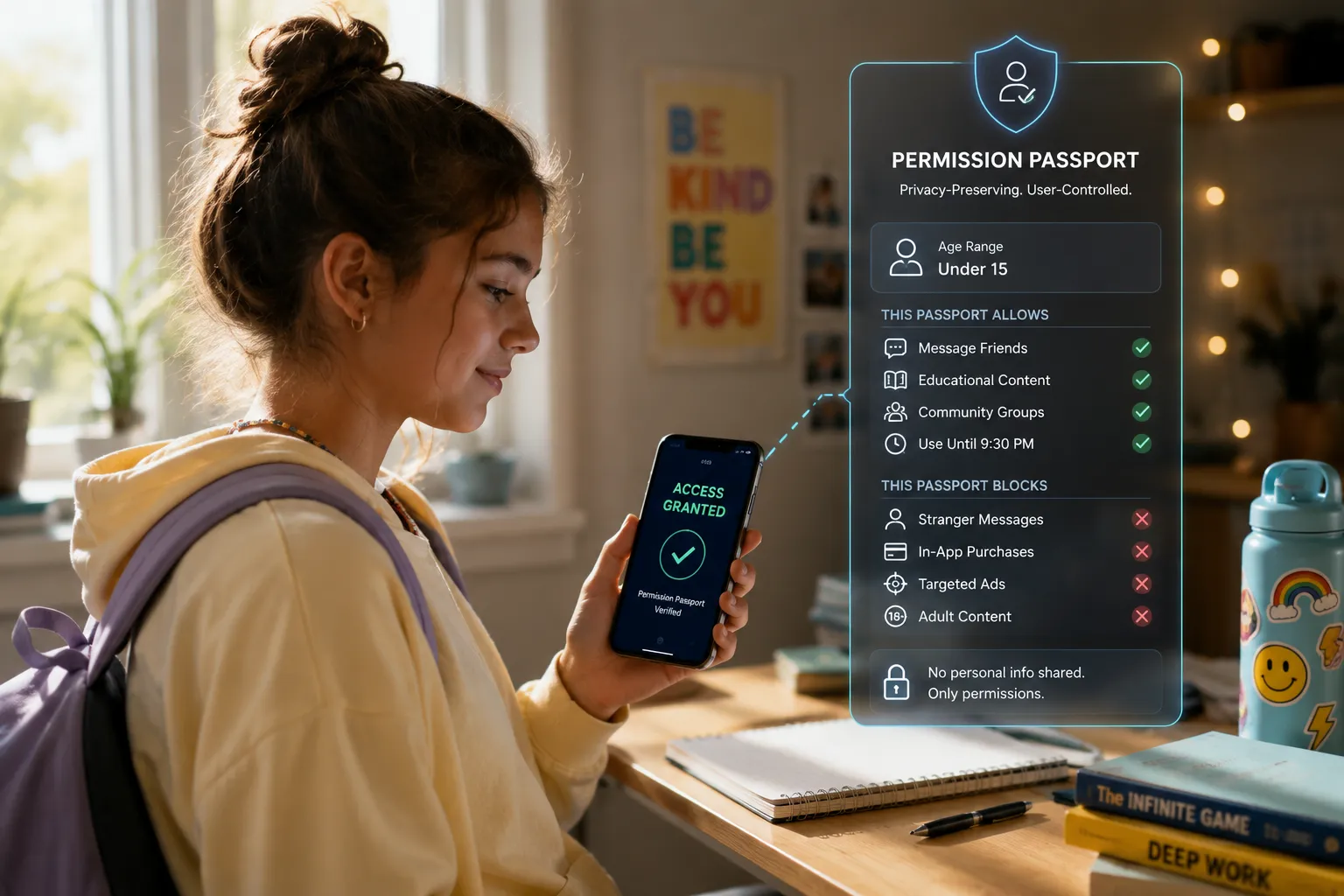
Age-verification laws are forcing websites to determine who is a child, but most current solutions require people to hand over sensitive information such as an ID, face scan, or full date of birth. A startup could create a privacy-preserving permission passport that proves what someone is allowed to do online without revealing who they are. The passport could show that a child is under 15, allowed to message friends but not strangers, blocked from purchases, or limited to certain hours, while eventually expanding to employees, elderly users, and AI agents. This is becoming necessary as governments regulate children’s access to social media and autonomous agents begin acting online on behalf of people and businesses. For example, a teenager could enter a social app using a verified token that unlocks age-appropriate features without the platform ever receiving their name, birthday, or government ID.
Description
No additional description provided.
The Pitch
Most online systems still treat “can this person do X?” as if it requires knowing “who exactly is this person?” That design made sense when trust was scarce and privacy was secondary. But a world of regulated minors, delegated agents, family controls, and compliance-sensitive platforms needs a different primitive: a way to prove authorization without creating another database of personal records.
The strongest wedge is that every participant wants the same uncomfortable thing for different reasons. Regulators want enforceable boundaries. Platforms want to reduce liability without becoming custodians of children’s IDs. Parents want control without surveillance becoming the default bargain. Users want access without surrendering permanent credentials to every site they visit. A permission passport becomes valuable because it solves an adversarial coordination problem: each side distrusts the others, yet all need a shared proof that something is allowed.
The deeper insight is that “age” is often the wrong product. The internet does not really need to know whether someone is 13 years and 8 months old; it needs to know whether they can receive direct messages, see adult content, make purchases, or interact with strangers. Converting identity facts into capability tokens is a more flexible and safer abstraction. It lets rules change by jurisdiction, platform, parent, institution, or context without forcing every website to rebuild its own compliance machinery.
This could also become one of the rare privacy businesses with structural demand rather than moral appeal. Privacy tools usually struggle because the user is the only party motivated to care. Here, platforms and institutions are pushed by law and risk to adopt something better than collecting IDs, while users benefit from less disclosure. The business works because privacy is not a premium feature; it is what makes the compliance system politically and commercially tolerable.
The larger opportunity is that children may simply be the first visible case of a broader shift from accounts to delegated authority. Employees, caregivers, contractors, bots, and AI agents will all need to prove bounded rights online: what they can access, spend, sign, say, or initiate. A company that becomes trusted for permission without identity could sit beneath many categories of digital interaction, not as another login button, but as a neutral layer that answers the internet’s most important operational question: not “who are you?” but “what are you allowed to do?”