Prediction Markets for Consumer Product Demand
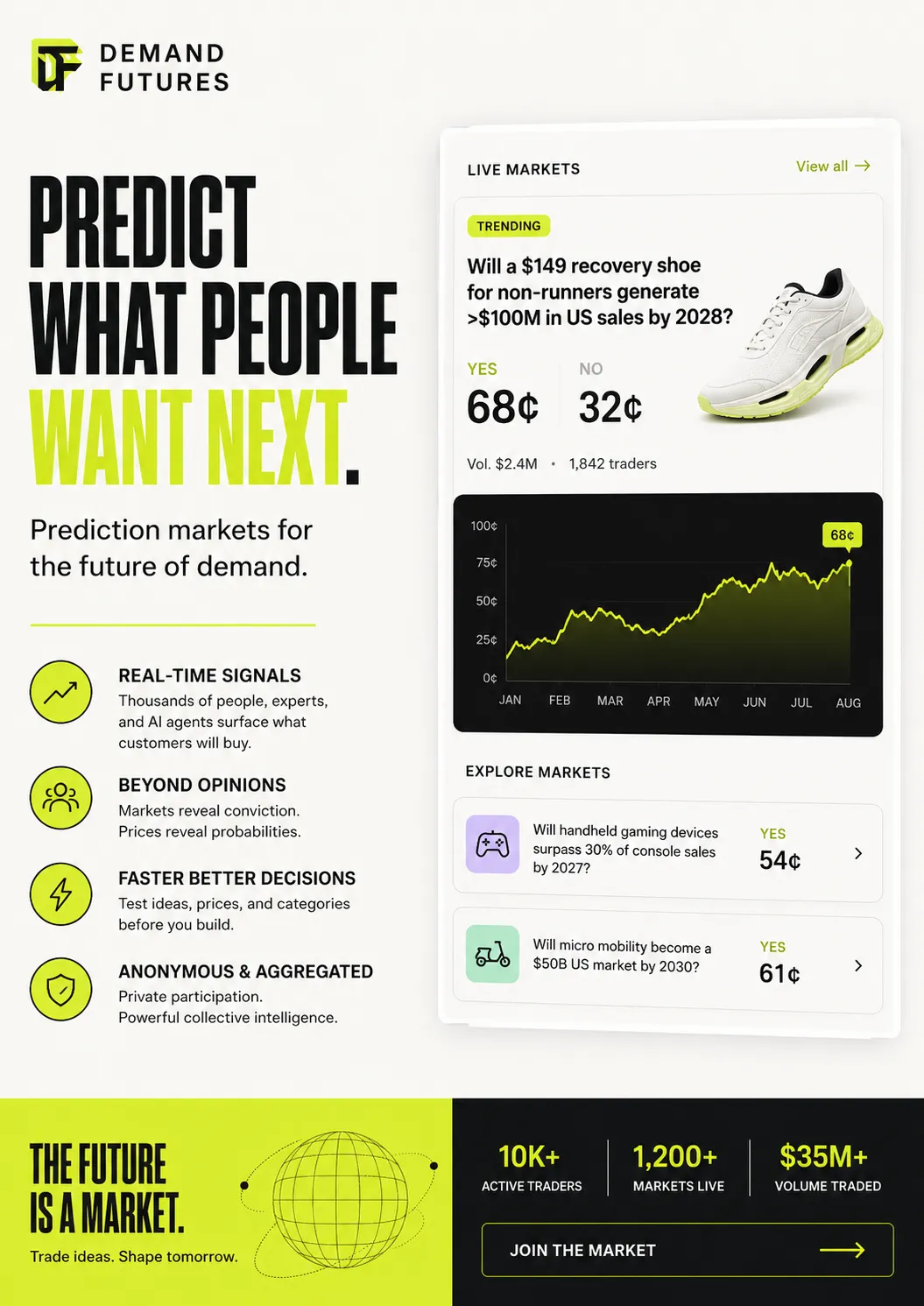
Companies spend billions asking consumers what they want and then discover whether they were right only after building it. Demand Futures would create prediction markets around products, behaviors and categories that don't exist yet, allowing consumers, retailers, creators, experts and AI agents to trade contracts based on what they believe people will actually buy. Nike could ask whether a $149 recovery shoe for non-runners will generate $100 million in US sales, with the market price continuously representing the probability that it will. Prediction markets already aggregate dispersed knowledge remarkably well; AI makes participating and evaluating thousands of tiny markets dramatically easier. Instead of another consumer survey saying 63% of people are interested, a company could see what people are willing to bet on.
Description
No additional description provided.
The Pitch
The most valuable information in consumer markets is not what people like, but what they will later be embarrassed not to have seen coming. Most research captures stated preference at a frozen moment; the better signal is a living price that moves as culture, distribution, competitors, influencers, and macro conditions change. The market would not just answer “is this a good idea?” It would show when an idea becomes good, when it stops being good, and which assumptions are quietly carrying the forecast.
The deeper opportunity is that many people already possess fragments of demand intelligence, but today there is no clean way to monetize being right early. A sneaker reseller may understand colorway momentum better than a brand manager. A physical therapist may see a latent recovery trend before apparel companies do. A TikTok creator may know which aesthetic is peaking before retail data notices. Prediction markets turn these scattered hunches into an organized sensor network, where conviction has to compete with other people’s conviction instead of hiding inside comments, decks, or focus groups.
This could also change how companies treat uncertainty. Most large organizations do not lack opinions; they lack a mechanism for letting strong outside evidence survive internal politics. A market price is harder to massage than a survey summary and less deferential than a senior executive’s instinct. Its usefulness is not that it is always right, but that it creates a shared, revisable estimate that can be watched over time. That is especially valuable for product decisions, where the costliest mistakes often come from locking in a belief too early and then spending months defending it.
AI makes the idea more interesting because it can create liquidity where human attention alone would be too scarce. Agents could monitor public data, parse earnings calls, track social signals, compare analog products, and participate in narrow contracts that no human would bother to follow manually. That turns the market from a few headline bets into a dense map of commercial possibility. The output is not merely prediction; it is a constantly updating model of demand formation.
If it worked, the company would sit in an unusual position: not as a research vendor, but as a new layer of market memory. It would accumulate records of what people believed before outcomes were obvious, who was consistently right, and which signals mattered. Over time, that history may become more valuable than any single forecast.