Prediction Markets for AI Scarcity Risk
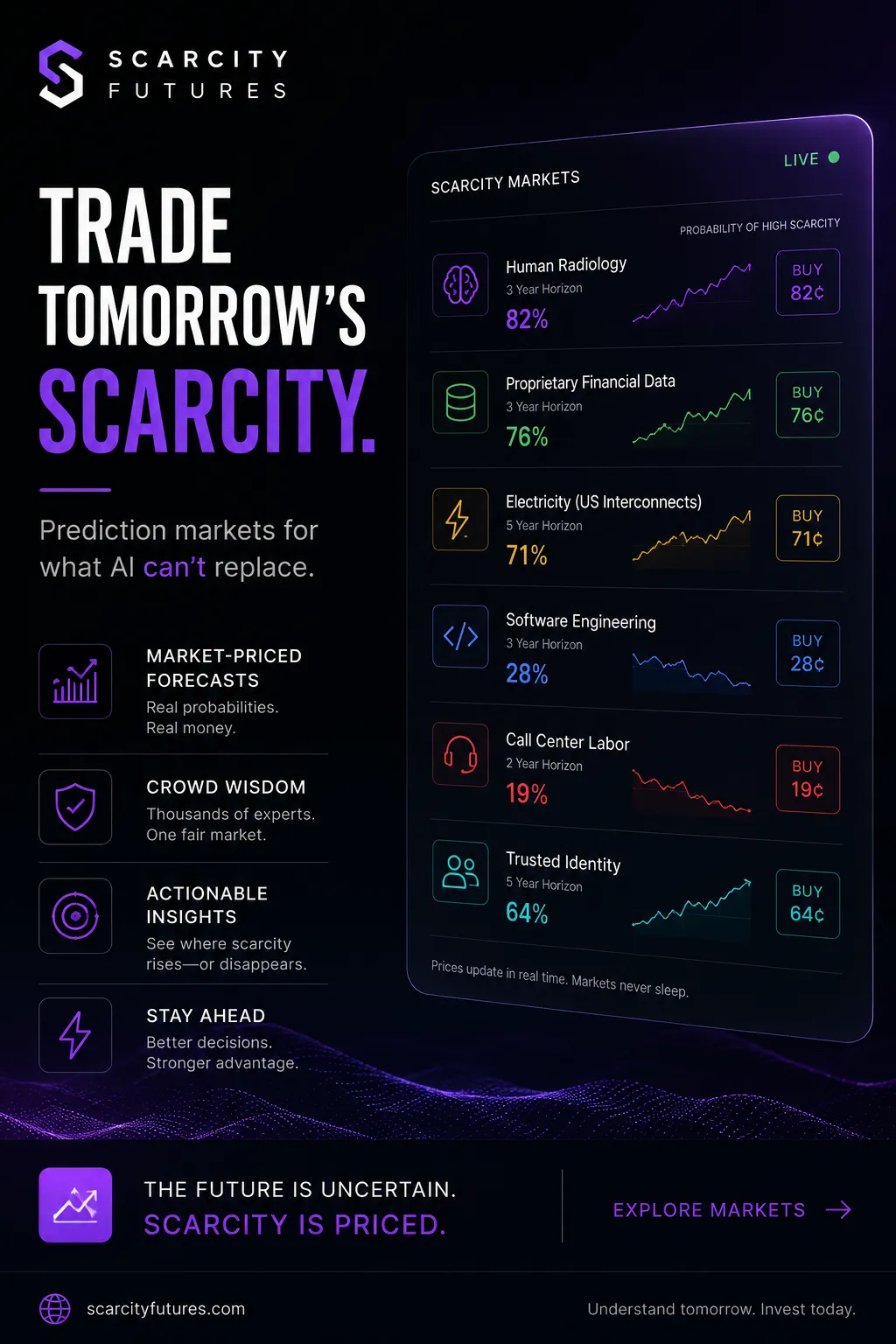
Everyone can see what AI can do today; businesses have a much harder time determining what will still be scarce three years from now. Scarcity Futures would create prediction markets around the future economic scarcity of capabilities and assets: human translation, radiology interpretation, proprietary financial data, warehouse space, trusted identity, electricity interconnects, celebrity likeness, software engineering, distribution relationships, etc. Participants trade contracts representing whether the economic value of a scarce resource will rise or collapse as AI progresses, producing continuously updated market-implied forecasts. A PE firm considering a call-center acquisition could see that the market assigns a 78% probability that its core human capability loses most scarcity value within 36 months. Rather than another AI disruption score, Scarcity Futures would let capital markets put a price on what AI cannot commoditize yet.
Description
No additional description provided.
The Pitch
AI does not just change productivity; it changes the map of scarcity. Most companies are still asking whether a task can be automated, but the more valuable question is whether the thing they own will remain difficult to obtain. A business built around pricing future scarcity would become useful because it reframes AI risk in economic rather than technical terms. The issue is not whether a model can perform legal research, write code, or read scans. It is whether the market will still pay a premium for people, datasets, licenses, relationships, infrastructure, or trust once those capabilities are easier to reproduce.
Prediction markets are especially well suited to this because AI disruption is full of confident narratives and weak timing. The same asset can be “obviously doomed” and still generate cash for a decade, or look defensible until a model release destroys its pricing power overnight. A traded market forces disagreement into a number. That number may be imperfect, but it is far more useful than an expert memo because it updates when incentives, evidence, and surprise enter the system. In a world where the half-life of strategic assumptions is shrinking, the refresh rate of belief becomes a product.
The business would also matter because scarcity is often hidden inside balance sheets. A company may think it owns a service operation, a media library, a clinical workflow, or a logistics footprint, when what it really owns is a temporary bottleneck. Once that bottleneck is named and priced, capital can move more intelligently. Some assets become melting ice cubes; others become more valuable precisely because AI increases demand for them. Electricity access, verified human identity, proprietary rights, physical locations, and trusted distribution may become more scarce, not less, as synthetic abundance spreads.
The deepest appeal is that this could become a new kind of financial weather report for the AI economy. Not a forecast of which model wins, but a market view of which forms of advantage survive commoditization. That is valuable because nearly every major business decision is, beneath the surface, a bet on future scarcity. Acquisitions, hiring plans, licensing deals, outsourcing contracts, real estate commitments, and data partnerships all depend on assumptions about what will remain expensive. Scarcity Futures would make those assumptions visible, tradable, and therefore harder to ignore.