Prediction Market Resolution Rule Testing Platform
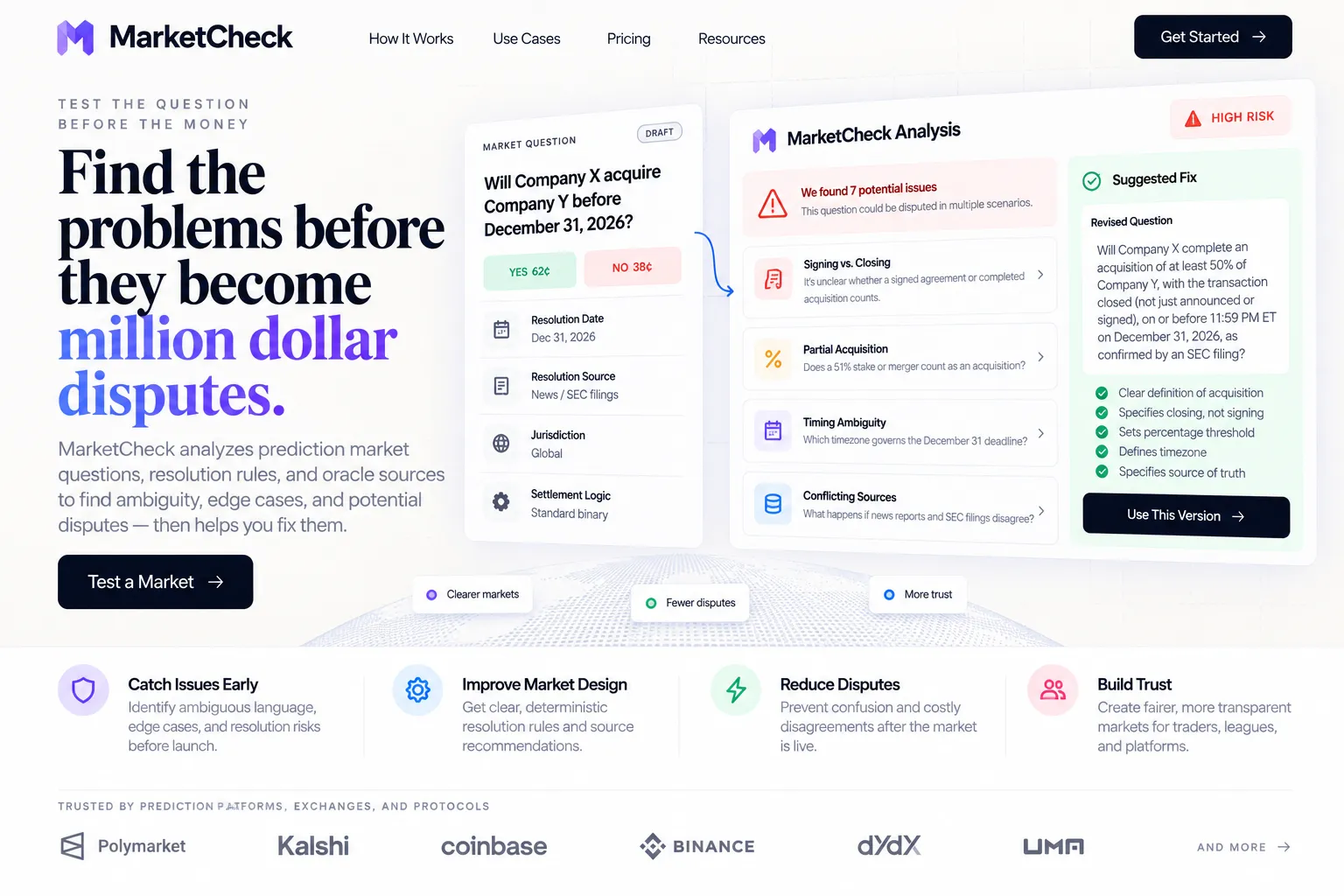
Prediction markets can settle millions of dollars on questions that sound clear until an unexpected edge case makes the outcome ambiguous. Build a testing layer that attacks every market before it launches, searching for conflicting definitions, unclear deadlines, source disagreements, jurisdiction issues, and scenarios where reasonable people could reach different answers, then rewrites the resolution rules until the outcome becomes deterministic. This matters more as prediction markets expand into increasingly complex questions and use multiple oracle and settlement systems, because better infrastructure does not fix a badly specified contract. Imagine a market asking whether one company will acquire another by year-end and the system immediately flagging whether signing or closing counts, what happens with a partial acquisition, which source governs, and what timezone controls the deadline. That's a product that needs to exist.
Description
No additional description provided.
The Pitch
This reduces a hidden form of counterparty risk. In a prediction market, ambiguity is a tax that only becomes visible at the worst possible moment: after money, reputation, and incentives are already attached to a question. The more valuable the market, the more valuable it becomes to litigate the meaning of a phrase. A system that finds these failure modes before launch turns resolution quality from an artisanal judgment call into a form of pre-trade risk control.
The non-obvious insight is that market creators are often too close to the question to see how it can break. They know what they meant, which makes them bad adversaries for their own language. The best tester would behave less like a copy editor and more like a maliciously literal lawyer with a database of past disputes: if “acquisition” can mean signing, closing, asset purchase, merger, tender offer, regulatory approval, or majority control, then the market was never one question. It was several possible contracts accidentally sharing a sentence.
This becomes more important as prediction markets move from novelty questions into domains where reality is messy: politics, corporate events, courts, science, geopolitics, sports governance, public health, crypto protocols. These are not just harder topics; they are topics where the authoritative source may itself revise, conflict, delay, or define terms differently from participants. The business works because complexity does not scale linearly with market volume. As platforms list more questions, the number of ways those questions can fail grows faster than human review capacity.
A good ambiguity layer could become trusted infrastructure precisely because it sits before anyone has a financial interest in the answer. Once a dispute exists, every participant reads the rules through their position. Before launch, neutrality is cheaper. The product’s value is not only fewer catastrophic settlements, but more confidence that markets can be created around consequential questions without turning every close call into a governance crisis.
The most durable version of this company would accumulate a proprietary memory of ambiguity itself. Every challenged resolution, every source conflict, every phrasing exploit, and every strange edge case becomes training material for the next market. Over time, it would not merely detect vague rules; it would encode the common law of how reality escapes language. That is a rare kind of infrastructure business: the more the world argues about outcomes, the better the system gets at preventing arguments before they are worth having.