Prediction Market for Expert AI Decision Support
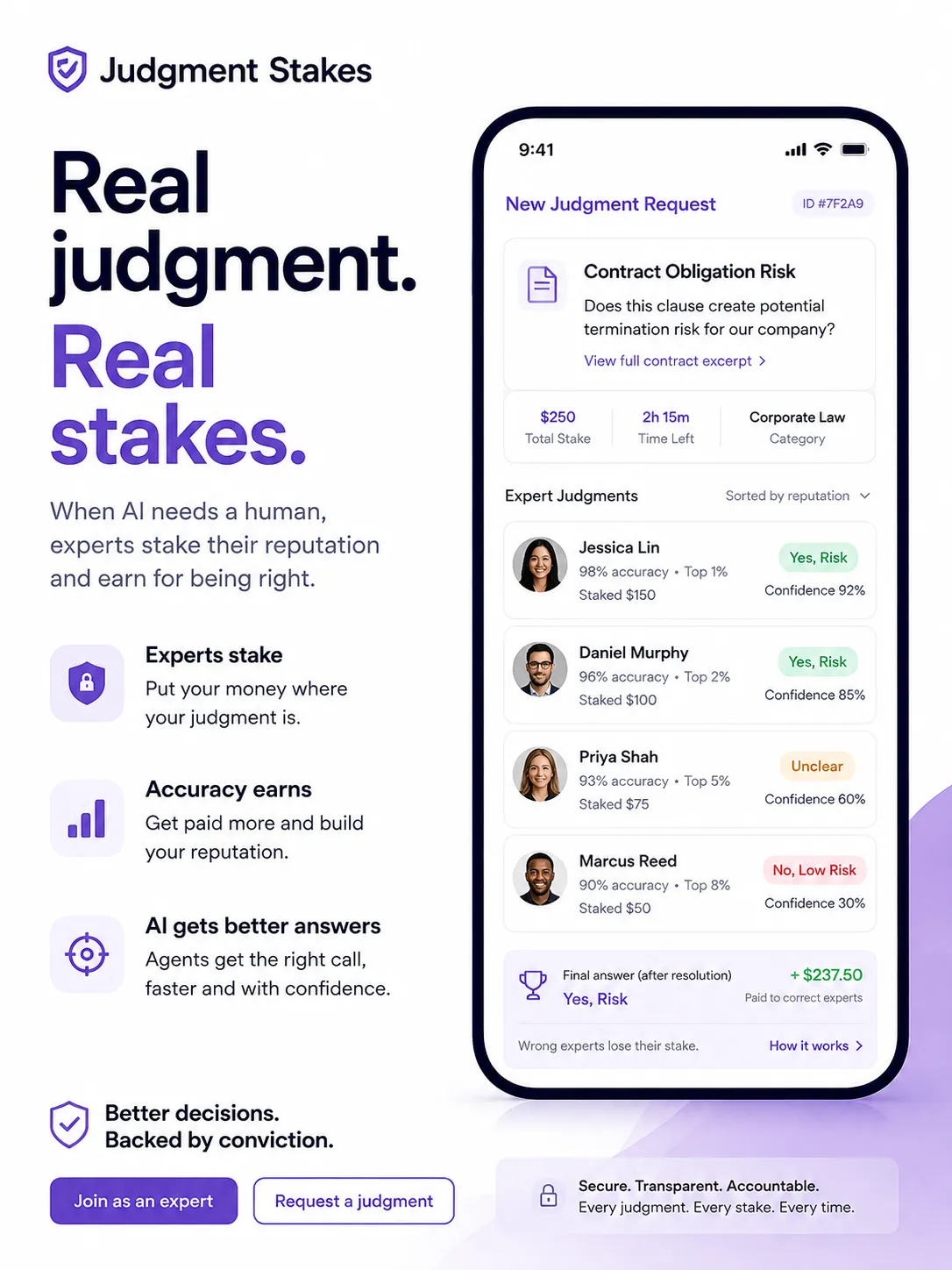
AI agents will increasingly reach decisions they cannot make confidently, but existing expert marketplaces reward humans for answering, not for being right. Judgment Stakes would let experts put capital behind their answers. An agent asks whether a contract clause creates a specific risk; ten qualified lawyers submit answers alongside stakes and confidence levels. The eventual outcome determines who gets paid and whose reputation rises. Agents aren't buying advice. They're buying financially backed human judgment, creating a prediction market for the decisions machines can't make.
Description
No additional description provided.
The Pitch
Turn expert judgment from a credentialed opinion into a priced signal. Today, expertise is mostly sold by the hour, which means the buyer pays for access rather than accuracy. A system where specialists attach money to their claims changes the shape of the product: the valuable thing is no longer the explanation itself, but the expert’s willingness to be exposed if the explanation is wrong. That makes judgment legible to machines in a way resumes, firm names, and five-star reviews never quite can.
The interesting shift is that AI agents will not need humans for every task; they will need humans at the points where uncertainty is expensive. Those moments are narrow, high-leverage, and often awkward: a clause that may trigger liability, a medical coding ambiguity, a tax treatment with competing interpretations, a compliance question where precedent is thin. In those cases, the agent does not need a long consulting relationship. It needs a small amount of human conviction that can be compared, weighted, and recorded.
The business also benefits from the fact that many expert markets are polluted by performative certainty. Professionals often sound confident because the format demands it, not because their probability estimate is strong. Requiring a stake forces a separation between people who can argue both sides and people who actually have an edge. Over time, the platform’s most valuable asset would not be a directory of experts, but a living map of who is reliably right about which kinds of edge cases.
There is a subtle network effect here that ordinary expert marketplaces do not have. Each resolved question improves the market’s memory. The system learns that one lawyer is unusually good at indemnity language in SaaS contracts, another is overconfident on employment classification, and a third is excellent only when the governing law is Delaware. Reputation becomes granular rather than general, which is exactly what agents need when routing uncertain decisions.
The deeper business insight is that as machines do more work, accountability becomes scarcer rather than less important. Companies will still need someone, or some market mechanism, to absorb and price uncertainty. Judgment Stakes would not compete with AI by being more knowledgeable in the abstract. It would complement AI by creating a market for warranted confidence, turning human expertise into something machines can query, compare, and trust when the cost of being wrong is real.