Portfolio AI Governance and Benchmarking Platform
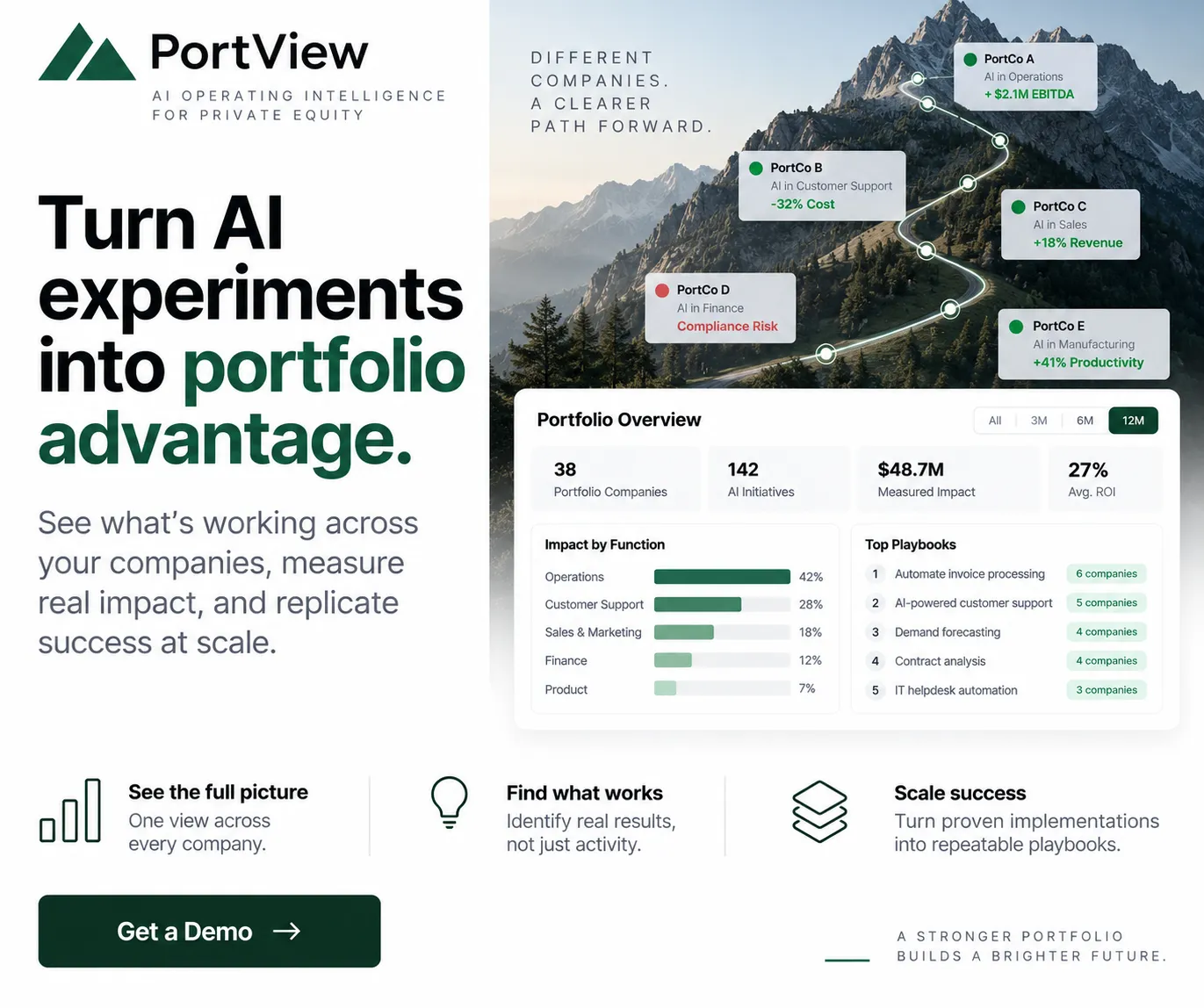
A private equity firm may own 30 or 40 companies, and every one of them will end up with its own mix of AI tools, agents, policies and experiments. The sponsor does not need to operate those systems directly, but it does need to know what is working, what is risky and what should be copied elsewhere. Build the portfolio-level intelligence layer for AI. Each company reports what agents it runs, what data they touch, what they cost, what value they create and what incidents occur. The system normalizes that information, identifies which implementations actually produce results and turns successful deployments into reusable playbooks for similar companies across the portfolio. The real advantage is not better reporting. It is giving one owner a way to learn across dozens of companies faster than any single company could on its own.
Description
No additional description provided.
The Pitch
A private equity portfolio is one of the few environments where AI learning can compound across companies without needing to merge the companies themselves. Each portfolio company experiences AI as a local experiment: a customer service bot here, a finance reconciliation agent there, a sales research workflow somewhere else. In isolation, most of these efforts are too small, messy or context-specific to become institutional knowledge. But across 30 or 40 companies, patterns start to emerge. The valuable asset is not any one agent; it is the ability to recognize when a use case that looks anecdotal in one company is actually repeatable in ten.
The sponsor sits in a strange but powerful position. It has enough authority to ask for visibility, enough economic interest to care about outcomes, and enough distance from day-to-day operations to compare companies without being trapped by their internal politics. Individual management teams may overestimate the brilliance of their own experiments or hide failures that make them look imprudent. A portfolio-level system creates a more honest memory: what was tried, what worked, what broke, what was abandoned, and what quietly became indispensable.
AI adoption also creates a new kind of operational risk that traditional board reporting is poorly equipped to see. The danger is not only a catastrophic incident; it is hundreds of small, ungoverned automations becoming embedded in workflows no one fully understands. In a portfolio, the same risk can appear repeatedly under different names. A sponsor that can spot these patterns early does not merely prevent downside; it can define what “responsible AI use” looks like in practical, operational terms rather than policy language.
The most interesting economic insight is that AI playbooks become more valuable when they are owned by someone who sees many similar businesses. A middle-market manufacturer may never become expert at AI-driven procurement analytics on its own. But if its owner has seen five adjacent companies attempt it, the sixth company starts from a different baseline. This turns AI from a bespoke technology project into a transferable operating capability.
If such a business existed, it would become the memory and comparison engine for a new form of ownership. Private equity has long claimed to create value by professionalizing operations. AI gives that claim a sharper test: can the owner learn faster than the assets it owns?