Portable Interest Graph for Fans
The internet knows who you follow, what you click, and what an algorithm thinks you like, but there’s no single place to explicitly say what you’re actually a fan of. Your favorite books, movies, musicians, creators, teams, brands, organizations, and people are scattered across dozens of platforms. Someone should build a true interest graph: a portable profile of everything a person genuinely cares about, where you can find other fans, get credit for discovering something early, and let creators build direct relationships with their biggest supporters. The timing feels right because AI is making identity and personalization much more useful, while creators and consumers are both increasingly aware of how little they actually own on the platforms where these relationships live.
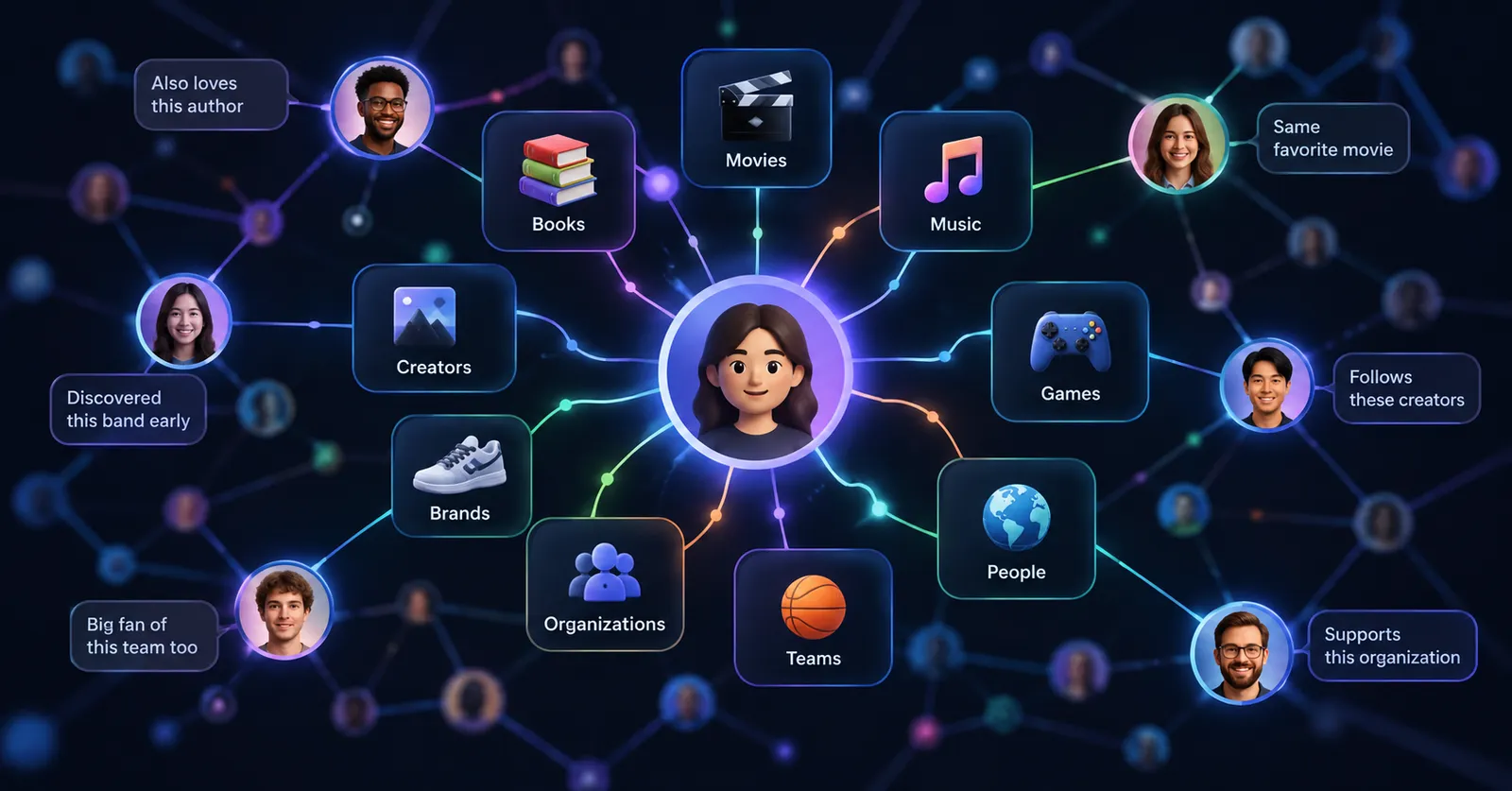
Description
No additional description provided.
The Pitch
a true interest graph would capture taste at the level people actually experience it: not as content consumption, but as affiliation. Following an account is cheap, watching a video is noisy, and clicking something may only mean boredom. But saying “this is one of my things” is a different kind of signal. It is closer to identity than behavior. That makes it valuable because it separates passing attention from durable attachment.
The internet has spent decades making popularity visible, but it is still surprisingly bad at remembering who cared first. Early fandom is socially valuable, but today it mostly disappears into old comments, ticket stubs, playlists, Discord servers, and private group chats. A system that preserves the history of enthusiasm could make discovery itself legible. The person who loved an author before the bestseller, backed a musician before the tour, or followed a founder before the company became famous has a kind of cultural credit that current platforms rarely recognize.
This would also change the balance between creators and platforms. Creators do not just need “audiences”; they need to know the difference between casual reach and real devotion. A million views can be less valuable than a thousand people who have made a creator part of their identity. If those relationships were portable and explicit, creators could stop treating each platform as a landlord and start treating fandom as an asset that persists across formats, algorithms, and eras.
For consumers, the deeper value is not recommendations in the usual sense. It is self-knowledge made social. People use taste to find friends, signal values, remember phases of life, and explain themselves to others. Yet there is no canonical map of a person’s enthusiasms, even though those enthusiasms often say more about them than a résumé or social feed. A well-designed interest graph would become a living autobiography of attention: not what you were served, but what you chose to keep.
The business works if it becomes the neutral layer beneath many cultural markets rather than another destination competing for attention. Books, music, sports, creators, games, causes, and brands all depend on the same hidden structure: people forming attachments and wanting those attachments recognized. Whoever owns that explicit map of affinity could become important not by manufacturing culture, but by making fandom portable, searchable, and durable.