Policy Compliance Controls for AI Agents
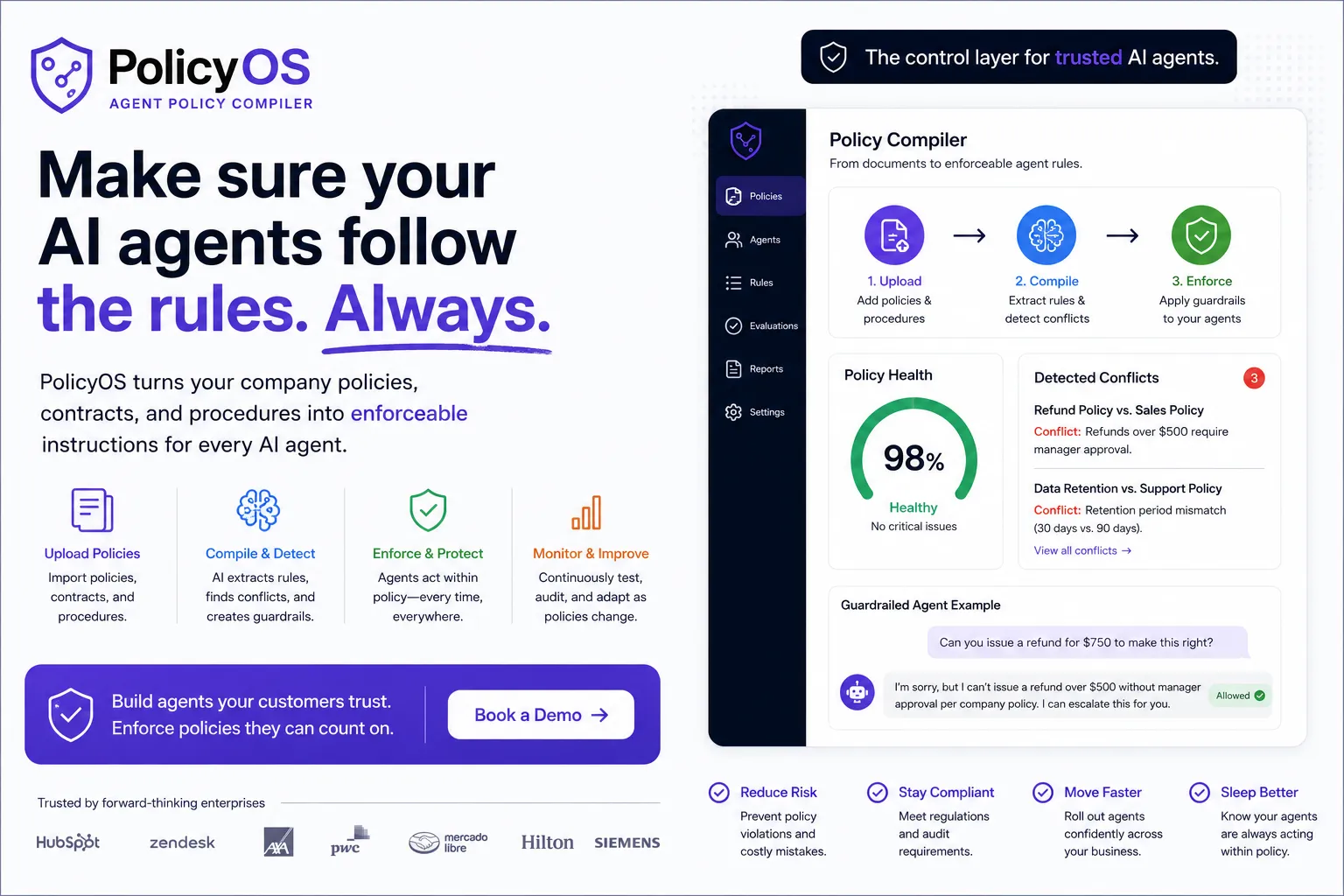
A platform that turns a company’s policies, contracts, compliance rules, and operating procedures into enforceable instructions for AI agents. Instead of manually configuring thousands of prompts and permissions, teams could upload documents such as refund policies, approval limits, data-handling requirements, and escalation rules. The system would translate them into machine-readable controls, flag contradictions, and stop agents from taking actions that violate company policy. As businesses deploy more AI workers, they will need a dedicated layer that determines not just what agents can do, but what they are actually allowed to do.
Description
No additional description provided.
The Pitch
AI agents will not fail only because they hallucinate; they will fail because they act correctly in the wrong institutional context. A refund agent might understand the customer’s request perfectly and still violate a regional policy, contractual obligation, approval threshold, or regulated workflow. As software shifts from displaying information to taking action, the scarce asset becomes not intelligence but authority: knowing which actions are permitted, under what conditions, and by whom.
Most companies already have the answers, but they are trapped in documents written for humans rather than systems. Policies, contracts, compliance manuals, and operating procedures are effectively the source code of the business, but today they are enforced through training, memory, meetings, and after-the-fact audits. That worked when humans were the execution layer. It breaks when thousands of AI-driven decisions happen instantly, continuously, and across departments. The business opportunity is to turn institutional intent into operational guardrails before automation outruns governance.
This becomes especially valuable because agent behavior will be too dynamic for traditional software permissions. Old access control answers the question, “Can this user access this system?” Agent control has to answer, “Is this specific action allowed in this specific context, given the customer, jurisdiction, contract, dollar amount, data type, and current policy?” That is a much richer and more fragile problem. The company that owns this layer becomes a kind of policy interpreter for the automated enterprise: not the brain of the agent, but its conscience and legal memory.
The strongest version of this business is not merely defensive. Once policies are machine-readable, a company can see where its own rules conflict, where approvals are unnecessarily slow, where exceptions are common, and where different departments are operating under incompatible assumptions. The same system that prevents an AI agent from making an unauthorized refund can reveal that the refund policy itself is ambiguous, outdated, or impossible to apply consistently. Compliance stops being a static archive and becomes a living operating system.
If AI agents become common inside companies, every enterprise will need a trusted boundary between autonomous action and organizational permission. The company that provides that boundary could become deeply embedded because it sits at the intersection of automation, risk, and institutional memory. It would not just help companies use AI; it would help them remain themselves as more of their work is delegated to machines.