Policy Compiler for AI Compliance Enforcement
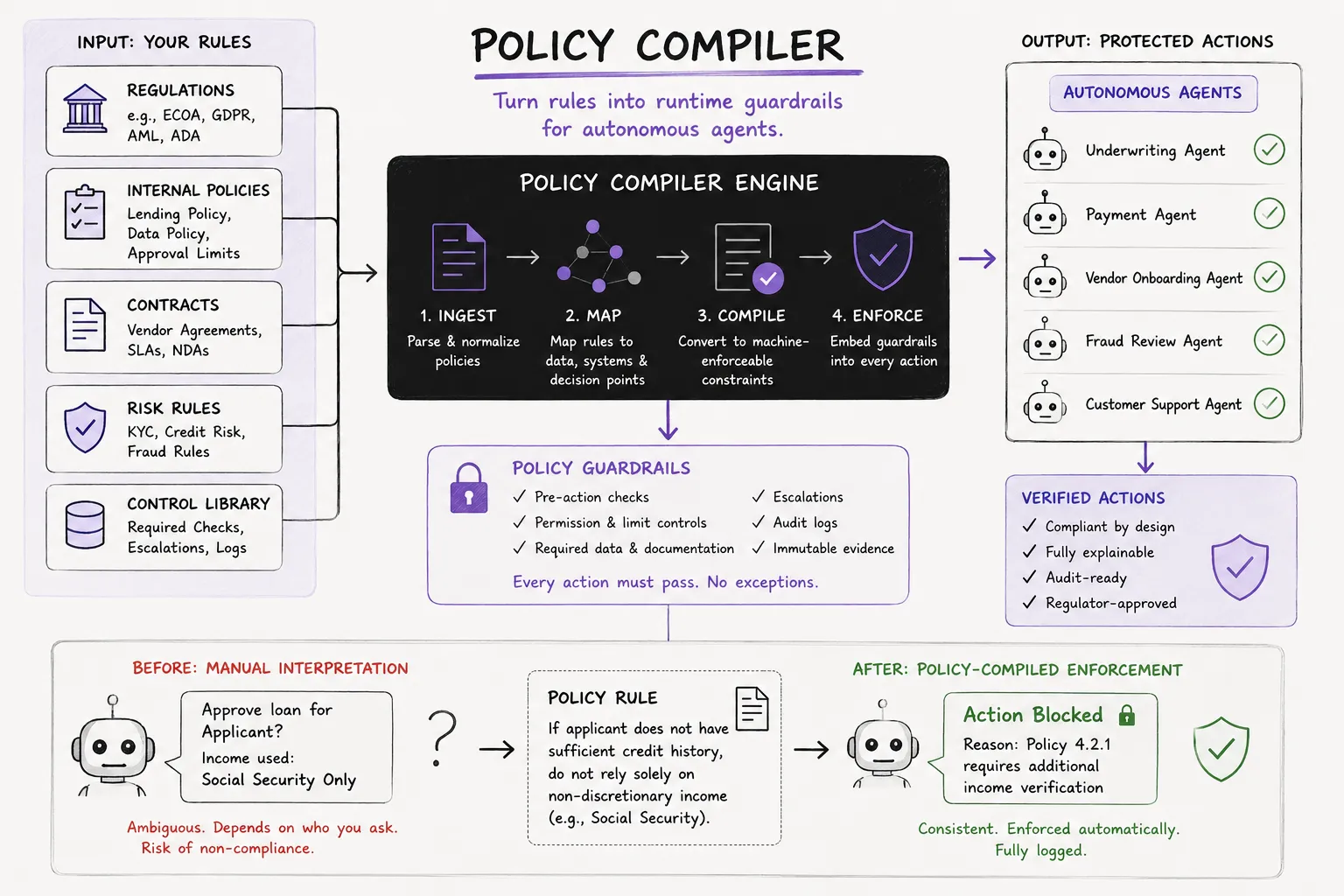
Companies maintain thousands of pages of policies, regulations, and internal rules describing what employees and systems are supposed to do, but those documents sit separately from the software carrying out the work. Policy Compiler would ingest those rules and convert them into machine-enforceable constraints that every AI agent must satisfy before an action can execute. As regulated businesses delegate more work to autonomous systems, compliance can move from something checked afterward to something embedded directly into execution. A bank could upload its lending policy and regulations, and every underwriting agent would automatically inherit required checks, prohibited data sources, escalation thresholds, and approval limits.
Description
No additional description provided.
The Pitch
The valuable shift is not turning policy documents into summaries; it is turning them into operating boundaries. Most companies already know what the rules are supposed to be, but the rules live in prose while the work happens in software. The gap between those two worlds is currently filled by training, audits, approvals, and after-the-fact investigations. A company that can make written policy executable changes compliance from an organizational memory problem into an infrastructure layer.
The business becomes especially compelling because AI agents make the old model break down. Human employees can be trained, supervised, and blamed; autonomous systems act at machine speed, across many workflows, often without a single obvious decision-maker. That makes “we reviewed the process quarterly” feel inadequate. If agents are going to perform credit decisions, procurement approvals, claims handling, customer remediation, or HR actions, enterprises will need a way to prove that each action was constrained before it happened, not merely explain why it happened later.
The non-obvious wedge is that policies are among the most valuable unstructured assets inside large organizations. They encode years of legal interpretation, operational scars, regulator feedback, risk appetite, and institutional judgment. Today, that knowledge is trapped in PDFs, wikis, and control matrices. If it can be compiled into reusable constraints, the company gains a living control system: every policy update can propagate instantly into the systems that matter, rather than waiting for product teams, compliance teams, and vendors to reinterpret it manually.
This could also become a rare product that both compliance teams and engineering teams want for different reasons. Compliance gets consistency, evidence, and fewer surprises. Engineering gets clear machine-readable requirements instead of ambiguous documents and slow review cycles. The product’s power is that it reduces discretion where discretion is dangerous, while preserving it where human judgment is actually needed.
Over time, the defensibility would come from translation quality and trust. The hardest part is not parsing text; it is knowing which sentence is binding, which exception overrides which rule, and how a regulator or internal auditor would expect the rule to behave in a real edge case. A system that learns those interpretations across policies, workflows, and audits would become more than a compliance tool. It would become the layer where an institution’s rules, risk tolerance, and software behavior finally meet.