Platform for Personalized Gene Therapy Development
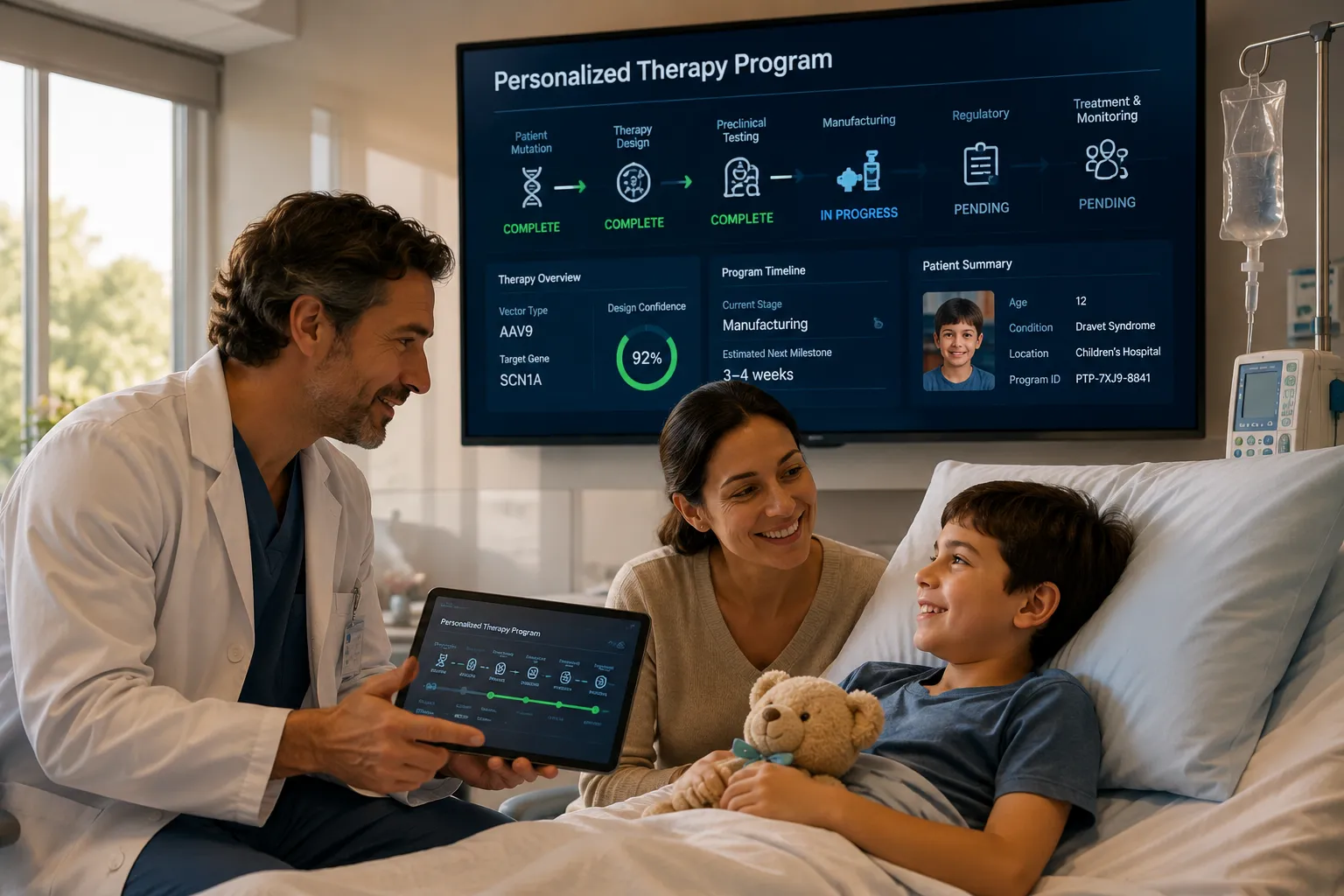
Personalized gene therapies can now be designed around a single patient’s exact genetic mutation, but creating each treatment still requires hospitals and researchers to rebuild the same manufacturing, testing, regulatory, and funding process from scratch. A startup could build the infrastructure platform for one-patient medicines, allowing a hospital to upload a patient’s mutation and coordinate therapy design, safety testing, manufacturing, regulatory submissions, financing, and long-term monitoring in one place. This is becoming possible as AI improves biological design, manufacturing becomes more modular, and regulators begin considering platform-based approaches to individualized treatments. For example, instead of a children’s hospital spending years assembling a custom therapy for one teenager with a rare form of epilepsy, it could use the platform to move from diagnosis to a treatment-ready program in a fraction of the time.
Description
No additional description provided.
The Pitch
One-patient medicine is not actually a one-patient market. The mutation may be unique, but the work around it is highly repetitive: documentation, assay selection, vector choice, toxicology logic, manufacturing release criteria, consent, reimbursement evidence, and post-treatment monitoring. The hidden opportunity is to recognize that the medicine is bespoke, while the operating system around the medicine can be standardized.
The strongest version of this company would not be selling “cures” so much as compressing institutional uncertainty. Today, a hospital facing an ultra-rare case is not only asking whether a therapy can be designed; it is asking who has done something similar before, what the regulator will accept, which manufacturer has capacity, how to price an intervention with no market, and how to defend the decision ethically. The platform becomes valuable because it turns rare cases from isolated improvisations into comparable precedents. Each patient makes the next patient less unprecedented.
The business also benefits from an unusual data advantage. Most medical data platforms aggregate patients with the same disease; this one would aggregate workflows across different diseases that share technical patterns. A splice mutation in one condition, a silencing approach in another, and an AAV manufacturing run in a third may all inform the next case. That means the company’s knowledge base compounds across biology, regulation, and operations even when patient populations remain tiny. In rare disease, where no single indication is large enough to support normal drug development economics, cross-disease learning is the market.
Hospitals are likely to need a neutral layer because none of the existing players is naturally positioned to own the whole process. Academic centers have trust and patients but lack repeatable infrastructure. Manufacturers have capability but not clinical context. Pharmaceutical companies are optimized for populations, not single genomes. Payers need evidence but cannot generate it. A platform that coordinates these actors can become the place where responsibility is organized, which is often the scarce resource in frontier medicine.
If this works, its importance is not merely that it makes custom therapies faster. It changes the default assumption about what counts as treatable. Many mutations today are ignored not because biology offers no path, but because the system cannot justify assembling an entire drug company around one person. The business is compelling because it makes the smallest possible market—the individual patient—economically legible.