Physical World Demand Intelligence Platform
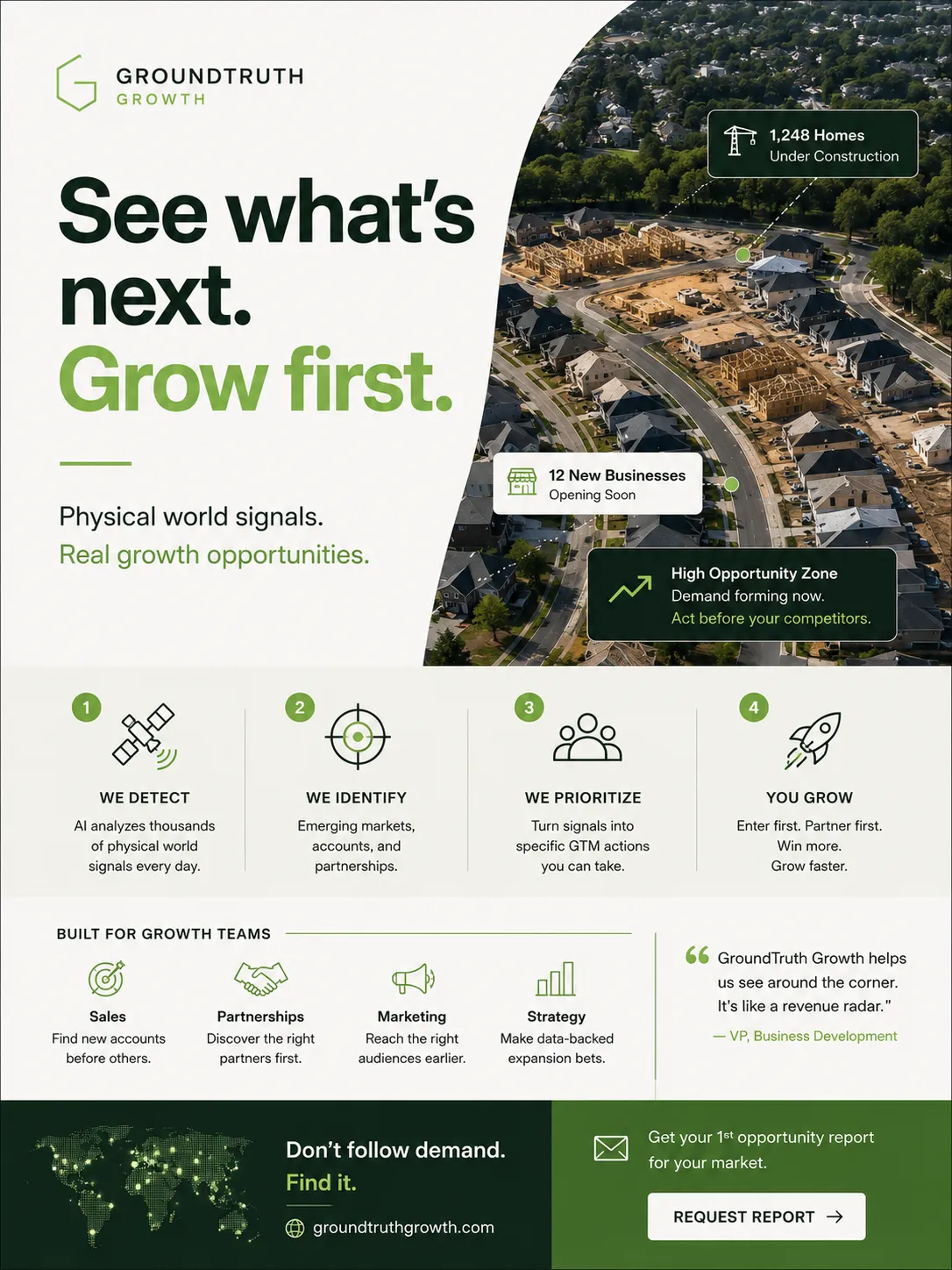
Companies trying to find their next customers or markets still rely heavily on signals generated after demand already exists: searches, purchases, CRM activity, surveys and historical demographic data. GroundTruth Growth finds demand before it becomes conventional consumer data by watching the physical world for changes that create new commercial opportunities. It combines satellite imagery, permits, construction records, business openings, property data and other public signals, then translates them into specific markets, accounts, partnerships and audiences a company should pursue. AI makes it possible to continuously connect those fragmented signals and determine which physical changes matter commercially. A home-security company could discover 4,200 homes nearing completion across 37 developments, identify the builders, HOAs and property managers controlling access to those future residents, and start signing distribution partnerships months before anyone living there searches for a security system.
Description
No additional description provided.
The Pitch
Physical change is often the earliest honest expression of future demand. A subdivision being graded, a warehouse being permitted, a clinic expanding, or a restaurant cluster forming are not opinions or intent signals; they are capital commitments. Money has already been spent, approvals have been obtained, and behavior will have to reorganize around the new reality. Most companies only notice once that reorganization shows up as web traffic or sales data, which means the most valuable window has already narrowed.
This business would matter because it turns geography into a living lead source. Traditional market data is usually organized around people as they are currently categorized: income bands, age groups, purchase histories, household composition. But many commercial opportunities are created by places in transition, not static populations. A neighborhood where 600 homes are about to be occupied is more actionable than a zip code with attractive demographics. A corridor adding cold-storage facilities says something different from one adding medical offices. The unit of insight is not “who is likely to buy,” but “what is about to become true here?”
The strongest customers would not be buying more data; they would be buying timing. In many categories, being early changes the economics of acquisition. If a company reaches the builder, property manager, franchisor, clinic operator, municipal buyer, or regional distributor before competitors see consumer demand, it can shape the channel rather than bid for attention later. The advantage is not merely knowing that demand will exist, but knowing who controls the chokepoints before the end customer appears.
There is also a useful asymmetry in the source material. Permits, parcels, zoning decisions, satellite changes, licenses, and openings are public or semi-public, but commercially illegible in isolation. Their value is trapped in fragmentation. The company that consistently interprets them across markets builds a map of cause and consequence: which construction patterns lead to which purchases, which openings pull which vendors, which land-use changes precede which local needs. Over time, the product becomes less about detecting events and more about understanding the commercial physics of places.
The deeper idea is that the internet made intent visible, but only after people expressed it digitally. A huge amount of demand is still born offline, through concrete, asphalt, leases, roofs, roads, and regulatory filings. A company that reads those signals well would give businesses a way to compete in the months before a market has a name, a search volume, or a customer list.