Physical World Anomaly Detection Platform
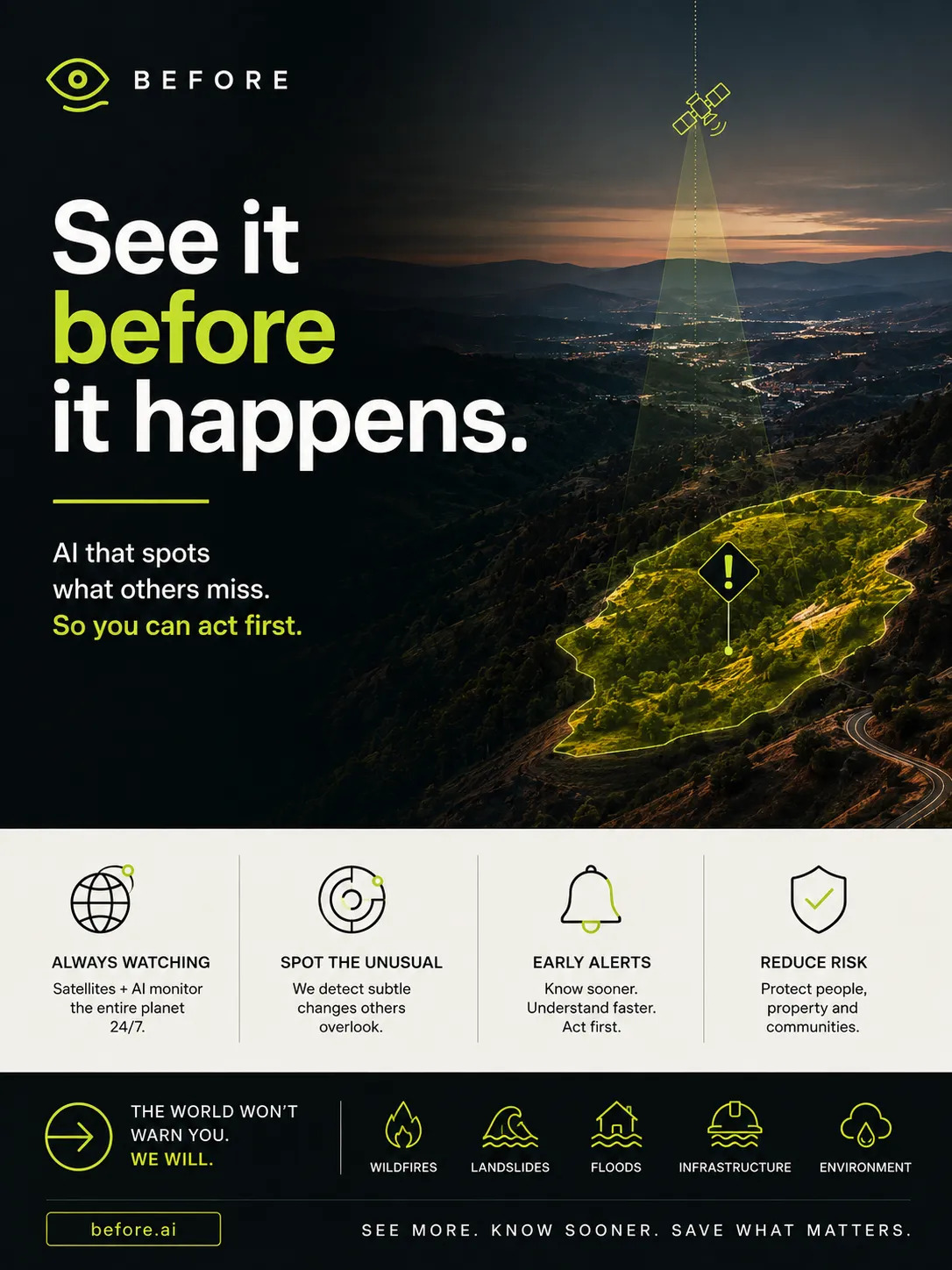
After every major disaster comes the same question: Could somebody have seen this coming? Build a company whose only job is continuously searching the physical world for conditions that are becoming abnormal before anyone has defined exactly what they’re looking for. Instead of training models to identify known events like fires, the system learns what millions of locations normally look like and flags meaningful deviations. Cheap observation plus multimodal AI makes anomaly detection across enormous geographic areas newly feasible. A hillside slowly changes shape for nine months; nobody asked software to look for a landslide, but Before notices that this patch of Earth is behaving differently and alerts the municipality. Google Earth showed us the world. Before tells us when the world starts acting strange.
Description
No additional description provided.
The Pitch
Most physical risk is not hidden; it is merely unasked-about. Institutions are organized around named threats: wildfire, flood, structural failure, illegal dumping, crop disease. But reality often deteriorates in ways that do not yet have a label. The valuable shift is from looking for events to looking for surprise. That makes the system useful precisely in the awkward interval when something is visibly changing but not yet legible as a crisis.
The business would sit on top of a strange asymmetry: the world is now observed far more often than it is interpreted. Satellites, drones, traffic cameras, weather stations, phones, industrial sensors, and public imagery produce a continuous exhaust of physical evidence, but most of it becomes scenery. The bottleneck is no longer whether an image exists; it is whether anyone is paid to notice that one bend in one river, one roofline, one slope, or one road shoulder has begun to drift from its own history. Turning overlooked imagery into a warning layer is a much higher-value use of existing observation networks than simply selling more maps.
The most interesting customers would not buy this because they trust predictions; they would buy it because they cannot tolerate not knowing. Cities, insurers, utilities, ports, rail operators, and large landowners all live with distributed assets that fail locally and expensively. Their problem is not a lack of dashboards, but that dashboards usually summarize what is already measured. A system that says “this place no longer resembles itself” creates a new category of operational attention, one that can justify inspection, maintenance, or insurance action before there is a headline.
Its defensibility would come from accumulating a memory of normality. The more locations the system observes, the more it learns the difference between seasonal variation, harmless change, human activity, sensor noise, and truly strange behavior. That dataset would be difficult to reproduce because it is not just imagery; it is longitudinal context tied to outcomes. Over time, the company would know not only what abnormality looks like, but which abnormalities matter.
The deeper appeal is that it changes disaster response from a calendar of incidents into a nervous system for the built and natural world. Modern society has become excellent at measuring damage after it happens. A company that makes pre-disaster ambiguity visible would be selling something rarer than information: earlier permission to act.