Personal Homepage for Connected App Activity
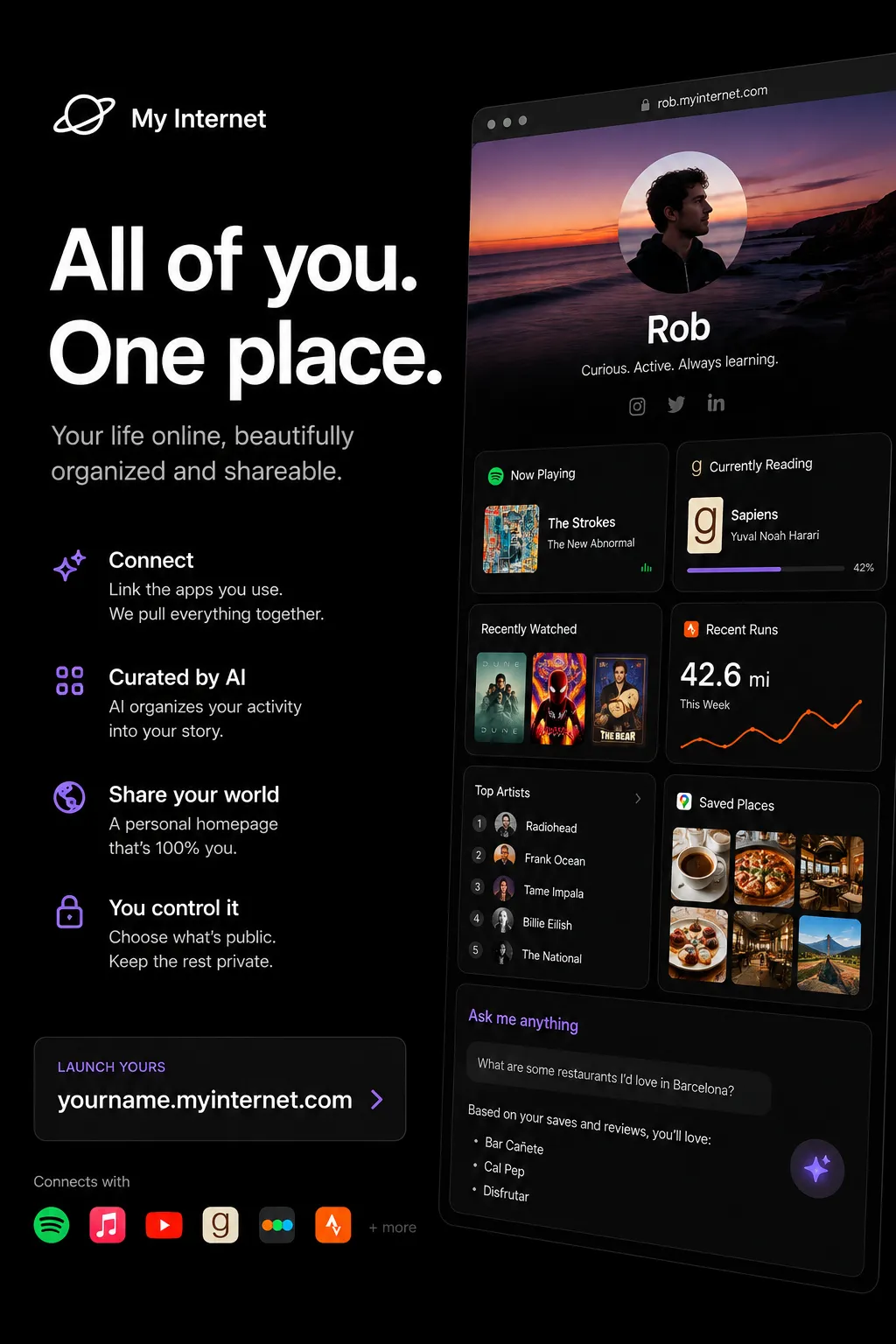
Your taste is scattered across Spotify, Goodreads, Letterboxd, Strava, YouTube, newsletters, saved places, and dozens of other apps, leaving no single place that feels like you online. Build a personal homepage that connects those accounts and automatically turns your activity into a living profile. AI can organize everything you choose to share while APIs make the first version possible to build without recreating the underlying services. Someone visiting your page could see what you are listening to, reading, watching, recommending, and doing lately, then ask your personal AI for something like “What restaurant does Rob recommend in Barcelona?” Charge $8 a month for custom domains, integrations, themes, analytics, and AI. About 10,500 paying users creates a $1 million-a-year business while quietly building the portable identity layer for something much bigger.
Description
No additional description provided.
The Pitch
Start from a simple truth: people already curate themselves, but the evidence is trapped in apps built for consumption, not identity. Spotify knows your music taste, Letterboxd knows your film taste, Strava knows your routines, Goodreads knows your reading life, but none of them are trying to help you become legible as a whole person. The interesting company is not another social network; it is a mirror that assembles the residue of a life already being lived online.
The non-obvious value is that taste has become a more useful identity signal than a résumé or bio. What someone reads, saves, replays, visits, and recommends often says more about them than what they claim to be interested in. A profile built from behavior rather than self-description would feel more alive and more trustworthy, especially for creative professionals, founders, writers, curators, and anyone whose reputation depends on judgment. The product works because it transforms passive digital exhaust into a coherent public surface.
This also solves a subtle distribution problem for individuals. Most people do not want to “post” constantly, but they do want to be remembered, understood, and discoverable. A living homepage lets them maintain presence without performing for a feed. That distinction matters: feeds reward frequency and reaction, while a personal page rewards accumulation and coherence. Over time, the page becomes more valuable precisely because it is not optimized around the newest update.
The AI layer is compelling less as a chatbot and more as a new interface to a person’s taste. Search engines answer what the web knows; this would answer what a particular person knows, likes, has tried, or would recommend. That turns personal curation into something usable by others. A friend should not need to scroll through five years of links to find your Lisbon recommendations or favorite books on architecture; they should be able to ask.
The larger business works if it becomes the neutral home for portable selfhood. People are increasingly renting identity from platforms whose formats change, audiences decay, and incentives drift. A paid personal layer has a different center of gravity: the customer is the person being represented, not the advertiser trying to reach them. If it earns trust, it can become the canonical URL for a human being online—not a profile in someone else’s system, but a small, durable index of what they care about.