Personal Economic Health Tracking App
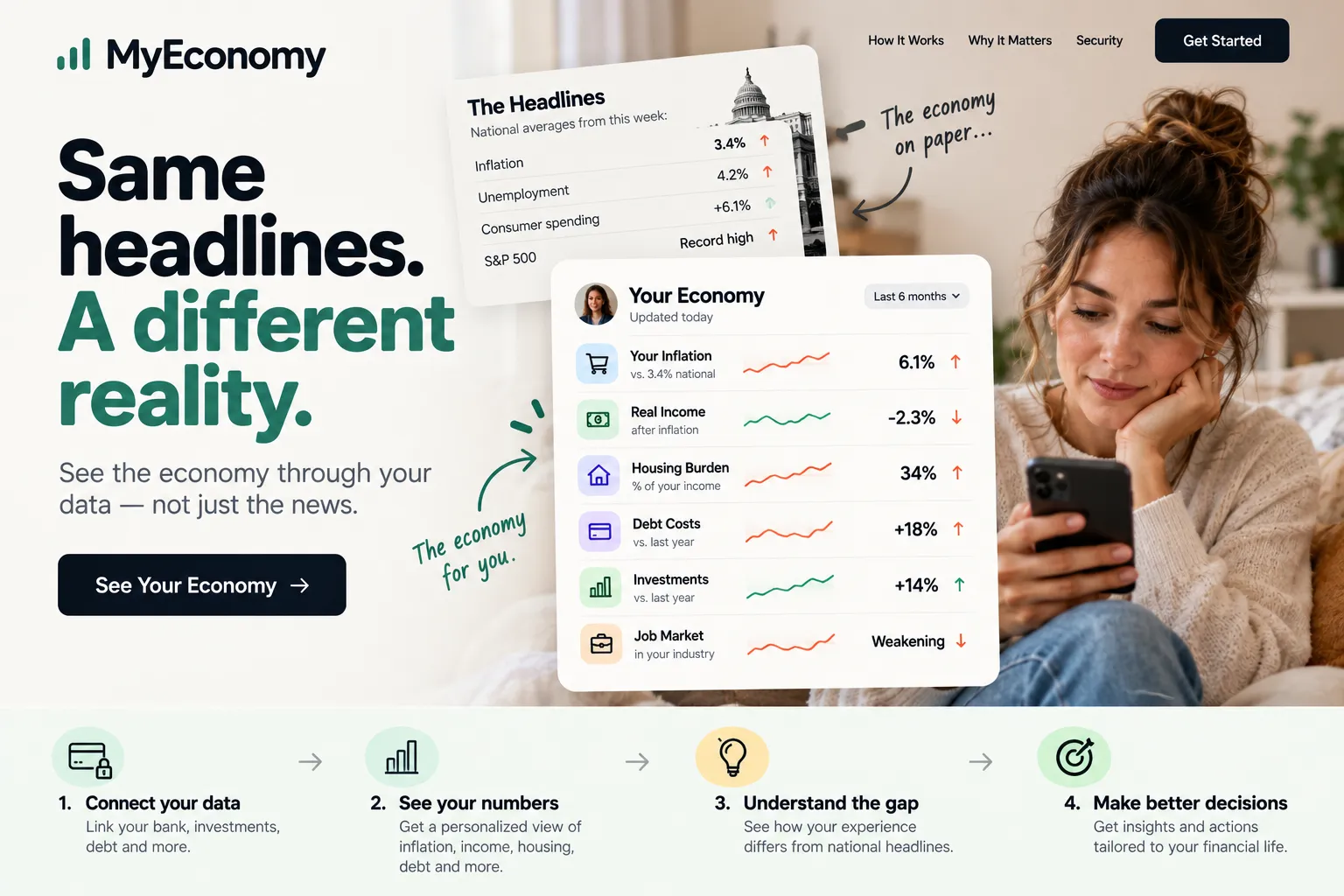
National economic data can say the economy is booming while a household feels like it is falling behind because inflation, housing costs, wages, debt, investments, and job risk affect every family differently. Build a personal economy engine that connects to your finances and calculates your own inflation rate, real income growth, housing burden, debt costs, job-market exposure, and investment gains instead of relying on national averages. This matters now because people have more financial data than ever while economic headlines increasingly fail to explain why their lived experience feels so different. Imagine opening the app and seeing that headline inflation is 3.4%, but your personal inflation is 6.1%, your real income is down 2.3%, and rising insurance and housing costs are responsible for most of the gap. That’s a product that needs to exist.
Description
No additional description provided.
The Pitch
“The economy” has become too abstract to be useful at the household level. People do not experience CPI, GDP, or unemployment as averages; they experience rent renewals, grocery receipts, mortgage resets, childcare bills, layoffs in their industry, and the quiet erosion of savings. A company that translates macroeconomic reality into a household-specific balance sheet would own a category that sits between personal finance software and economic media, but is more emotionally resonant than either.
The non-obvious wedge is that most financial tools tell people what they spent, while this would tell them what changed. That distinction matters. A budgeting app can show that groceries cost $900 last month; a personal economy engine can show that the household’s grocery inflation is running twice the national rate and is now absorbing the entire raise one partner received. People are often not looking for another dashboard. They are looking for an explanation of why discipline no longer produces the results it used to.
This business would also benefit from the growing distrust of aggregate narratives. When official numbers conflict with lived experience, people do not necessarily want ideology; they want a more precise mirror. The product’s power would come from making economic disagreement empirical at the individual level. Two neighbors can both read the same inflation report and be right to feel completely different things, because one owns a home with a fixed mortgage and the other is exposed to rent, insurance, and variable debt. Personalization turns economic data from an argument into a diagnosis.
There is also a strong behavioral advantage: economic pain is recurring, not episodic. Every paycheck, renewal notice, interest-rate change, tuition bill, job posting, and market swing creates a new reason to check whether the household is gaining or losing ground. Unlike traditional financial planning, which often feels distant and aspirational, this would be grounded in the immediate question people already ask themselves: are we actually better off than we were last year?
The deeper business opportunity is to become the household’s economic interpreter. Once a person trusts a system to explain their real cost of living, real wage path, and real exposure to shocks, it becomes a natural place to understand decisions that otherwise feel isolated: changing jobs, moving cities, refinancing debt, adjusting investments, or negotiating compensation. The durable value is not prediction. It is giving people a private, quantified version of an economy that finally matches the one they live in.