Personal Data Escrow for AI Agents
Personal AI agents need access to sensitive information like addresses, payment details, IDs, health data, and family information to complete useful tasks, but giving an agent the raw data also creates the risk that it exposes or misuses information it never needed to see. Build a personal-data escrow layer that stores sensitive information once and gives agents narrowly scoped capabilities instead of the underlying secrets, allowing them to complete approved actions without revealing the data itself. This matters now because agents are moving from answering questions to buying, booking, messaging, and coordinating on users’ behalf. Imagine asking an agent to arrange a Marketplace pickup and giving it permission to coordinate the location and time without ever letting it see or send your home address.
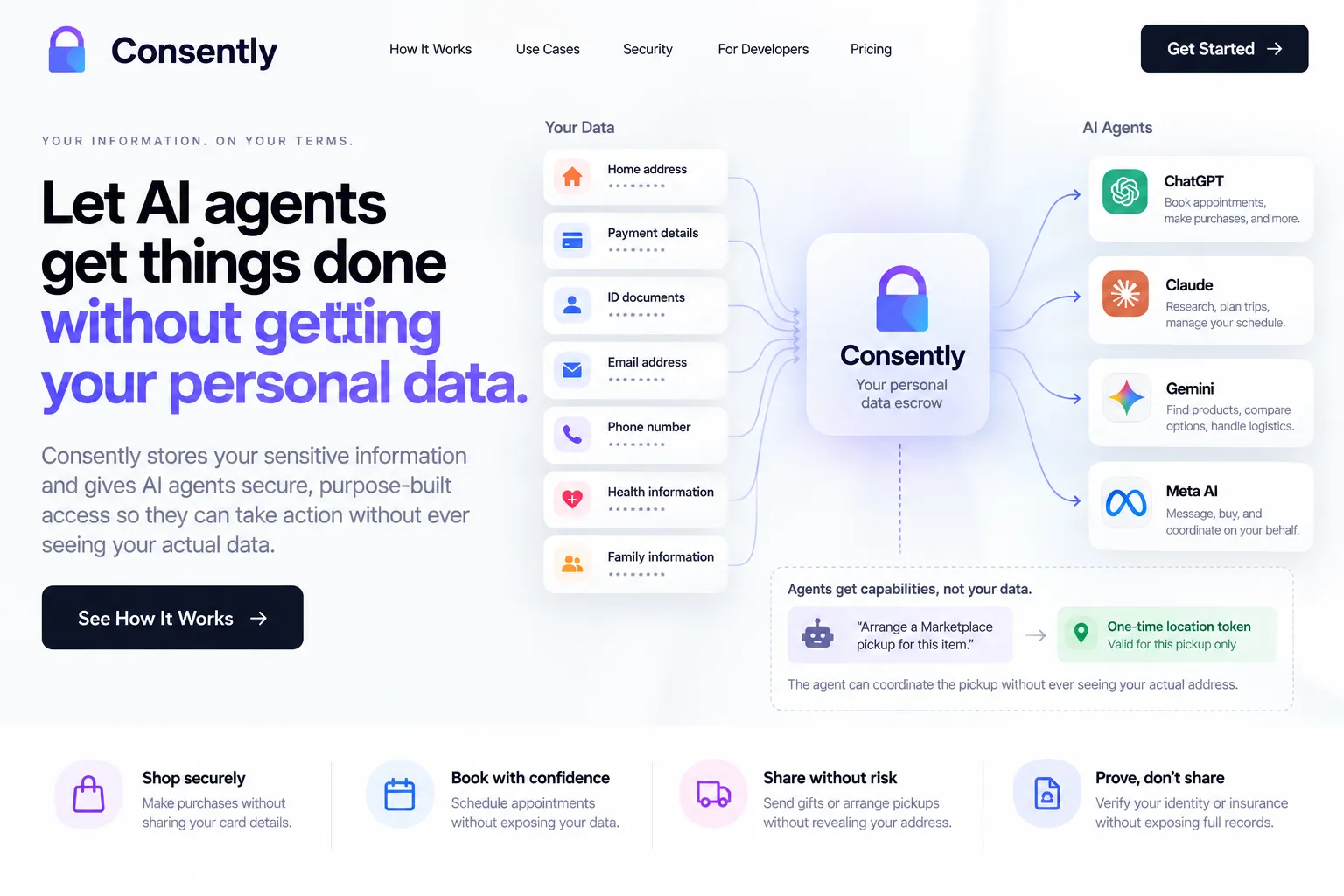
Description
No additional description provided.
The Pitch
AI agents will not become truly useful until they are trusted with the boring, dangerous parts of life: forms, purchases, appointments, pickups, renewals, medical portals, travel changes, school logistics. The limiting factor is not intelligence but permission. People will happily ask an agent to act for them only when they can grant authority without handing over their entire private life. That creates room for a new kind of trusted middle layer: not another assistant, but the place where assistants go to ask for just enough power to finish the job.
The important shift is that personal data becomes more valuable when it is not copied. Today, every service asks users to re-enter the same sensitive facts, leaving fragments of identity scattered across apps, inboxes, merchants, forms, and chat threads. AI agents could make that sprawl much worse by moving private details through prompts, logs, APIs, and third-party tools. A data escrow reverses the pattern. The secret stays still; only constrained actions travel. That is a more natural architecture for an agentic internet than trusting every agent, plugin, and vendor to behave perfectly.
This business would also sit at a rare control point between users, agents, and institutions. If agents are going to book appointments, verify eligibility, ship packages, fill claims, or coordinate with strangers, someone has to translate human consent into machine-readable authority. “Can share my mailing address with this merchant,” “can prove I am over 18,” “can schedule within these hours,” and “can pay up to this amount” are not just privacy settings; they are the grammar of delegated action. Whoever standardizes that grammar could become an invisible but essential part of how agents operate.
The trust advantage compounds because the product gets safer as it becomes more central. A user does not want ten different agents each storing copies of their passport, insurance card, children’s school details, and credit cards. They want one hardened place with memory, auditability, revocation, and clear boundaries. In a world where synthetic messages, autonomous purchases, and accidental disclosure become common, the ability to answer “what did I authorize, and what was actually shared?” will feel less like a feature and more like basic hygiene.
The deeper opportunity is that privacy here is not a moral add-on; it is what unlocks utility. The agents that know the least necessary information may become the ones allowed to do the most.