Personal AI Compute Financing Service
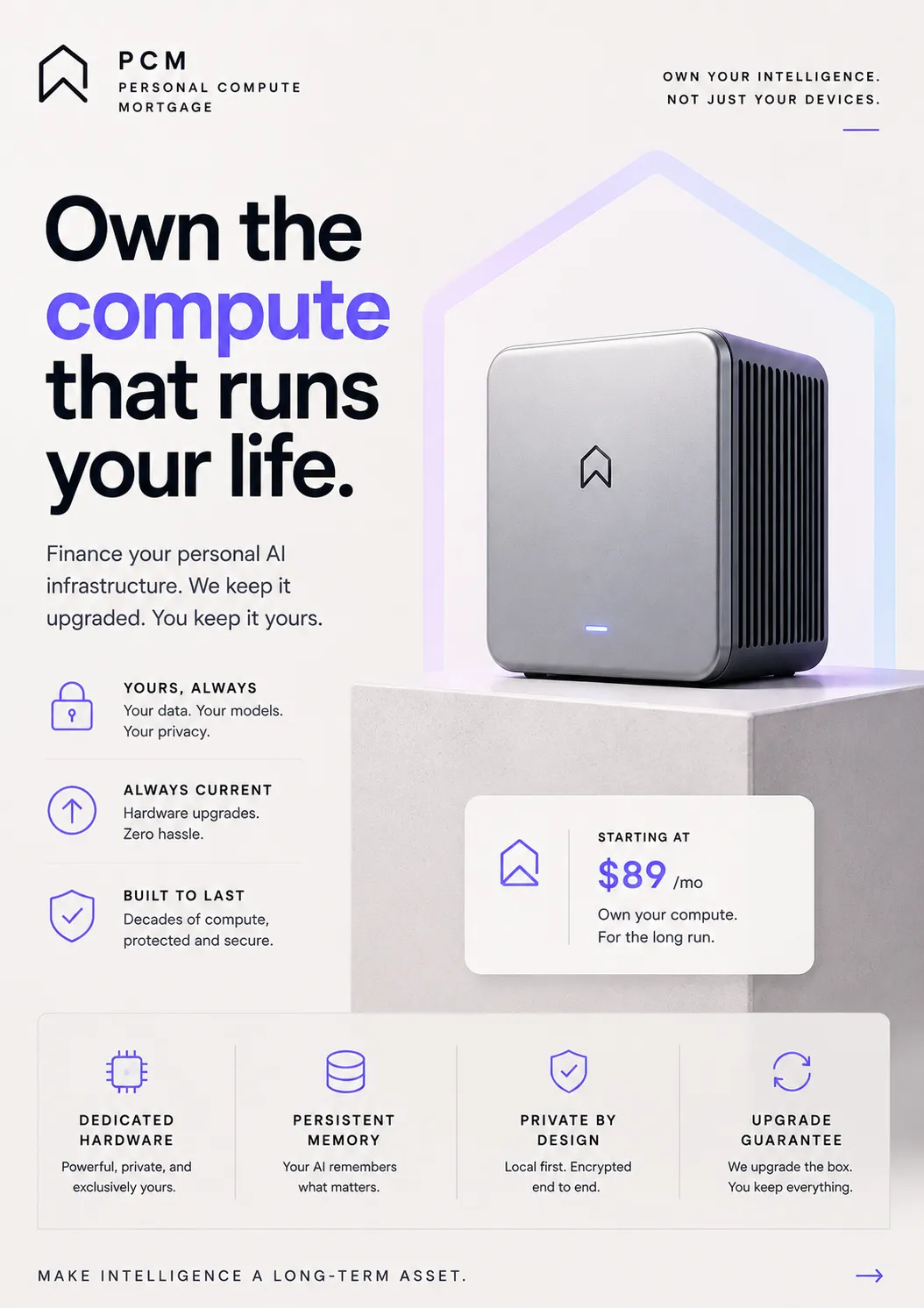
If personal AI becomes the repository for someone's memories, finances, communications, and decisions, renting all of its intelligence from cloud providers may eventually feel like renting your brain. A Personal Compute Mortgage would finance a guaranteed level of privately owned AI capacity over decades rather than a particular computer. The provider replaces hardware as it ages while the customer retains the models, memory, identity, and data running on it. Instead of buying a new device every few years or permanently renting intelligence by the token, households could own a continuously upgraded piece of computational infrastructure.
Description
No additional description provided.
The Pitch
There is a gap between how people think about personal ownership and how AI infrastructure is currently sold. Consumers are accustomed to owning the things that hold their identity: homes, phones, hard drives, documents, photo libraries. But the more capable AI becomes, the stranger it will feel for the most intimate layer of a person’s life to live entirely inside somebody else’s meter. The business works if private compute becomes less like a gadget and more like domestic infrastructure: something people expect to be persistent, financeable, insured, and upgraded without renegotiating their relationship to it every few years.
The non-obvious insight is that continuity may become more valuable than raw performance. A household AI that has accumulated ten years of context, preferences, correspondence, medical history, financial patterns, and family knowledge is not easily portable in any emotionally meaningful sense. The asset is not the box in the closet; it is the durable relationship between identity, memory, and compute. A company that guarantees this continuity could occupy the same psychological category as a bank vault or a family home server, but with the usability expectations of a consumer appliance.
This also turns hardware obsolescence from a customer problem into the provider’s core competency. Today, personal devices depreciate visibly and awkwardly: batteries fade, chips age, storage fills, and the owner decides when the pain is high enough to replace them. In this model, the customer is not buying hardware; they are buying a floor beneath which their personal intelligence cannot fall. That is a more resilient promise because the provider can pool upgrade cycles, forecast component needs, recover residual value, and optimize fleets in ways individual households cannot.
The business becomes especially interesting if regulation and social norms start treating AI memory as sensitive in a way that ordinary app data never quite was. There is a difference between a service knowing things about you and a system becoming the operational substrate of your life. For affluent households, professionals, families with complex caregiving responsibilities, or anyone managing consequential decisions, the premium may not be for privacy in the abstract. It may be for reducing the number of institutions that can interrupt, meter, inspect, or reshape the intelligence they depend on.
The deepest appeal is that it reframes AI from consumption to possession. Cloud AI encourages people to think in sessions, subscriptions, and tokens. A privately financed compute estate encourages people to think in decades. If personal AI is going to become a companion record of a life, the company that makes it feel ownable could become one of the few technology businesses selling permanence in a market otherwise built around access.