Personal Agent for Monetizing Small Opportunities
People own dozens of things with economic value—expertise, attention, data, relationships, availability, unused assets—but most of it never earns anything because negotiating tiny opportunities is more trouble than the money is worth. Build a personal agent that continuously finds, prices, negotiates, and collects payment for opportunities that fit your rules. A recruiter could pay for 15 minutes of your expertise, a researcher could license anonymized data, a brand could buy rights to an old photo, or someone could pay for a warm introduction, all without you handling the back-and-forth yourself. This becomes possible now because personal agents can increasingly understand context, negotiate, transact, and enforce user preferences at near-zero marginal cost. Imagine waking up to $340 your agent earned overnight from three tiny opportunities you would never have bothered pursuing manually. That’s a product that needs to exist.
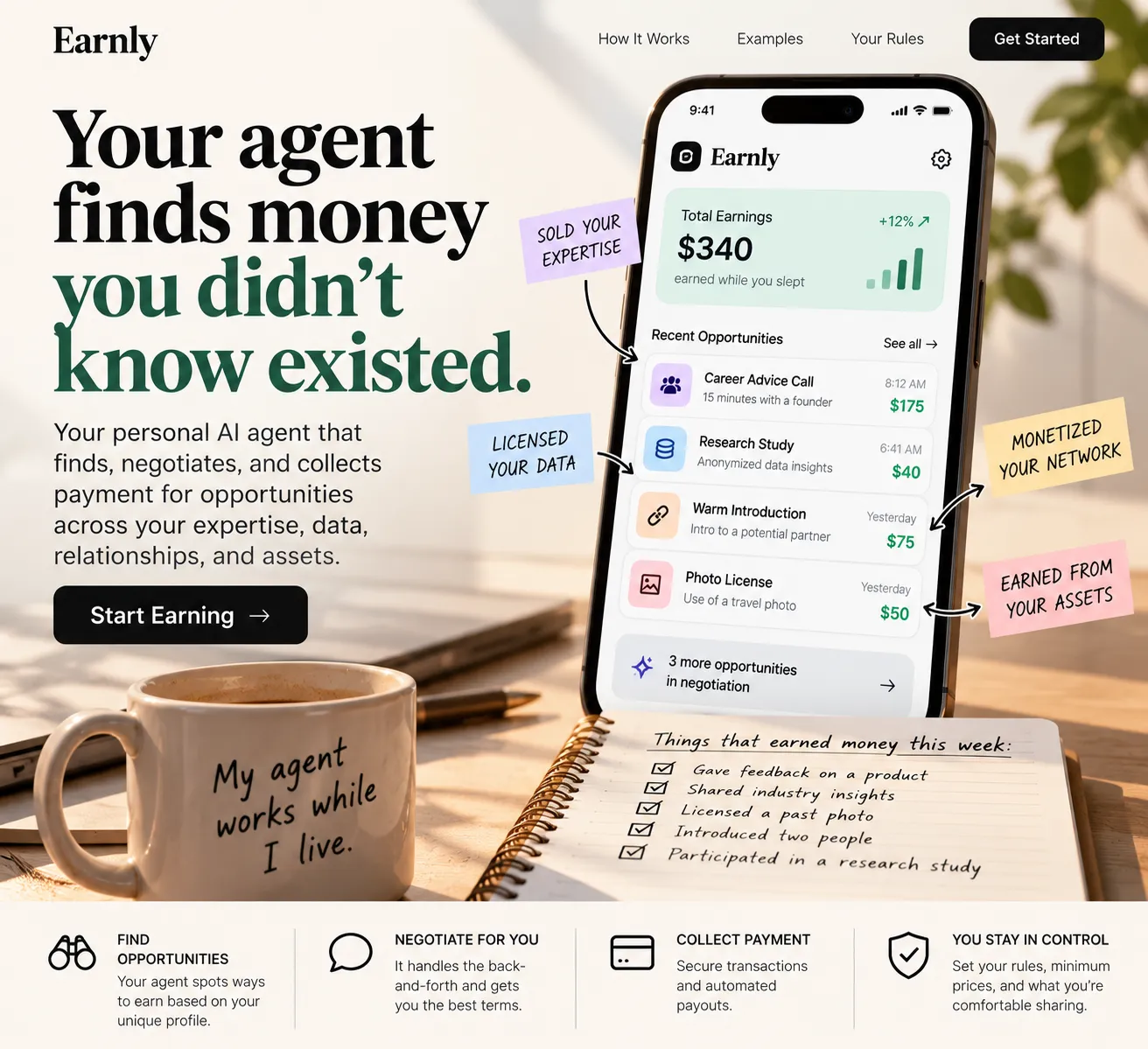
Description
No additional description provided.
The Pitch
The modern individual has become a bundle of underpriced call options. A person’s calendar, inbox, camera roll, purchase history, professional memory, social graph, location patterns, and dormant possessions all contain latent value, but none is valuable enough on its own to justify a transaction. The business works if it turns these fragments from “not worth thinking about” into an always-on market surface.
Most marketplaces fail at the edges because human attention is the clearing cost. A $40 data license, $75 expert call, or $120 usage right to a photo is irrational if it requires reading terms, replying to strangers, deciding whether the request is legitimate, and chasing payment. But if the owner only sets durable boundaries once, the minimum viable transaction size collapses. That is the key economic shift: not higher-value opportunities, but lower-friction consent.
The trust layer may be more valuable than the matching layer. People will not let the internet bid on their identity unless the agent is more like a fiduciary than a chatbot: conservative by default, able to say no, and good at detecting asymmetric asks disguised as harmless favors. If the product becomes the place where personal permissions are stored, interpreted, and enforced, it sits at a powerful choke point between individuals and anyone who wants access to them.
There is also a cultural inversion here. Today, companies routinely monetize people’s behavior because individuals cannot practically meter access to themselves. A personal agent changes the unit of commerce from “platform extracts value from aggregate users” to “a person selectively licenses specific slices of their life.” That does not require everyone to become a creator or entrepreneur; it makes ordinary personhood commercially legible in small, bounded ways.
The most interesting businesses often emerge when a previously non-economic category becomes transactable. Search made intent legible. Stripe made small online businesses legible. Shopify made independent retail legible. A personal monetization agent would make the long tail of individual economic surface area legible. If it worked, it would not feel like a side hustle tool. It would feel like discovering that people had been carrying invisible inventory all along.