Performance-Based AI Agent Authority System
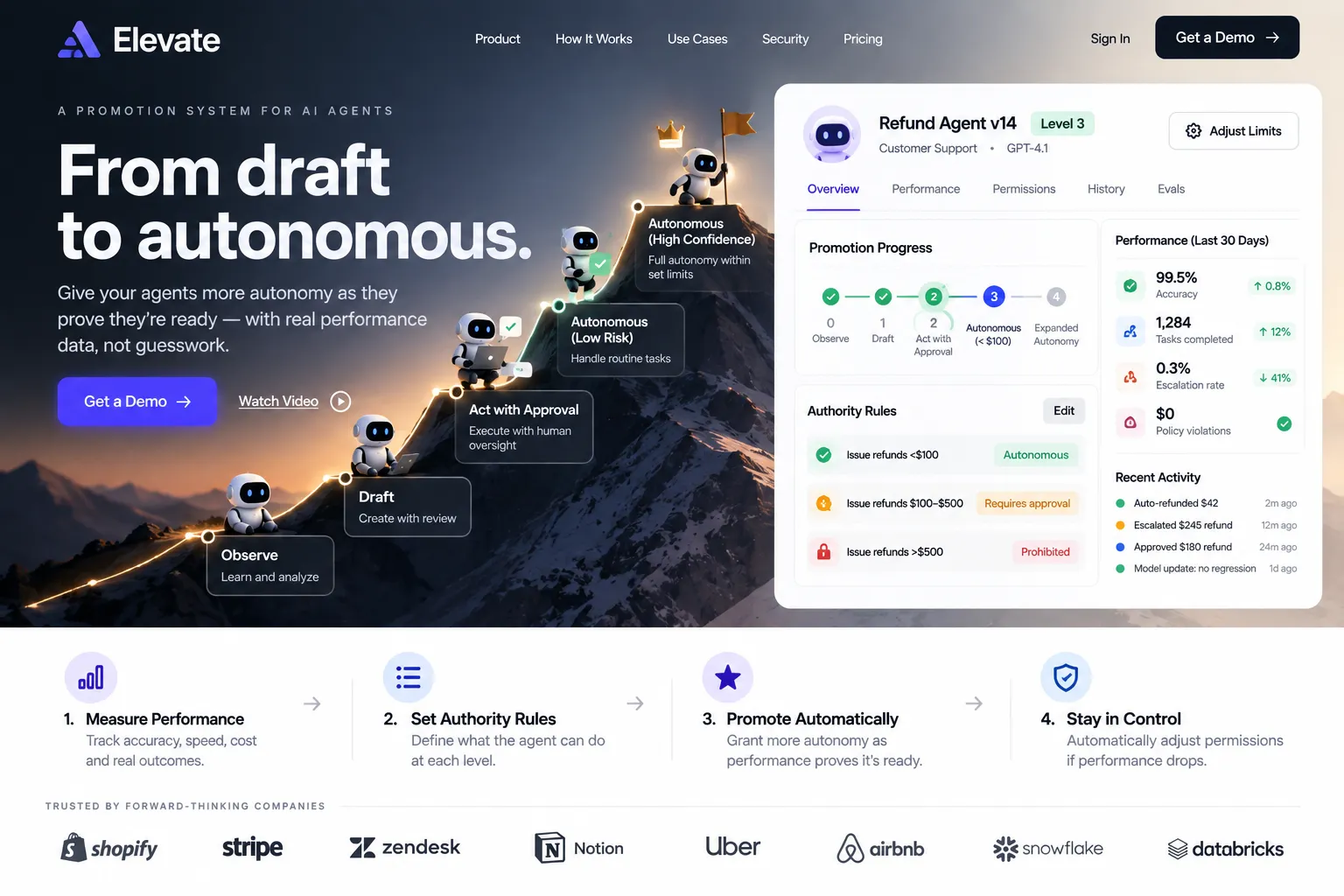
Companies still treat AI agents too much like an on/off switch: either a human does the work or the agent does. Build a promotion system where agents earn more authority over time based on demonstrated performance. An agent might begin in observation mode, graduate to drafting, then act with approval, then handle low-risk actions autonomously, while higher-risk decisions remain restricted. This becomes important now because enterprises can increasingly measure agent performance with real evals and production data, making autonomy something that can be continuously earned instead of granted once. Imagine a refund agent that automatically handles refunds under $100 after proving 99.5% accuracy, requires approval from $100 to $500, and instantly drops back a level if a new model update causes regressions.
Description
No additional description provided.
The Pitch
This turns autonomy into an operational control surface rather than a philosophical debate. Most enterprises do not actually fear AI agents because they are incapable; they fear them because responsibility is binary and poorly instrumented. A promotion system gives companies a way to say, “yes, but only as far as the evidence supports,” which is much closer to how organizations already manage people, vendors, and risk.
The deeper insight is that agent performance is not a static property of the software. It changes with model updates, workflow changes, policy changes, seasonality, edge cases, and adversarial user behavior. Traditional software permissions assume the tool remains basically the same after access is granted. AI breaks that assumption. A system that continuously re-validates authority becomes valuable because it matches the living nature of the thing being controlled.
This could become a durable layer because the most important record in an AI-operated company may not be the prompt, the model, or the workflow, but the trust history of each agent in each context. Which tasks has it handled? Under what conditions? Against which evaluation standard? With what failure modes? Over time, that record becomes an institutional memory of machine competence. It would be painful to recreate, and increasingly necessary to defend decisions internally, legally, and operationally.
The business also benefits from a subtle organizational truth: companies rarely adopt automation all at once, but they do adopt systems that let them expand automation without reopening the same argument every week. Once leaders trust the ladder, every new capability can move through it. The product becomes the mechanism by which cautious organizations become more automated without feeling reckless.
If this category exists, it likely sits between evaluation, permissions, compliance, and workflow orchestration, but its emotional center is simpler: it gives managers a way to supervise non-human workers. The companies that win in AI adoption may not be the ones with the most powerful agents, but the ones with the best systems for deciding when those agents have earned the right to act.