Partner Sales Production Optimization Software
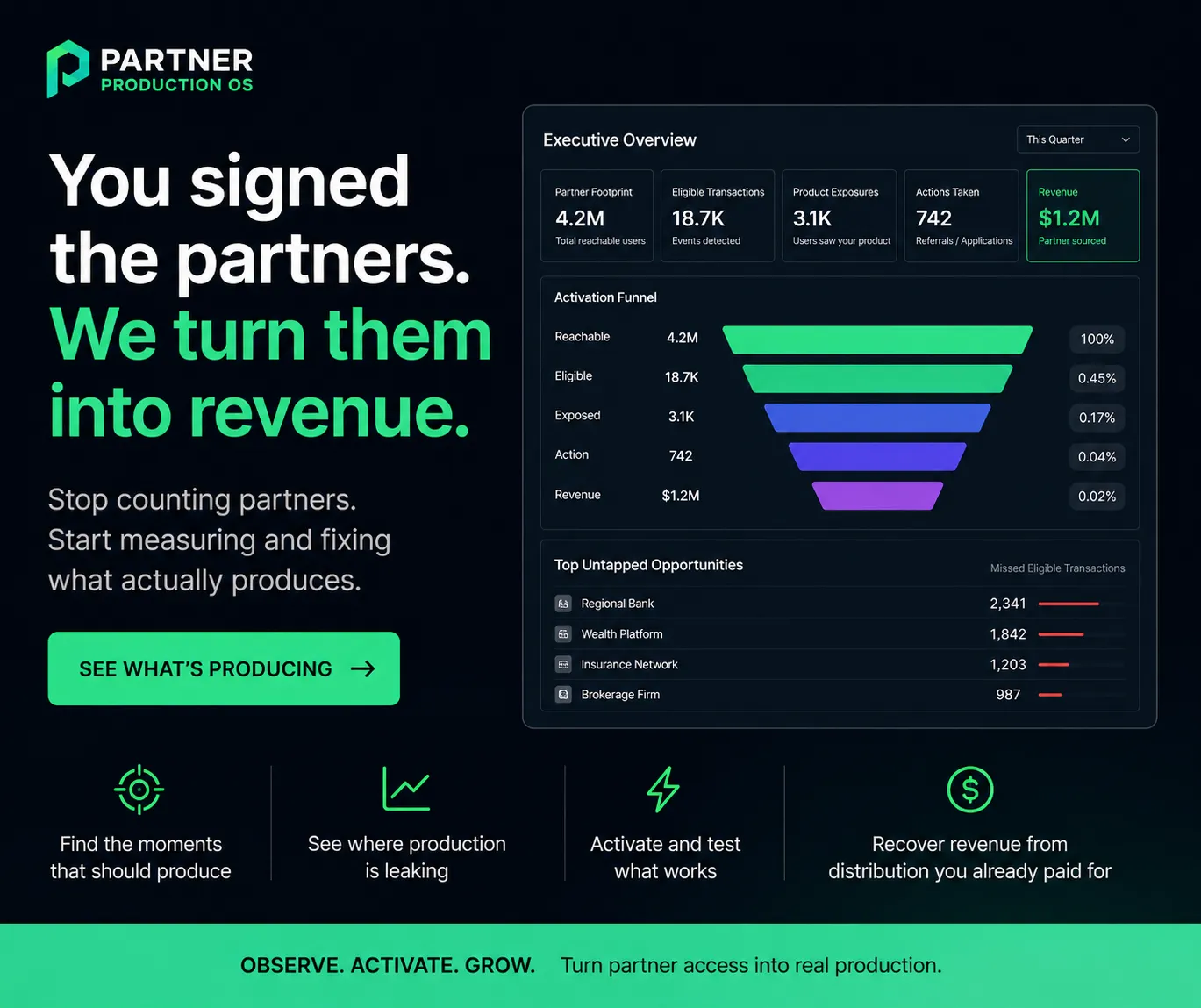
Companies sign partners, integrate them, and count the footprint as distribution. Then little happens. The problem is that the software manages the partner organization while production depends on an individual changing behavior inside a real transaction. Partner Production OS would track the path from eligible transaction to exposure to action to revenue, identify where production dies, then test ways to fix it inside the partner’s existing workflow. Why now: APIs, event data and AI make it possible to instrument and optimize behavior across systems instead of relying on portals and training. Example: an RIA platform has 4,000 advisors enabled for an estate product. The system finds 700 relevant client events, only 120 product exposures and 22 referrals, then identifies exactly where the other 580 opportunities disappeared.
Description
No additional description provided.
The Pitch
Partnerships are one of the largest forms of corporate make-believe. A signed agreement creates the appearance of growth before any customer has been touched. The economic truth is much harsher: distribution does not exist at the company level, it exists at the moment one person remembers, trusts, and chooses to introduce something during an already-busy transaction. A business that measures that moment would turn partner management from relationship theater into an operating discipline.
The valuable insight is that most partner underperformance is not caused by lack of interest or bad incentives in the abstract. It dies in small, observable gaps: the trigger was missed, the message arrived too late, the advisor did not know what to say, the client context was unclear, the referral process felt risky, or the next step required leaving the system of record. These failures are usually invisible because partner teams measure lagging outcomes and anecdotal feedback. Whoever owns the event-level map owns the real diagnosis.
The business could become important because it sits at the intersection of revenue and behavior, not reporting. Existing systems tell companies who their partners are, what content they have seen, and how much revenue arrived. They rarely understand the sequence of micro-decisions between eligibility and production. That sequence is where the profit is. Improving a conversion rate inside an existing partner channel can be more attractive than acquiring new partners, because the supply of potential transactions is already there and the trust relationship already exists.
There is also a structural reason this category could endure: every serious partner program becomes more complex over time. More products, more partner types, more compliance constraints, more data sources, more handoffs. Human partner managers cannot continuously inspect thousands of transactions for missed behavioral prompts. But if the system can detect patterns across partners, it can learn which interventions work in which contexts. The product becomes smarter as it sees more failures, not merely larger as it stores more accounts.
The deeper business is not software for managing partners; it is software for making indirect distribution behave more like a measurable production line without stripping away the human relationship that makes it valuable. That is a rare combination. It respects that partners are people embedded in workflows, while giving the company a way to manage the actual physics of revenue creation.