Partner Revenue Leakage Analysis Tool
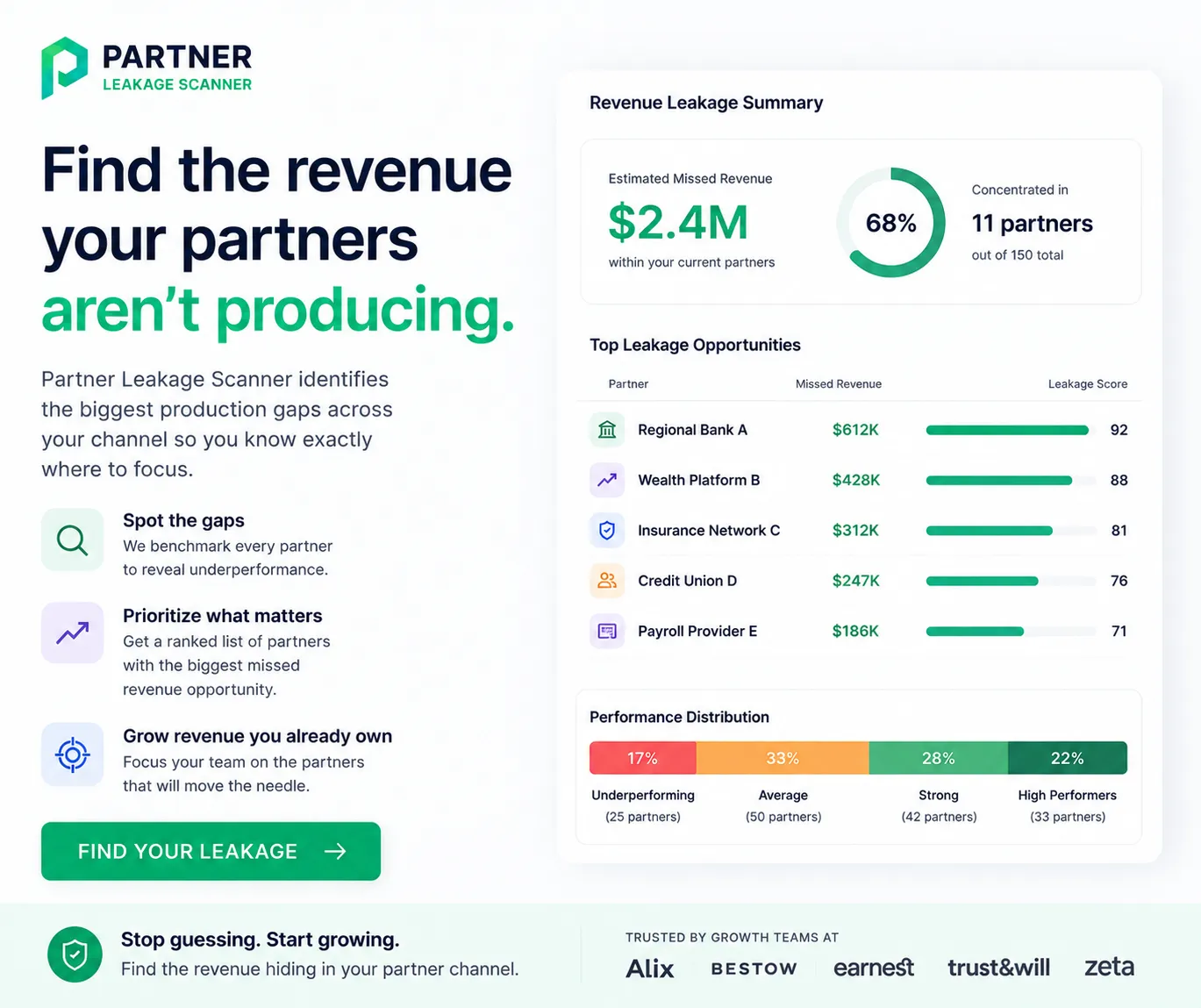
Companies sign and integrate partners, but often have no good way to know which ones should be producing far more than they are. Partner Leakage Scanner takes existing partner data and identifies the biggest production gaps based on reach, partner type, age, historical performance and peer benchmarks, then ranks where revenue is most likely being left on the table. Why now: AI makes messy partner data easier to normalize and analyze, while companies are under more pressure to grow from distribution they have already paid to build instead of constantly adding new partners. Example: a company uploads data on 150 partners and discovers that 11 represent 68% of its estimated missed revenue, giving the team a clear list of where to focus next.
Description
No additional description provided.
The Pitch
Partner programs are one of the few revenue assets companies already own but rarely understand. Most teams can name their largest partners and their newest partners, but they often cannot name the partners that are quietly underperforming relative to their potential. That distinction matters: the most valuable opportunity is not always the partner producing the most today, but the one whose footprint, maturity, or peer group suggests it should be producing much more.
The deeper insight is that partner performance is usually judged in isolation, when it is inherently comparative. A distributor, reseller, affiliate, marketplace partner, or channel account only becomes legible when placed against similar partners with similar characteristics. Without that context, low output can look normal and mediocre output can look successful. A business that turns partner data into relative performance intelligence would give companies a new kind of revenue map: not where activity is happening, but where the absence of activity is meaningful.
This is also attractive because the operational pain is hidden inside a very human bias. Partner teams tend to focus on loud partners, strategic logos, recent signings, and relationships with political weight. Underperformance often persists because it is awkward to challenge, hard to prove, and easy to rationalize. A credible scanner changes the conversation from “we feel this partner should do more” to “partners like this typically do far more.” That makes the product valuable not just as analysis, but as an internal truth-telling mechanism.
The business would also benefit from being tied to existing sunk cost. Companies have already spent money recruiting, onboarding, enabling, and integrating partners. Finding more output from that installed base feels less speculative than acquiring new partners or launching new channels. In tighter markets, this kind of product becomes especially compelling because it reframes growth as recovery: revenue that should have been captured already, but was obscured by messy data and weak comparisons.
The most interesting version of the company would become a memory layer for partner ecosystems. Over time, it could learn what healthy production looks like by partner type, market, age, and motion, turning scattered partner records into benchmarks that individual companies could never assemble alone. That compounding knowledge is what makes the idea more than a reporting tool: it would help define what “good” actually means in a part of the business where most teams have been operating on anecdotes.