Partner Conversion API for Workflow-Based Referrals
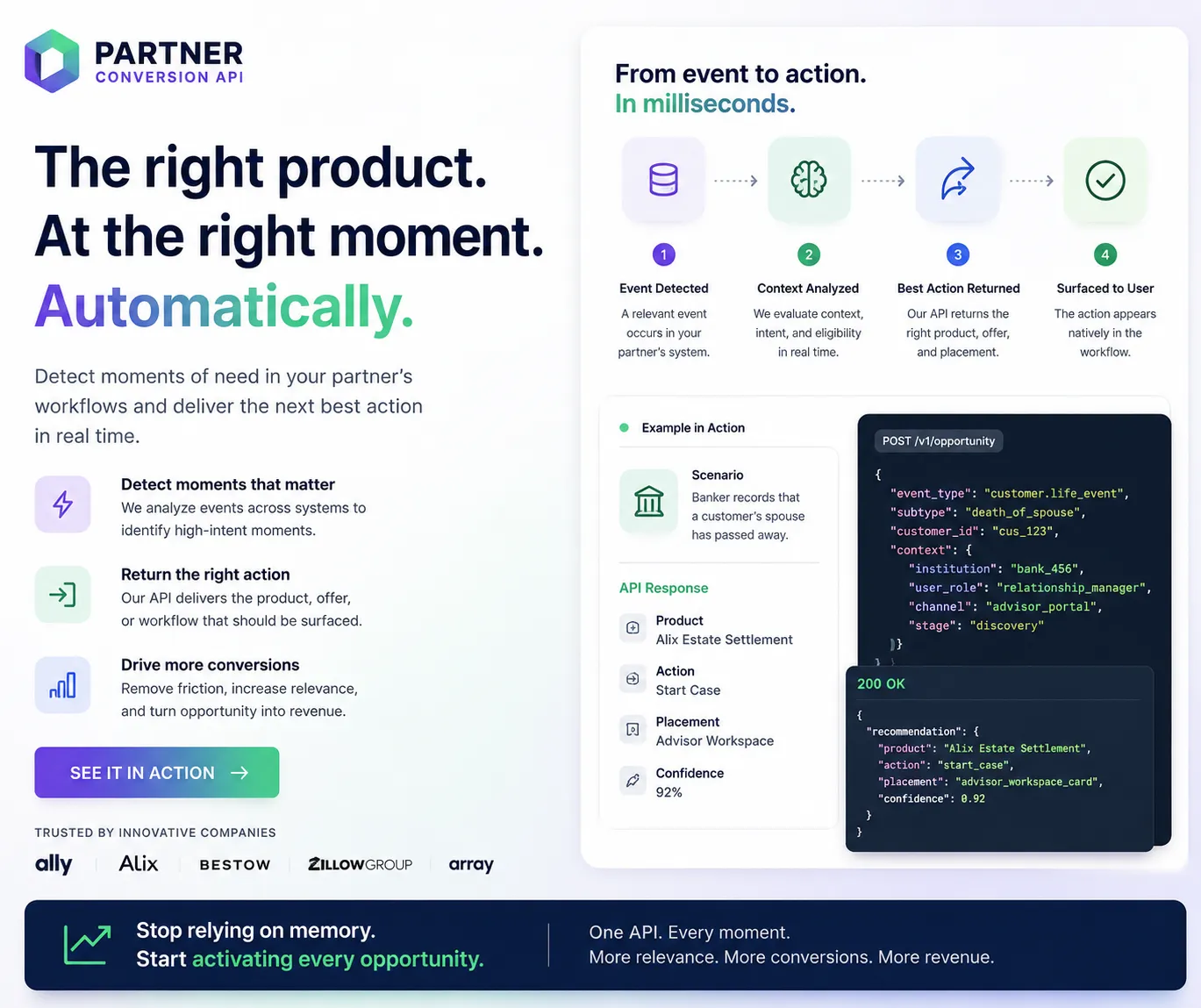
Most partner products depend on someone remembering when to use them. That is a bad distribution model. A Partner Conversion API would detect moments when a product becomes relevant inside another company’s workflow and return the right action automatically. Why now: more business activity runs through structured software systems, which means the moment of need can increasingly be recognized from data rather than human memory. Example: a bank records that a customer’s spouse has died. Instead of hoping the banker remembers an estate-settlement partner, the API recognizes the event and inserts the appropriate service directly into the workflow. The goal is to make partner distribution behave less like training a salesforce and more like software routing.
Description
No additional description provided.
The Pitch
Monetize the difference between “having a partnership” and “being present at the exact moment of need.” Most partner programs are structurally weak because they rely on memory, goodwill, and human interpretation. The partner may be valuable, but the referral path is fragile. A system that turns latent intent inside workflows into timely action would make partnerships behave more like infrastructure than relationship management.
The interesting shift is that many life and business events now leave machine-readable traces before they become explicit buying journeys. A death, a loan denial, a new employee, a business incorporation, a missed payment, a home purchase, a diagnosis, a compliance failure—each is not merely a record in a system, but a commercial inflection point. The company that can interpret those moments responsibly becomes a kind of translation layer between operational data and useful outside services.
This could be powerful because it improves conversion without creating more demand-generation noise. Most marketing tries to interrupt people before they know they need something or chase them after they have already started searching. Workflow-triggered distribution sits in the narrow window where the need is real, contextual, and still unresolved. That timing is unusually valuable: the recommendation feels less like advertising and more like the next natural step.
The business would also benefit from compounding specificity. Each workflow has its own vocabulary, permissions, timing, and risk tolerance. A generic referral marketplace cannot easily know when a cue is meaningful, inappropriate, urgent, or legally sensitive. But an API that learns the event grammar of banks, insurers, HR systems, healthcare platforms, legal software, or accounting tools could become hard to replace because its value lies in knowing not just what happened, but what should happen next.
The deeper thesis is that partner distribution has been treated as a sales problem when it is often a recognition problem. The scarce asset is not another directory of vendors; it is the ability to notice relevance at the moment it appears. If business software increasingly becomes the place where real-world events are first recorded, then the company that routes those events to trusted actions could own a quiet but valuable layer of commerce: not search, not ads, not affiliate links, but context becoming conversion.