Partner Appetite Routing Platform
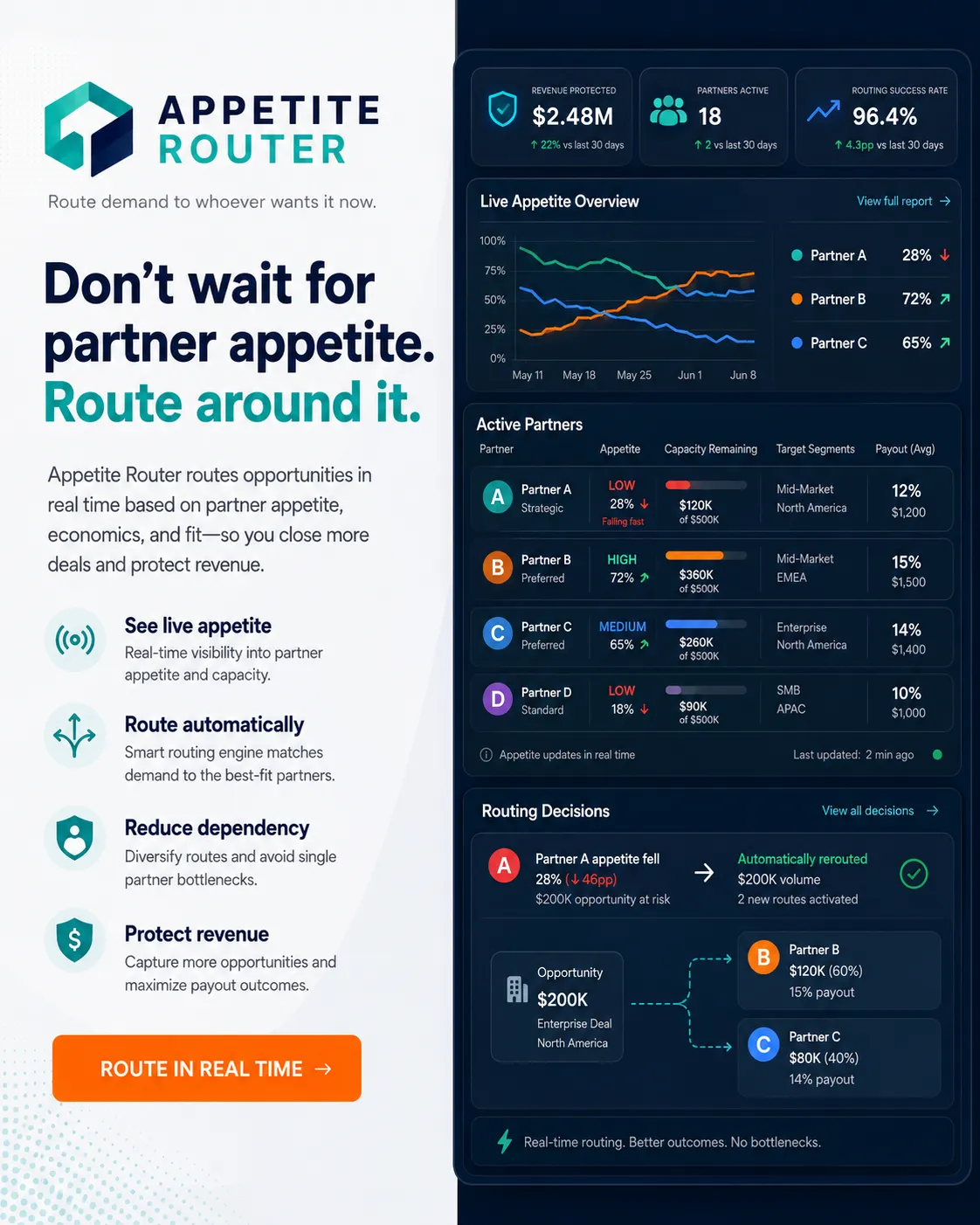
Companies connected to multiple lenders, insurers, marketplaces or distribution partners still treat each relationship as a separate pipe. Appetite Router would turn them into a single programmable market. Partners continuously publish what they want right now, and the system automatically routes each eligible customer, transaction or opportunity to the best available counterparty based on appetite, economics and probability of acceptance. Why now: APIs and real-time decisioning make partner appetite machine-readable instead of something discovered after conversion collapses. Example: one lender suddenly stops accepting near-prime borrowers. Instead of losing the revenue, the router immediately shifts that cohort to three lenders whose appetite has increased. The product does not tell you partner dependency is dangerous. It makes any individual partner replaceable.
Description
No additional description provided.
The Pitch
Many companies already sit on fragmented demand that is worth more than they realize. A loan marketplace, insurance broker, travel platform, payroll provider, or vertical SaaS company may see thousands of customers who do not fit the first partner’s rules, but those “declines” are often only declines in one institution’s private model. The same customer can be unwanted, desirable, or highly profitable depending on which balance sheet, risk rule, geography, or quota is looking at them. The business exists to reveal that hidden spread.
Partner appetite is not a static commercial agreement; it behaves more like weather. A lender tightens after a bad loss month, an insurer pulls back in one state, a marketplace seller runs out of inventory, a carrier becomes aggressive in a lane it needs to fill. Most companies experience these shifts as unexplained conversion changes or account-manager anecdotes. Turning appetite into live infrastructure changes the unit economics of every transaction because the company is no longer optimizing against yesterday’s assumptions.
The deepest advantage is that the router would learn across both sides of the market. Individual partners know what they accepted and rejected. Individual distributors know what they sent and whether it converted. But the routing layer sees the negative space: who almost wanted what, which cohorts are becoming more valuable, where acceptance probability diverges from stated criteria, and which partners are quietly substitutable. That information compounds into a map of demand and appetite that neither side can fully build alone.
It also changes the power balance in distribution relationships. Today, a large partner can behave like infrastructure while still having the discretion of a counterparty; when it changes rules, the distributor absorbs the shock. A programmable market makes partners compete continuously at the margin. Not through annual renegotiation, but through the simple fact that every opportunity can move elsewhere the moment another counterparty values it more.
This is the kind of business that becomes more useful as markets become less predictable. Volatility usually creates operational drag: more exceptions, more manual triage, more missed revenue. Here, volatility becomes the source of value, because changing appetite creates routing opportunities. The company would not merely automate partner selection; it would make commercial relationships liquid.