Parent-Controlled Kids Shopping App
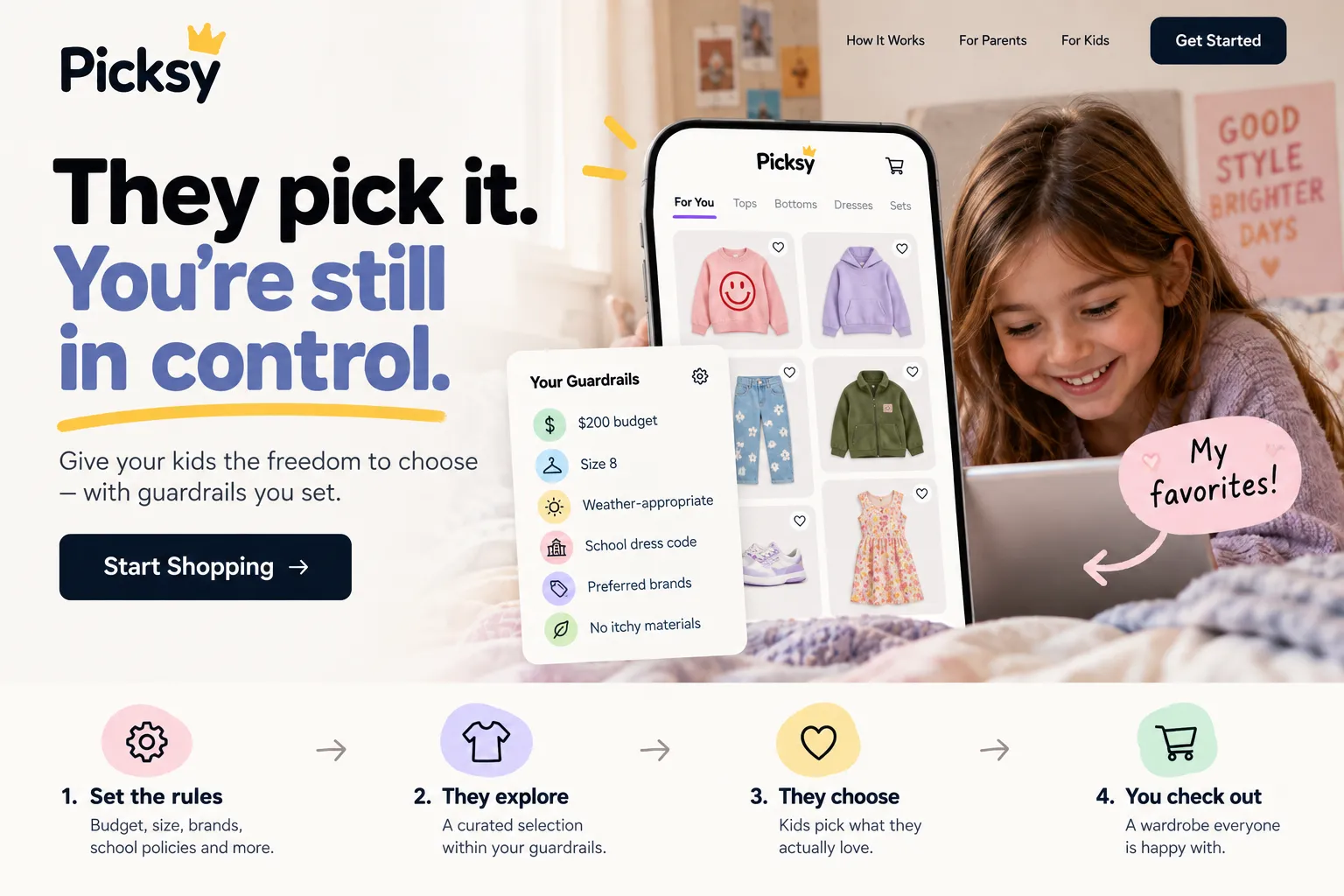
Parents want to give kids more independence, but shopping still forces adults to either make every choice themselves or hand over too much control. Build a shopping layer where parents set the boundaries—budget, size, weather, school rules, materials, brands—and kids get to choose freely inside them. The system turns thousands of products into a small set of parent-approved options, then gives the child a simple, visual experience to pick what they actually want to wear. This matters now because kids are influencing purchase decisions earlier while parents increasingly want to encourage independence without giving up responsibility. Imagine a parent setting a $200 back-to-school budget and approving 30 pieces, then handing the phone to their eight-year-old to build the wardrobe themselves without ever seeing something outside the rules.
Description
No additional description provided.
The Pitch
This converts a recurring family negotiation into a calmer decision system. Kids do not merely need apparel; they need small, safe arenas in which their preferences are taken seriously. Parents, meanwhile, are not trying to optimize endlessly across every SKU on the internet. They are trying to avoid the exhausting moment when a child falls in love with the wrong thing: too expensive, impractical, inappropriate, unavailable, or destined to cause a morning fight.
The interesting insight is that children’s shopping has two customers inside one purchase, and most commerce interfaces pretend there is only one. Adult shopping tools are built around search, filters, reviews, and price comparison. A child’s choice is emotional, visual, identity-driven, and often immediate. The parent’s choice is constraint-heavy and anticipatory: Will this survive the playground, match the weather, follow school rules, and arrive before Monday? A business that separates constraint-setting from choice-making could serve both minds better than a traditional store serves either.
This also turns curation from a merchandising function into a household governance tool. The parent is not just narrowing inventory; they are defining what freedom means in that family. That creates a kind of trust that ordinary retailers rarely earn. If the system reliably prevents bad options from appearing, the parent can step away, and the child experiences the rare pleasure of real agency rather than the fake agency of choosing from a screen full of future arguments.
The durable business here would come from owning the moment before the store. Once a child has made choices inside a trusted layer, the retailer becomes less important than the permission architecture. That layer could direct demand across many suppliers while preserving the family’s rules, history, and preferences. Over time it would know the difference between “my kid loves dinosaurs” and “my kid will only wear soft waistbands,” which is far more valuable than generic recommendation data.
The deeper reason this should exist is that childhood independence is usually constrained by adult inconvenience. Parents often say no not because the child is incapable, but because the surrounding system makes saying yes too risky or time-consuming. A shopping interface that makes bounded freedom easy would not just help families buy things. It would make one everyday category feel a little more like growing up.