Outcome Measurement Infrastructure for Enterprise Software
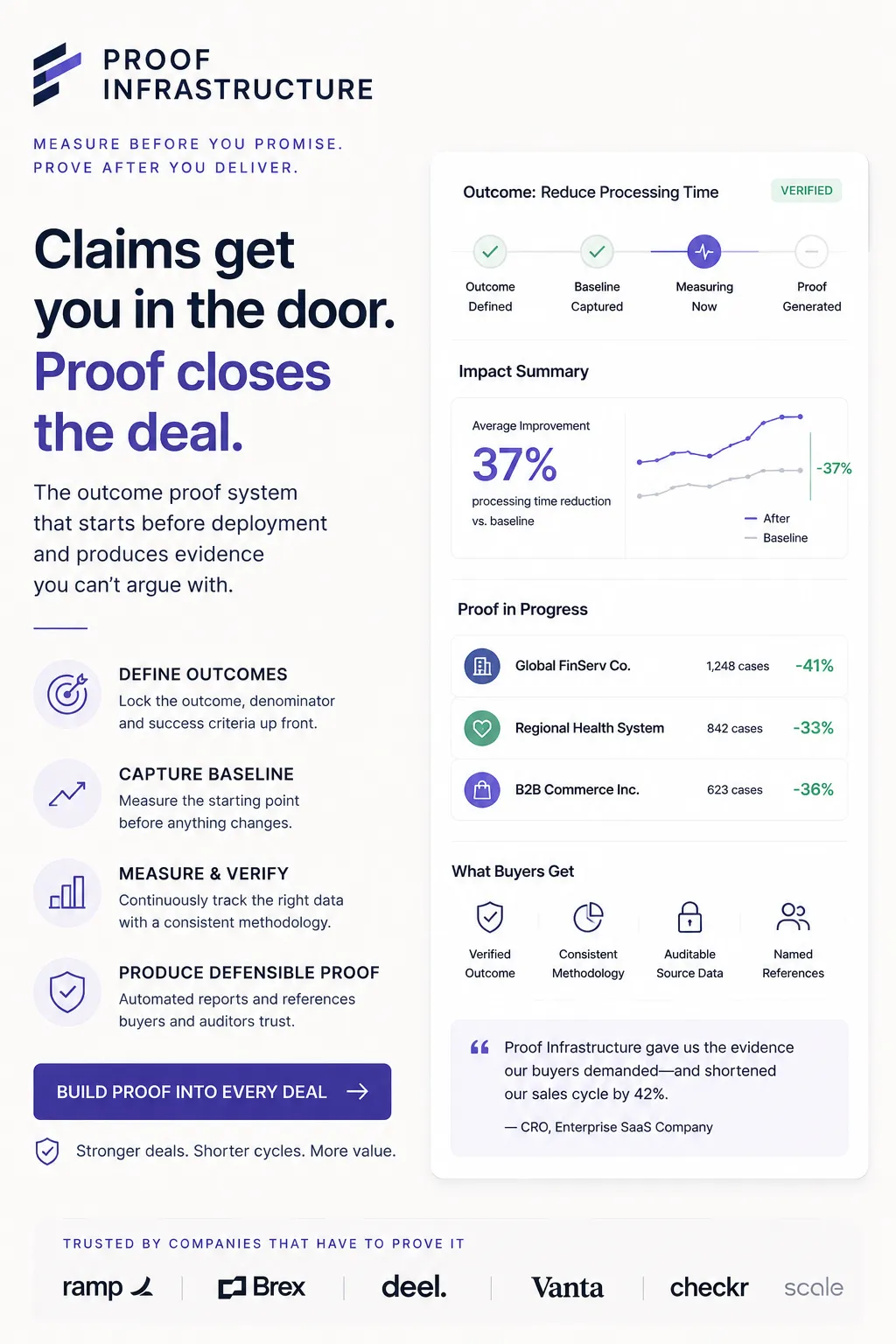
Companies sell outcomes they cannot later prove because measurement starts after the customer has already deployed. Proof Infrastructure would define the outcome before implementation, capture the baseline, instrument the required data and continuously produce defensible evidence of what changed. Why now: enterprise buyers increasingly expect measurable value, while existing value-realization and customer-proof tools largely help companies communicate outcomes after the fact rather than design the evidence system before deployment. Example: an automation company claims it saves 40% of staff time. Every new customer is automatically baselined before launch, the same denominator is tracked after deployment, and six months later the company has 37 independently reproducible outcomes instead of one marketing claim.
Description
No additional description provided.
The Pitch
The hardest part of selling business software is no longer making an ambitious promise; it is surviving the moment when a buyer asks, “Compared to what?” Most companies answer with anecdotes, hand-built case studies, or dashboards that were never designed to withstand scrutiny. The business opportunity is in turning evidence from a retrospective marketing artifact into a built-in operating layer of the product relationship.
The non-obvious value is that proof has to be designed before the work begins. Once a customer has already changed process, staffing, tooling, or behavior, the original comparison point is gone or corrupted. That makes many later claims feel negotiable, even when the product really worked. A system that preserves the counterfactual at the start creates something rare in enterprise markets: a shared source of truth that both buyer and seller can keep returning to when budgets, renewals, expansions, and internal politics get difficult.
This could also change how companies compete. Today, the loudest claims often travel farther than the best-proven ones, because proof is expensive and unevenly produced. If one vendor can accumulate dozens or hundreds of comparable, independently traceable outcomes, its advantage compounds. Each deployment does not merely produce revenue; it strengthens the next sale by expanding a structured body of evidence. Over time, the company with the best proof infrastructure may not need to make the biggest promise, because it owns the most credible history of observed change.
The buyer side is just as important. Enterprise customers increasingly buy tools on behalf of many internal stakeholders, each with different definitions of success. Finance wants cost impact, operators want cycle time, executives want strategic progress, and teams want less friction. Defining the measurable outcome before implementation forces alignment that many purchases otherwise avoid until it is too late. In that sense, the product is not just measuring value; it is quietly reducing the ambiguity that causes enterprise software to disappoint.
The strongest version of this business becomes a trust layer between vendors and customers. It gives sellers cleaner evidence, gives buyers a better way to justify decisions, and makes success harder to exaggerate but also harder to ignore. In markets crowded with claims, defensible proof becomes a kind of currency.