Organizational Complexity Cost Measurement Software
An operating system that measures organizational complexity as a real economic cost. Every new SKU, geography, customer type, workflow and exception adds hidden load across the company, but finance systems do not attribute that burden back to the decision that created it. Complexity OS would build a graph of products, customers, teams and workflows, measure the incremental load created by each layer of breadth, and tell executives which complexity is earning its keep. Example: a company believes seven product lines generate $100M of revenue. The system shows that two lines account for 8% of revenue but 31% of support load, 24% of implementation exceptions and 19% of engineering interruptions. Suddenly simplification becomes measurable rather than philosophical.
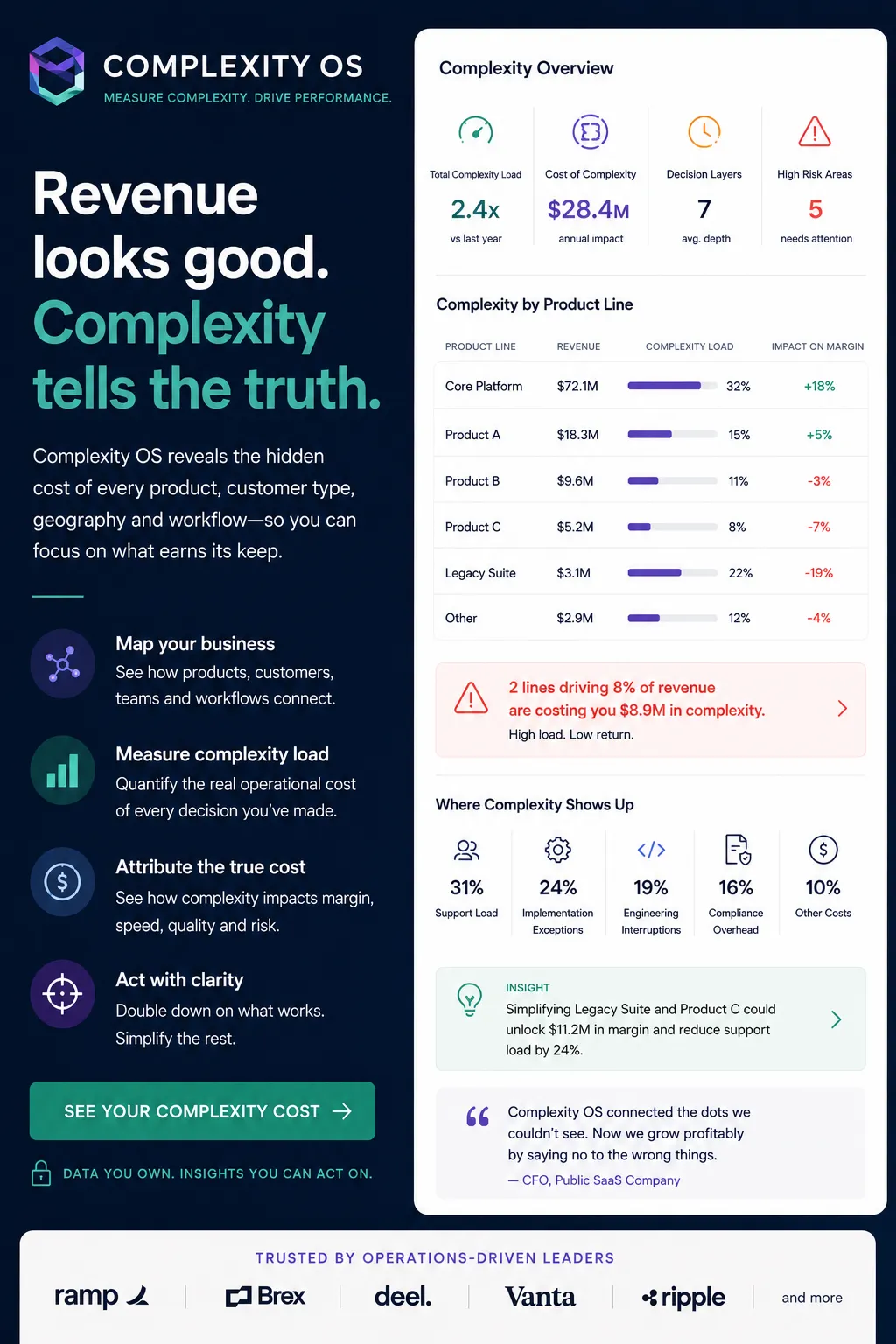
Description
No additional description provided.
The Pitch
Turn “focus” from a managerial virtue into an accounting category. Companies already know complexity is expensive, but they usually experience it as fog: slower meetings, edge-case support tickets, harder forecasting, messier onboarding, and senior people spending their best hours adjudicating exceptions. Because those costs are dispersed, the revenue owner of a marginal product or segment gets credit while the operational burden is socialized across everyone else. A system that names the bill changes the internal politics of simplification.
The deeper opportunity is that most companies are now rich enough in operational data to see complexity, but their reporting systems were built to see departments. CRM, ERP, ticketing, product analytics, project management, data warehouses and code repositories all contain fragments of the same story: which promises create downstream work. The valuable layer is not another dashboard, but a translation layer that connects commercial variety to organizational drag. If it can show that one customer class routinely creates legal reviews, custom implementation steps and roadmap interruptions, it gives leaders a way to see profit quality, not just profit quantity.
This would also matter because complexity compounds quietly. A new geography, SKU or workflow rarely looks irrational on its own; the damage comes from interaction effects. One product variant may be manageable, and one exception process may be tolerable, but together they create a combinatorial burden that no team experiences in full. That is why organizations often simplify only after a crisis, when the accumulated mess has already become culture. Measuring complexity continuously would make restraint easier before it feels urgent.
The business would be especially powerful because it sits between finance and operations, two functions that often speak different languages. Finance sees margin but not friction; operators feel friction but cannot always express it in economic terms. A credible complexity system would create a shared object of truth: not “this team is overwhelmed,” but “this revenue stream consumes more organizational attention than it returns.” That is a rare kind of software—one that does not just automate work, but changes what counts as evidence in executive decisions.
The enduring value is that growth keeps producing false positives. Revenue can hide bad shape for a long time. A company that helps distinguish scale from sprawl would become more useful as businesses get larger, more modular, more global and more instrumented. It would give executives permission to stop worshipping breadth for its own sake and start asking a sharper question: which parts of the business deserve to exist?