Orbital Time Vault: Safeguarding Humanity's Digital Legacy
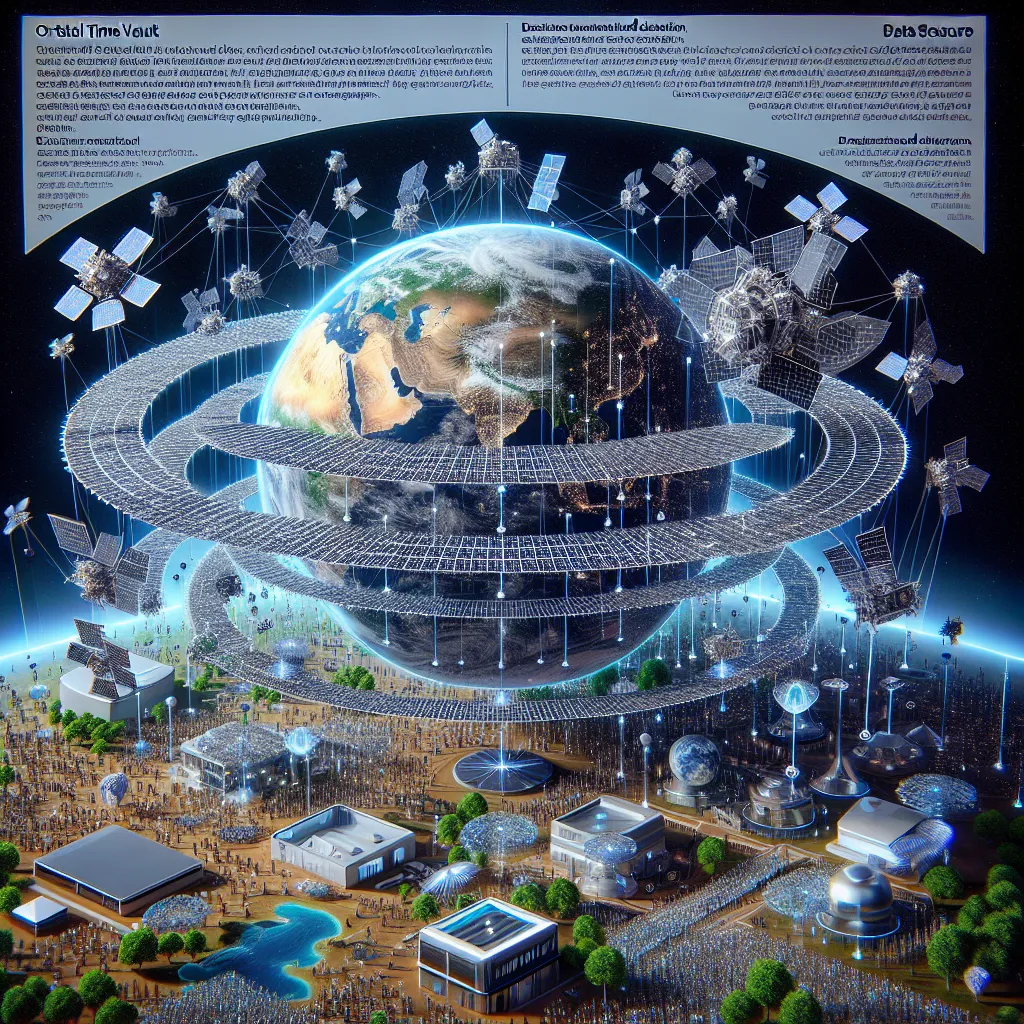
As humanity becomes increasingly dependent on digital infrastructure, we have no truly neutral, resilient way to preserve our most critical data—think scientific breakthroughs, foundational AI models, legal frameworks, decentralized identities, or cultural archives. Earth-bound storage is vulnerable to war, regime collapse, EMPs, and censorship. A technically possible but wildly underexplored idea is to build an Orbital Time Vault: a network of satellites in low and medium Earth orbit that stores immutable, versioned snapshots of humanity’s most important digital assets. Synced via blockchain protocols for integrity and provenance, and protected by quantum-secure encryption, this constellation would serve as a permanent, unowned, tamper-resistant “ledger in the sky.” Updates could be transmitted via decentralized ground stations or embedded in data relays. Over time, the system could preserve open-source AI weights, public health research, climate treaties, or even intergenerational identity records—ensuring continuity across political, social, and technological upheaval. It’s a planetary insurance policy. And no one’s building it yet.
Description
No additional description provided.
The Pitch
Imagine a world where the essence of human civilization—scientific knowledge, cultural archives, and foundational technologies—remains secure and untainted, despite the ebbs and flows of political or social turbulence. As the digital age rapidly evolves, its dependence on data surpasses all expectations. Yet, our reliance comes with a vulnerability: conventional data storage systems are susceptible to a multitude of threats, such as geopolitical conflicts, censorship, natural disasters, and technological obsolescence. The solution could lie within an audacious concept: the Orbital Time Vault.
This endeavor imagines an intricate network of satellites, positioned in low and medium Earth orbit, serving as a safeguard for humanity’s most vital data assets. By leveraging blockchain protocols, these space-borne safekeepers would ensure data integrity and authenticity, fortified further by quantum-secure encryption that defends against unauthorized access. This vision aims to establish a universally accessible, tamper-resistant digital ledger—a true archival buffer against the unpredictable challenges of our times.
The solution to these vulnerabilities is both scalable and resilient. Utilizing satellite technology, the Orbital Time Vault offers an immutable archive in the sky, impervious to terrestrial threats. These satellites would be continually synchronized with decentralized ground stations, ensuring real-time updates and data integrity. This robust system would enable the preservation of open-source AI models, pivotal public health studies, global climate agreements, and cultural heritage records.
Delving into the specifics, the Orbital Time Vault could begin as a minimal viable product (MVP) with a limited constellation of satellites. Initial deployment would prioritize essential data types, facilitated by partnerships with research institutions, open-source communities, and cultural organizations. Blockchain technology would serve as the underlying protocol for ensuring that all interactions with the system are transparent and verifiable.
To bring this vision to realization, several pivotal tools and strategies must be employed:
1. Satellite Technology: Compact and cost-effective miniaturized satellites (CubeSats) could be used, ensuring that the deployment is both economically and technologically feasible.
2. Blockchain and Encryption: Integrate state-of-the-art blockchain platforms and quantum-secure cryptographic protocols to ensure data immutability and protection.
3. Ground Infrastructure: Establish decentralized ground stations capable of secure data transmission and reception, allowing continuous updates and system resilience.
The go-to-market (GTM) strategy would emphasize partnerships with data-sensitive sectors such as academia, government, and non-profits, alongside a broad campaign to highlight the intrinsic value of secure, unassailable data archives. Pioneers in blockchain and aerospace initiatives would act as key collaborators to further enhance credibility and reach.
The business model can leverage a combination of subscription models for premium data storage, partnerships with governmental and non-governmental organizations for strategic reserves, and a tiered access system that allows phased access to global entities. Additionally, grants and sponsorships from organizations invested in digital preservation could sustain initial growth and expansion.
In essence, the Orbital Time Vault serves as a visionary leap—a beacon of continuity and retrospective wisdom that defies temporal and spatial limitations. As a pioneering force yet untapped, this initiative has the potential to fundamentally reshape how humanity safeguards its legacy in the cosmos.