Operational Complexity Cost Analysis Software
Companies add segments, SKUs and verticals because each looks incremental on a roadmap, but the operational burden compounds across sales, implementation, support, product and finance. Scope Load would quantify the real capacity cost of every new line before it gets launched, then show where breadth is already degrading the core business. Why now: companies have more operating data than ever, but planning tools still model revenue upside far better than organizational complexity. Example: a SaaS company wants to open a sixth vertical. Scope Load shows that the first five already require 2.4x the available implementation capacity and that the newest two are depressing margins and slowing delivery in the original market.
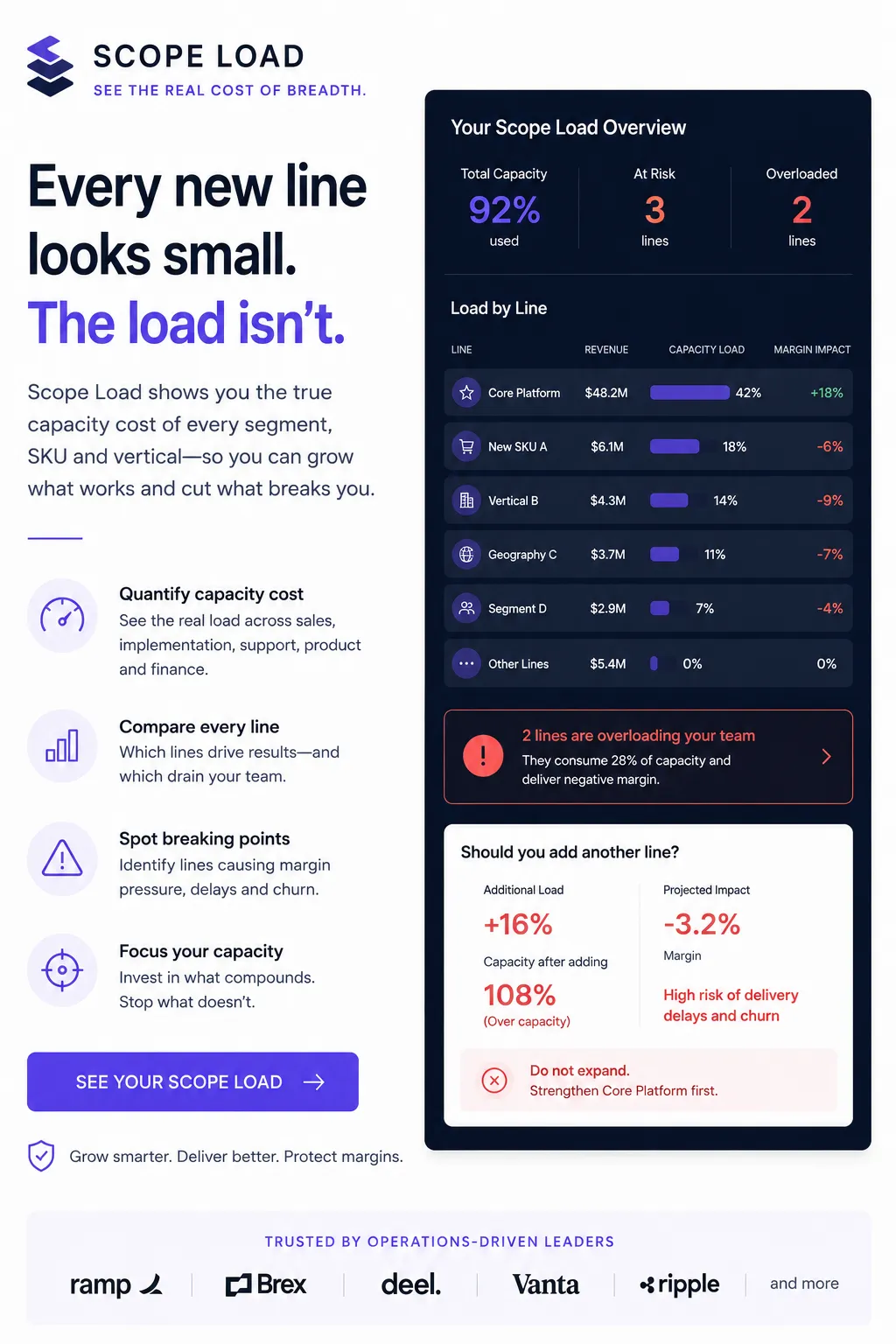
Description
No additional description provided.
The Pitch
A compelling business sits in the gap between how companies approve expansion and how expansion actually gets absorbed. Most organizations treat a new segment or SKU as a revenue question, while the cost is paid in fragmented attention, exception handling, longer queues, bespoke training, messier reporting, and slower decisions. The interesting opportunity is not to say “do less,” but to make the hidden unit economics of variety visible before variety becomes culture.
The strongest truth is that complexity rarely looks expensive at the moment it is created. A new customer type may only need “one small workflow change,” but that change becomes a fork in onboarding, a caveat in sales enablement, a branch in support scripts, a field in finance, and a future edge case in product. Companies are often precise about gross margin and strangely vague about cognitive margin: how much organizational attention remains after all exceptions are handled. A business that can measure that attention drain would give leadership a language for a cost they already feel but cannot currently prove.
This also becomes more valuable as companies mature. Early growth rewards saying yes; later performance often depends on knowing which yeses are now taxing the system. The painful part is that the damaging lines are not always the obviously unprofitable ones. Some categories produce revenue while quietly lowering service quality, slowing the main roadmap, or forcing the best employees into coordination work. The business works if it can reveal that a dollar of revenue from one line may consume three times the operational surface area of a dollar from another.
The buyer is not just purchasing analytics; they are purchasing permission to simplify. In many companies, killing or delaying expansion feels politically harder than launching it, because the upside has owners and the complexity has only sufferers. Turning scope into a measurable load changes the internal debate from taste and turf to capacity and tradeoff. That is powerful because the product would not merely describe the organization; it would alter which decisions are socially defensible.
The durable insight is that growth creates its own form of technical debt, but in the operating model rather than the codebase. Businesses have learned to track customer acquisition cost, churn, and cloud spend with discipline. They have not yet built an equally serious instrument for measuring the drag created by breadth itself. A company that becomes the system of record for that drag would sit near some of the most consequential decisions a management team makes: what to enter, what to stop, and what to keep simple.