On-Demand Human Judgment for AI Agents
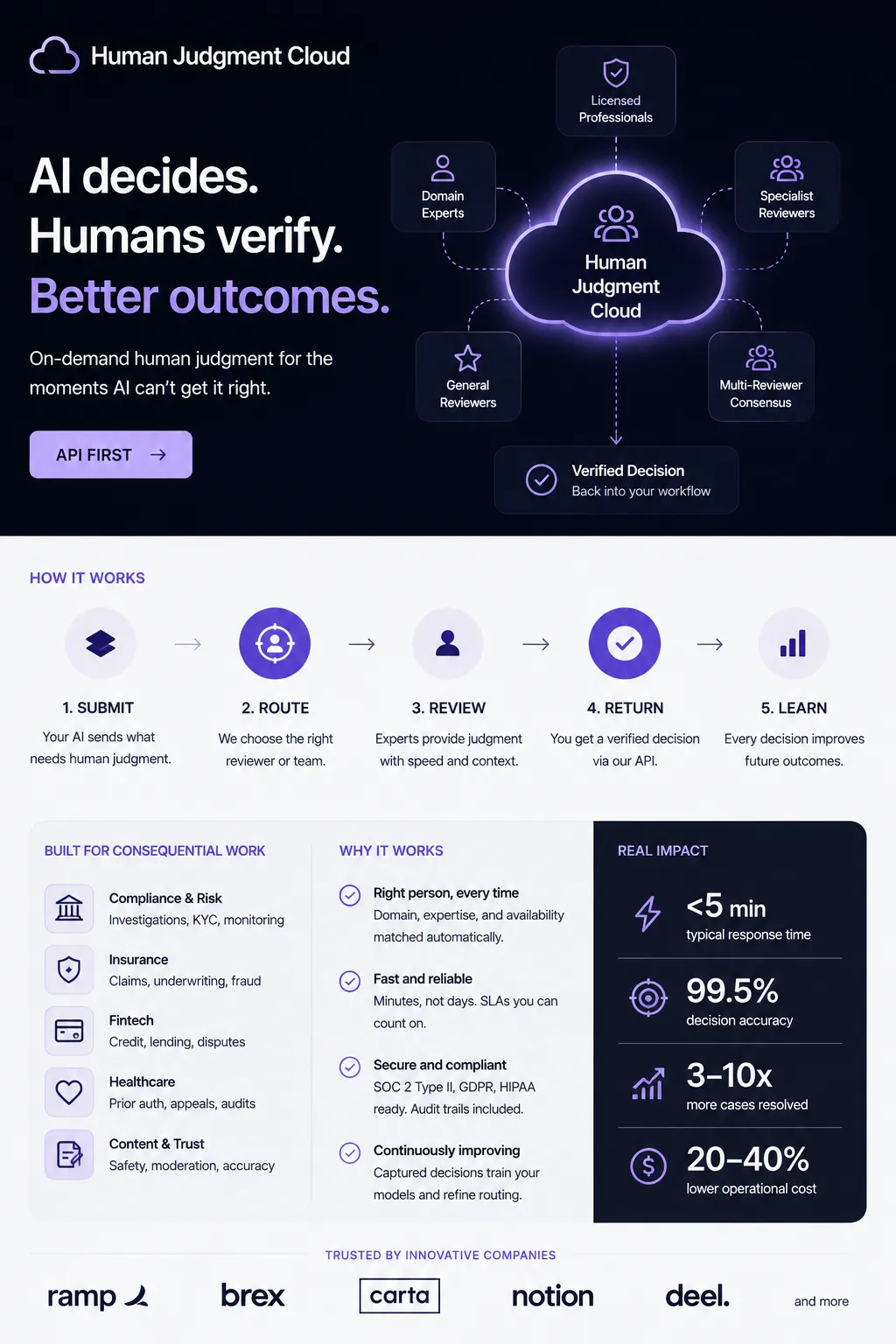
AI systems are getting better at doing work, but many will continue to encounter decisions where confidence is too low, consequences are too high or specialized expertise is required. Human Judgment Cloud is infrastructure that lets software request verified human judgment on demand, automatically choosing between another model, a general reviewer, a domain specialist, a licensed professional or multiple reviewers for consensus. Why now: AI agents are moving from generating content to taking consequential actions, creating a need for scalable verification outside the company’s own workforce. Example: an AI compliance agent reaches an ambiguous case, sends it to the cloud, receives a verified decision in minutes and uses that resolution to improve how similar cases are handled next time.
Description
No additional description provided.
The Pitch
As software begins to make decisions rather than merely prepare drafts, the valuable question is no longer “Can a model answer this?” but “Who is allowed to stand behind this answer?” Many industries already run on review, approval, escalation and sign-off; AI does not eliminate those rituals so much as make them occur at machine speed. A network that can supply trusted judgment at the moment of uncertainty becomes a missing layer in the operating system of automated work.
The deepest advantage is that human judgment is not a single commodity. There is an enormous difference between a quick sanity check, a consensus vote, an expert interpretation and a licensed decision. Today companies often handle these distinctions with static workflows, overqualified employees or brittle outsourcing processes. A judgment cloud could make expertise dynamically match the shape of the risk. Most decisions do not need the most expensive human available; the business works if it routes edge cases with enough precision that expertise is neither wasted nor absent.
This also creates a valuable record that ordinary labor marketplaces do not produce. Each judgment is not just a completed task; it is a labeled exception tied to context, confidence, reviewer identity, disagreement and outcome. Over time, the system would learn which kinds of ambiguity deserve human escalation, which reviewers are reliable in which domains, and which decisions can safely return to automation. The feedback loop is unusually strong because the product improves not by replacing humans wholesale, but by learning exactly when humans are still needed.
The trust component may matter more than the labor component. Companies adopting AI will need to show customers, regulators and internal leaders that consequential actions were not simply left to an opaque model. A verifiable chain of judgment turns “the AI decided” into “the system escalated appropriately, the right standard was applied and the decision can be audited.” That is a subtle but powerful shift: the product is selling not just answers, but defensible process.
If it existed, the company could become increasingly hard to displace because its value would compound around hard-to-recreate reviewer histories and decision precedents. The most useful asset would not be a pool of humans in the abstract, but a map of which humans, credentials and consensus patterns produce dependable outcomes for specific forms of uncertainty. In a world filled with capable AI, knowing when not to trust AI may become one of the most important businesses.